
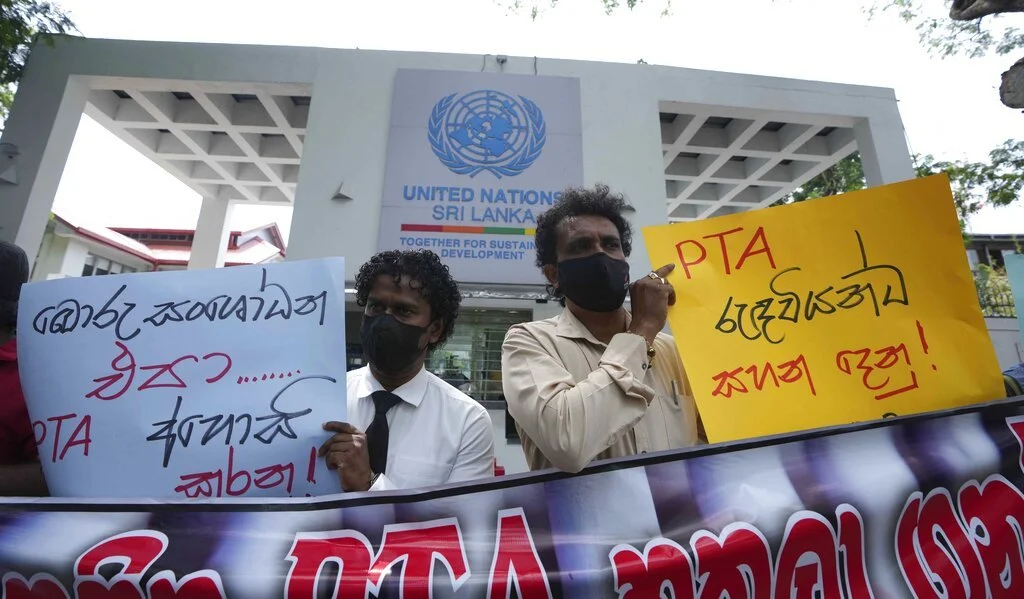
Sri Lankan civil rights activists protest against the controversial Prevent Terrorism Act outside the UN office in Colombo, Sri Lanka, Thursday, March 3, 2022. Placards in Sinhalese read " stop bogus amendments", left, and "Grant relief to PTA detainees".(AP Photo/Eranga Jayawardena)
Sri Lanka’s proposed counterterrorism legislation has drawn criticism from human rights organizations over provisions that would preserve broad detention powers under a law intended to replace the country’s controversial Prevention of Terrorism Act (PTA). While the proposed Protection of the State from Terrorism Bill (PSTB) introduces new safeguards for detainees, critics argue that it retains executive authority to order prolonged detention with limited judicial oversight.
The controversy comes amid President Anura Kumara Dissanayake’s efforts to fulfill his earlier pledge to repeal the PTA, which has historically been associated with arbitrary detention and the suppression of political dissent. The PTA has been a central component of Sri Lanka’s security framework since it was first enacted in 1979 as a temporary measure to combat separatist militancy during its 26-year civil war against the Liberation Tigers of Tamil Eelam.
After being made permanent in 1982, the law has since granted authorities sweeping powers to arrest suspects without warrants and detain them for extended periods without charge or trial. Sri Lanka has a documented history of the PTA’s disproportionate use against the country’s Tamil and Muslim minority populations, as well as allegations of torture, coerced confessions, and arbitrary detention.
The proffered PSTB does introduce appreciable protections absent from the PTA, including mandatory access to legal counsel and judicial inspections of detention facilities. However, under the bill, the defense secretary still has the power to authorize detention for an initial period of two months, which can be further extended from two month periods up to an aggregate of one year. Additionally, magistrates would lack the authority to overturn these orders, leaving significant detention powers with the executive branch. The bill would also establish an Independent Review Committee to examine detention orders, although its members would be appointed by the defense minister and its recommendations would not be binding.
These provisions have prompted calls for further revisions from Sri Lanka’s Human Rights Commission, which has advocated for giving courts meaningful authority to grant bail and ensuring detainees have prompt access to legal counsel. In an October 1 letter to the Justice Minister, the Commission warned that “the bill’s denial of meaningful judicial oversight” over detention orders was inconsistent with Sri Lanka’s constitution and urged greater independence in the detention review process.
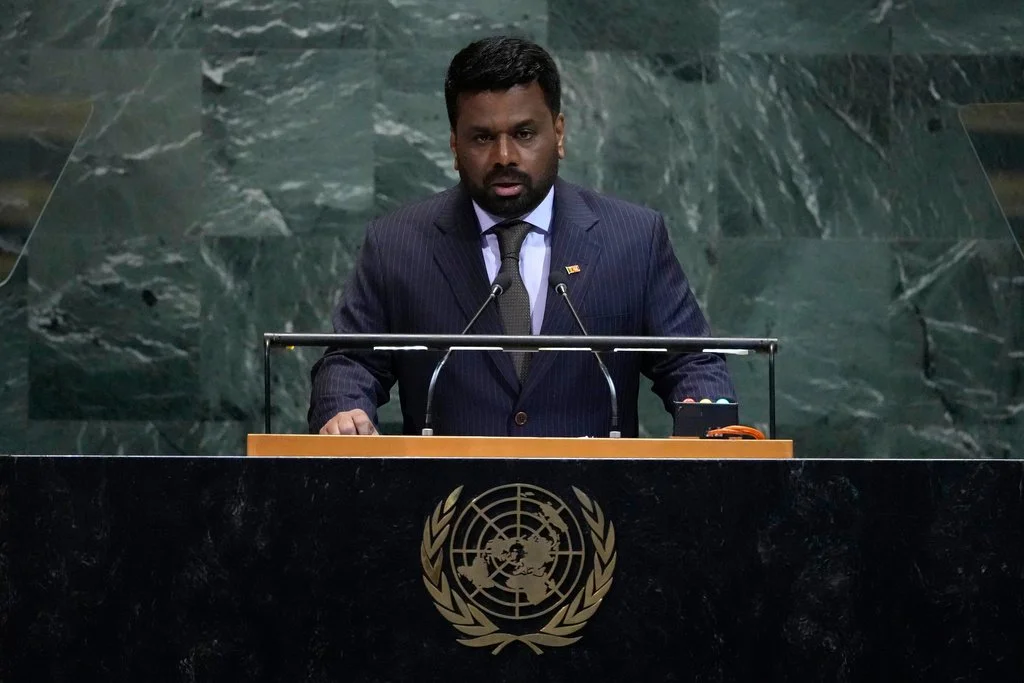
President of Sri Lanka Anura Kumara Dissanayake addresses the 80th session of the United Nations General Assembly, Wednesday, Sept. 24, 2025, at U.N. headquarters. (AP Photo/Pamela Smith)
Human Rights Watch has similarly questioned whether the proposed safeguards would adequately protect detainees, warning that other provisions, like ones that exempt terrorism suspects from bail protections and grant authorities the power to withhold reports from detainees and their lawyers, could allow suspects to remain in custody without charge for up to two years. The criticism reflects broader concerns that replacing the PTA may not sufficiently address the legal shortcomings that have drawn scrutiny for decades, despite the government's stated commitment to counterterrorism reform.
The government maintains that the proposed legislation addresses longstanding deficiencies in the PTA while preserving the country's ability to respond to security threats. At a Cabinet briefing in August,, government spokesperson Nalinda Jayatissa said the bill was designed to protect fundamental rights while combating terrorism and organized crime. Justice Minister Harshana Nanayakkara has similarly argued that the replacement would better protect citizens without targeting particular ethnic or religious groups.
The government’s efforts to replace the PTA advanced in August, when the Cabinet approved the bill's publication and submission to Parliament following a review by a technical expert committee. Although its eventual passage would technically fulfill the government's pledge to repeal the PTA, the extent of the resulting changes to detention practices remains contested.