
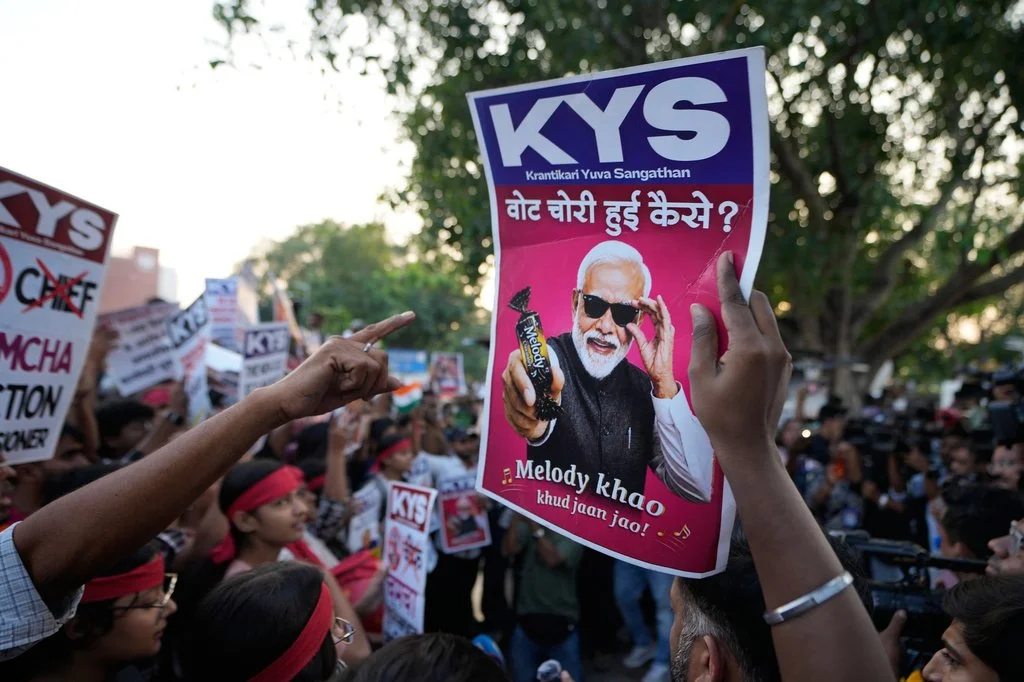
Activists hold placards during a "Tiranga March" organized by the youth "Cockroach" movement, demanding the resignation of India's chief election commissioner, in central New Delhi, India, Friday, Oct. 16, 2026.(AP Photo/Channi Anand)
October 12, New Delhi — Thousands of protesters marched to India’s Supreme Court demanding Chief Election Commissioner Gyanesh Kumar‘s resignation following alleged electoral roll fraud.
Monday’s “March for Democracy” preceded a series of demonstrations led by opposition parties and India’s Cockroach Janata Party, a youth-led movement that sparked protests over India’s education system this summer and led to the resignation of the education minister. Alleged fraud claims came after the Election Commission carried out a “Special Intensive Revision” (SIR) to remove 130 million people from the electoral roll over the past year,an unprecedented number of deletions since India gained independence in 1947.
Modi appointed Gyanesh Kumar amid opposition objections a year after changing the process for appointing the three-member Election Commission in 2023. As chief commissioner, Kumar faced intense scrutiny, especially after reports showing Election Commissioners Sukhbir Singh Sandhu and Vivek Joshi raising 14 objections over 10 months regarding voter revision decisions.
According to the Election Commission, the SIR exclusively removes dead, relocated, and untraceable people. Yet critics allege that removal of this magnitude benefits the ruling Bharatiya Janata Party (BJP), led by Prime Minister Narendra Modi, and disenfranchises Muslims and other minorities. The BJP denied these claims and accused the opposition of undermining democracy by calling into question the electoral process. The Election Commission conceded that wrongly deleted voters can re-enroll but similarly denied fraud allegations.
Meanwhile, the New York Times reported tens of millions of voters flagged by algorithms for deletion over anomalies in their information and millions who appealed their removal decisions stuck in adjudication. Others struggle to prove their existence after being removed for being dead. “I am standing in front of them. I will bring my entire family to stand in front of them. They can see for themselves that we exist,” said Nanhe Lal, 43, a toy store worker in Delhi who was on his third visit to a voter center with documents to prevent the deletion of his name.
Electoral revision processes have shifted considerably from the past. In contrast to the system in which voters would make voluntary updates to the rolls, the SIR uses centralized software with limited power for local elected officials to check the accuracy of revisions.
Additionally, the Office of the UN High Commissioner for Human Rights (OHCHR) expressed concerns over the alleged use of AI in flagging irregularities for voter information, thereby risking “disenfranchised legitimate voters, undermining democratic fairness, and raising concerns about the reliability of automated decision-making in such a high-stakes context.” Former election commissioner Ashok Lavasa criticized the process further, claiming it differs from the “physical verification, door to door” that ensures inclusion, and places the burden of proof entirely on citizens instead.
These outcomes induced skeptics to accuse the Commission of favouring the ruling party. Prior to the nationwide revisions, Modi won three times in office and BJP popularity persisted. Despite a lower national turnout in 2024, the BJP secured multiple state-level victories, including historically flipping West Bengal. The victory came after a voter roll revision removed 9 million names. Among these names, about 100,000 appeals have been adjudicated, a majority of which were legitimately restored to the voter roll. By that time, the BJP had secured the state.
Political analyst Neelanjan Sircar predicted an approximately 4-percentage-point swing from the Trinamool Congress (TMC), a regional opposition party, to the BJP in that election, suggesting that the SIR may have helped the BJP at the TMC’s expense. A government official who, out of fear of retribution, reported to the New York Times anonymously, said the SIR was implemented for political reasons, “to use the party’s vast local machinery to flag people to local authorities for deletion.”
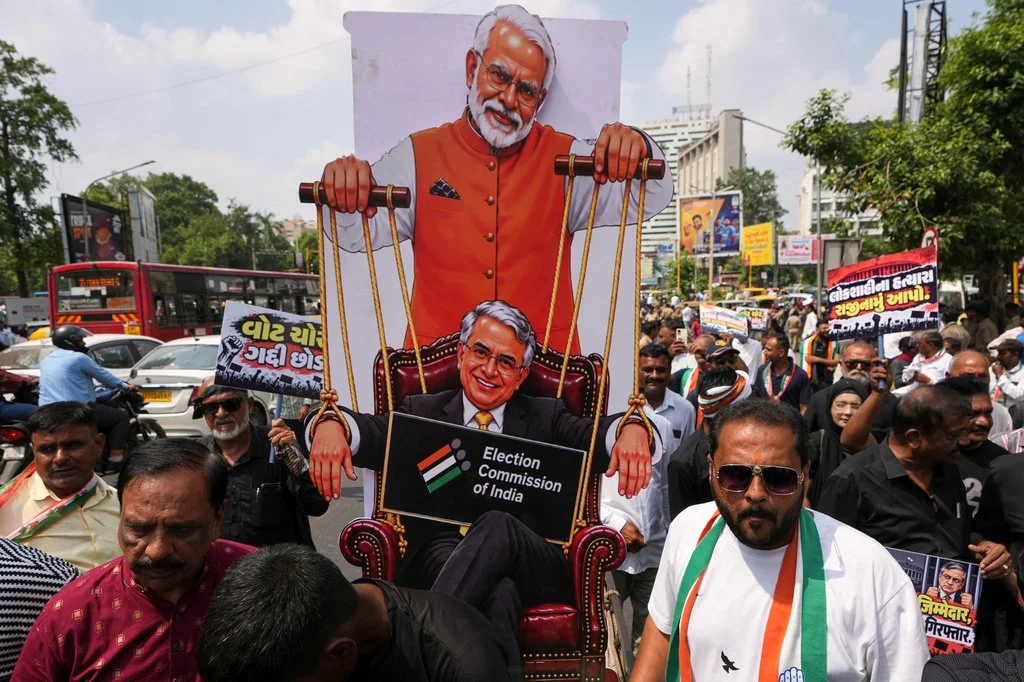
Supporters of India's opposition Congress party hold a poster featuring Indian Prime Minister Narendra Modi, top and Chief Election Commissioner Gyanesh Kumar, bottom, during a protest against Kumar, the Special Intensive Revision (SIR) of electoral rolls, and the alleged the exclusion of millions of voters from draft electoral rolls, in Ahmedabad, India, Tuesday, Sept. 29, 2026. (AP Photo/Ajit Solanki)
Another anonymous official claimed political advantage was secondary to the primary objective of purging Muslim illegal immigrants. While critics allege a similar objective, they instead claim the process discriminated against Muslim Indian citizens who were accused of illegal immigration. OHCHR findings do show the SIR process disproportionately affected Muslims, whether deliberately or not. In Nandigram for instance, Muslims accounted for 95 percent of the deleted voters while forming 25 percent of the constituency’s electorate.
Others, including Praveen Rai, a political analyst at the Centre for the Study of Developing Societies in Delhi, argued that there was no credible evidence that voters from any religious or caste group had been deliberately removed from electoral rolls to benefit the BJP. While intentional attempts at electoral manipulation remain unresolved, analysts continue to evaluate the SIR’s potentially disenfranchising effects across other minorities.
Jain, an assistant professor of law at the National Law School of India University, highlighted the SIR’s disproportionate impact on people without stable housing, including migrant workers who return to their villages for seasonal work or who find it difficult to access older family documents or establish their residency. Other analysts and former election officials say authorities are demanding that people verify voting rights with relevant documents. Because of weak recordkeeping, many people in India struggle to produce such documents, thereby relinquishing their voting rights. Additionally, differences in caste, class, and gender may determine whether people have access to government documents.
The widespread accusations sparked broader questions about democracy and the rule of law under Modi’s government. In May, the Supreme Court upheld the Election Commission’s SIR exercise but ruled that the poll panel could not determine citizenship disputes. Critics say the Election Commission overstepped its power under Kumar and became the arbiter of Indian citizenship. These claims dissuade the legitimacy and integrity of India’s institutions. Rohinton Nariman, a former solicitor general of India and Supreme Court judge, said, “The heart of our democracy, which is the right to vote, is at great peril.” Whether current skepticism about India’s broader electoral legitimacy may affect the credibility of election outcomes to oppositions and critics remains undetermined.