
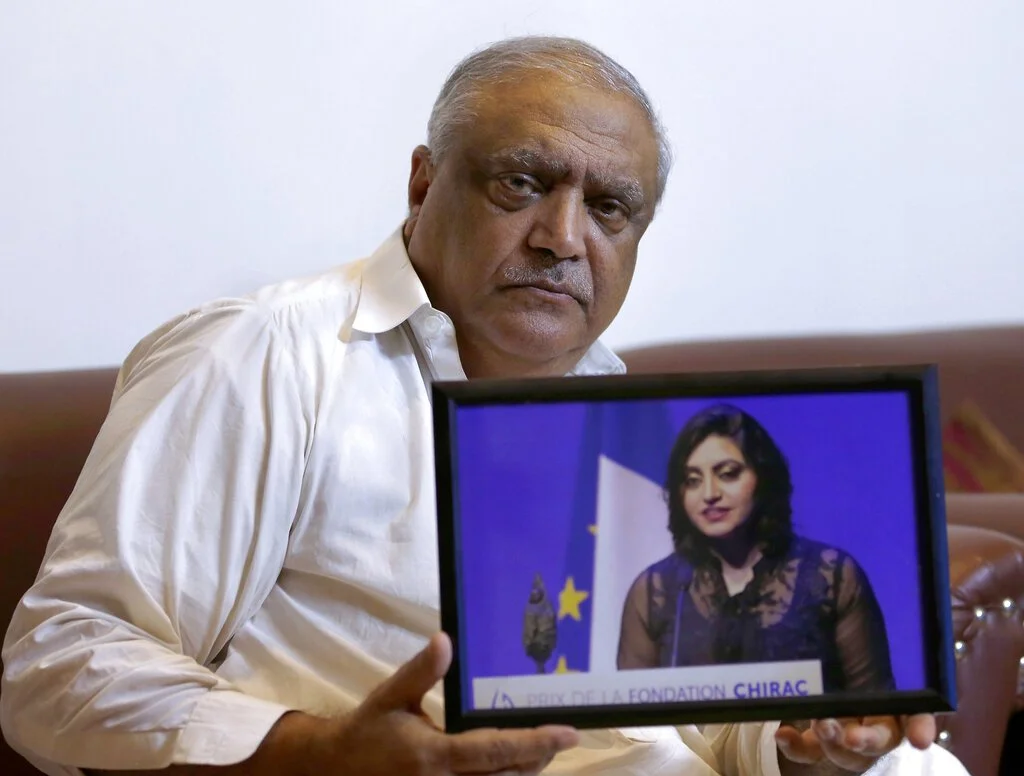
In this Oct. 17, 2019, file photo, Professor Mohammad Ismail, father of Pakistani human rights activist Gulalai Ismail, holds a photo of his daughter in Islamabad, Pakistan. Gulalai Ismail was charged under the anti-terrorism act after she criticized army actions in the border regions. In Pakistan, being a dissident or even raising a critical voice is dangerous business. Rights groups say that despite the election in 2018 of a civilian government, the army still rules from behind with an iron fist. (AP Photo/Anjum Naveed, File)
Pakistan’s Anti-Terrorism Act (ATA) was enacted by the parliament in 1997 with the intent to prevent terrorism and sectarian violence, and to ensure speedy trial of heinous offenses. Since then, the Act has been amended on several occasions, including the most recent 2025 amendment to expand detention powers. Despite the fact that governments over the years enforced the Act in response to terrorist concerns, the ATA has also been known for its use to consolidate broader state police powers and suppress opposition.
There is no denying that the state requires protection against extreme terrorist threats. According to a Dawn report, Pakistan ranked No. 1 on the Global Terrorism Index for the first time, recording a 6 percent increase in terrorism-related deaths in 2025, with 1,139 victims/lives claimed. Most recently, in September 2026, militant violence increased substantially with 225 attacks recorded nationwide, as compared to 199 in August. In response, security forces conducted 74 counterterrorism operations resulting in 280 militant fatalities. A key organization in Pakistan’s current terrorism landscape includes Tehrik-e-Taliban Pakistan (TTP). Resurgent since 2021 and with ties to Al Qaeda, the group seeks to defeat Pakistan’s government and establish Sharia law in Khyber Pakhtunkhwa. TTP carried out 595 attacks in 2025. Other such organisations include the Balochistan Liberation Army (BLA),an ethnic separatist group founded in 2000 that was designated as a Foreign Terrorist Organization by the U.S State Department in 2025, and the Al Qaeda-aligned Ittehad-ul-Mujahideen Pakistan (IMP), which has been increasing the frequency and scale of its attacks.
Despite the dire need to deploy anti-terror measures, it is worth analyzing whether the ATA has been narrowly deployed to deter terrorism. In early October, the government declared a state of emergency in the northwestern Khyber Pakhtunkhwa province, suspending the provincial government of Pakistan Tehreek-e-Insaf (PTI), the party of the imprisoned former Prime Minister Imran Khan. A statement issued by Prime Minister Shehbaz Sharif said the suspension came in response to PTI’s “deliberate disengagement from the fight against terrorism.” Suspiciously, the move came after protesters planned to march to the capital demanding Imran Khan’s release. The police cracked down on protesters that day, charging dozens of PTI supporters with terrorism offenses. Previously, an anti-terrorism court accused four journalists of “inciting violence” during the riots following Khan’s arrest in May 2023, raising questions about whether such suppression is necessarily tailored toward real terrorist threats.
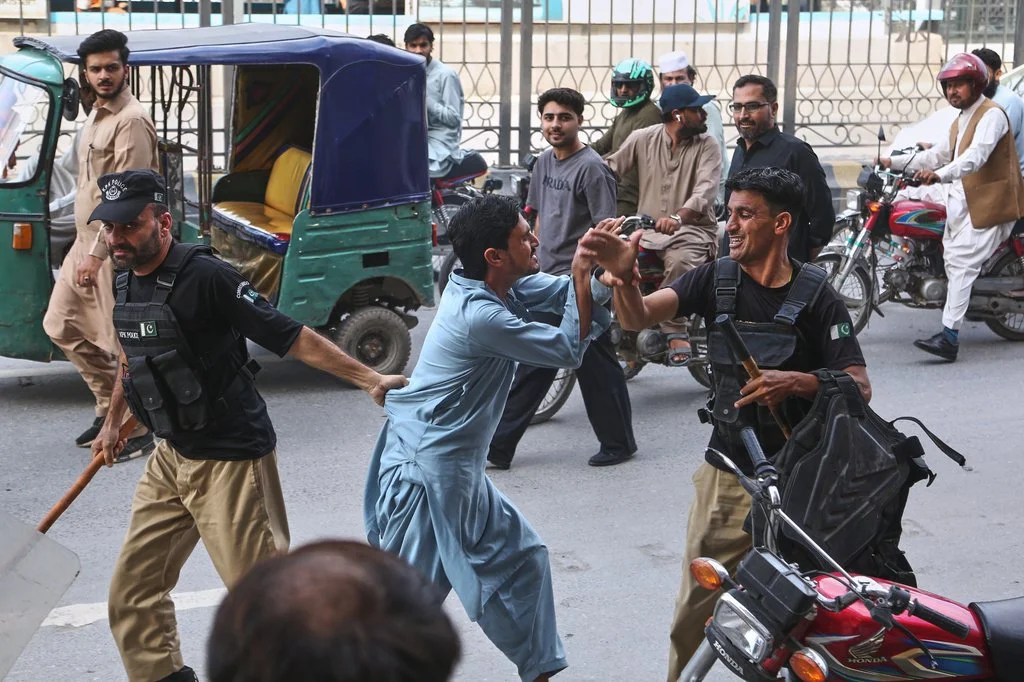
Police officers detain a supporter of imprisoned former Prime Minister Imran Khan’s party during a protest against the Pakistani president’s decision to declare a state of emergency in northwestern Khyber Pakhtunkhwa province and suspend its government, in Peshawar, Pakistan, Monday, Oct. 12, 2026. (AP Photo/Muhammad Zubair)
Police officers detain a supporter of imprisoned former Prime Minister Imran Khan’s party during a protest against the Pakistani president’s decision to declare a state of emergency in northwestern Khyber Pakhtunkhwa province and suspend its government, in Peshawar, Pakistan, Monday, Oct. 12, 2026. (AP Photo/Muhammad Zubair)
In September 2026, lawyers Mazari-Hazir and Chattha were arrested on terrorism-related charges hours after the Supreme Court released them on bail because they participated in a protest that authorities allege was illegal. Authorities further expressed concern about the couple’s social media posts supporting local activists and criticizing the military. Later, the court sentenced both lawyers to three years in prison for “obstructing and assaulting public servants.” According to family members, Mazari-Hazir and Chattha were denied legal representation of their choice and access to key legal documents.
In addition to protesters, the state has a well-documented history of enforcing anti-terror charges against minorities. While the BLA remains a key perpetrator of violence, authorities’ actions often extend to Baloch civilians and activists. Around September 2025, Sammi Deen, an award-winning human rights defender, Shalee Baloch, and a dozen others across Balochistan were added to the Fourth Schedule, Pakistan’s anti-terrorism watch list. In June, a Quetta Anti-Terrorism Court charged human rights leader Mahrang Baloch with terrorism and murder. The court found Baloch and other leaders of the Baloch Yakjehti Committee guilty of murder of security personnel during the July 2024 protests. However, the court lacked direct evidence implicating Baloch in the killings.
Broad use of anti-terror laws extend to Kashmiris. Amnesty International expressed concern after the government designated the Jammu and Kashmir Joint Awami Action Committee (JKJAAC) as a terrorist group. This classification allowed authorities to carry out brutal crackdowns, including arbitrary arrests and deadly use of force, on protesters across Pakistan-administered Jammu and Kashmir. “The proscription of JKJAAC under anti-terror laws is disproportionate, unlawful and a violation of the right to freedom of association,” said Isabelle Lassee, Amnesty International’s deputy regional director for South Asia. These anti-terror charges are often so misguided that the court is compelled to revoke them. Lal Masjid caretaker Hussain was placed on the Fourth Schedule list without relevant evidence. When the Islamabad High Court called on officials to produce such evidence, the respondents failed to do so. As a result, the court ordered authorities to remove his name from the Fourth Schedule and to unfreeze his CNIC and bank accounts, which happened to be a consequence of his placement on the Fourth Schedule.
These instances demonstrate the lack of due diligence, sufficient evidence, and fair trials that accompany anti-terror charges. It is unclear how targeting nonviolent activists, lawyers, and journalists is necessary to ensure security. On the contrary, especially when it comes to minorities, the effect may be the opposite. In Balochistan, for example, the expansion of militancy comes from the lack of political representation, the collapse of reconciliation efforts with Baloch nationalists, a growing use of anti-terror laws to target peaceful rights activists and several other factors. These militarized approaches to countering protesters and activists often increase the risk of violence overall. On the other hand, broader application of anti-terror laws does suppress dissent. The government’s crackdowns on protesters generally across minorities and other parties, especially those in support of alternative party PTI, imply the government’s broader intention to subdue criticism rather than to deter terrorism. “The weaponization of anti-terror laws to target dissent has become a norm in Pakistan,” cautioned Yasmine Ahmed, senior director for Regional Human Rights Impact.
Notably, officials previously charged Imran Khan with breaching the ATA. Khan was elected prime minister in 2018. Following conflicts with Pakistan’s army, the former prime minister lost parliament support and was ousted from power in a no-confidence vote in April of 2022. Since then, Khan heavily criticised the government and the state’s army, calling for fresh elections. He accused authorities of torturing his aide, who was being detained under sedition charges. In August 2022, state authorities charged him under the ATA for allegedly making threats against the state officials. Islamabad High Court granted Khan protective bail on this case. He was arrested later in 2023 on corruption charges, which he and his party maintained was politically motivated.
ATA expansion and misuse is not limited to the current government. Under Pervez Musharraf, the 2001 ordinance let the state ban organizations accused of being involved in terrorism. HRW’s 2007 report says the ATA was used to detain thousands of opposition members. Under the PPP regime, the Actions (in Aid of Civil Power) Regulation of 2011 gave the army broad detention powers. Many aggravated responses sprang from terrorist attacks, including the 2014 Army Public School attack resulting in the National Action Plan to combat terrorism more comprehensively. Yet, the Act’s continued expansion and misuse is a cause for concern for political opponents and civilians alike.
Experts have commented on the broader scope of the ATA, which may aid in the government’s weaponization beyond its intended purposes. Section 6(1) of the ATA defines terrorism as the use or threat of action where certain predicate offences are “designed to coerce and intimidate or overawe the Government or the public or a section of the public or community or section or a foreign government or population or an international organization or create a sense of fear or insecurity in society, or; the use or threat is made for the purpose of advancing a religious, sectarian or ethnic cause or intimidating and terrorizing the public, social sectors, media persons, business community or attacking the civilians, including damaging property by ransacking, looting, arson or by any other means, government officials, installations, security forces or law enforcement agencies; Provided that nothing herein contained shall apply to a democratic and religious rally or a peaceful demonstration in accordance with law.”
Chief Justice of Pakistan Asif Saeed Khosa referred to this definition as “too wide,” including “so many actions, designs and purposes which have no nexus with the generally recognised concept of what terrorism is.” According to the justice, the term “terrorism” can be applied to the use of force, under an organized plan, for the realization of religious, ideological or political goals. Barrister Ali Zafar highlighted that the Supreme Court had examined the provisions of the existing Anti-Terrorism Act and determined many of its provisions to be unconstitutional. He further pointed out how the Act was originally meant to be enforced in times of extraordinary circumstances to protect against extraordinary threats. “But as lawmakers, we must always remember: every extraordinary power given to the state can both be used and misused,” he cautioned.
To that end, many say the Act overall provides “legal cover” for state discretion, including arbitrary detention and secret imprisonment. In 2025, the Act was amended to include the authorized use of armed forces or civil armed forces acting under government orders, to issue preventive detention orders for up to three months, provided reasons are recorded. Often, such reasons are left to state discretion. Considering the government’s latest actions, they also tend to lack due diligence and sufficient evidence. As a result, the state is able to arbitrarily detain people and simultaneously legitimise it through the law.
By applying the Act broadly, issuing “emergency states” and legalizing preventive detention, the state may reason that the dire need to combat terrorism necessarily means people have to give up their rights to due process, free speech, association, etc. Putting aside the argument that the government specifically targets dissent, it may be true that generally, extraordinary circumstances such as terrorist threats may necessitate the loss of some rights to establish security — as intended by the Anti-Terrorism Act. However, the debate between security and rights in Pakistan may not be as relevant as many would claim. Often, striking a balance between security and rights would require a reasonable assumption of proportionality and necessity. The state’s use of terror laws to charge nonviolent civilians, including lawyers and journalists, is a false presumption of threat that cannot reasonably necessitate state action or deter real terrorism. On the other hand, the state targets minorities such as Baloch and Kashmiri activists. This assumes that such minorities inherently pose threats and therefore justifies discrimination, undermining the goal of collective security.
More importantly, the ATA is broad and vague enough to allow for greater state discretion and power. This may mean that extraordinary actions can be taken in the case of extraordinary and unpredictable circumstances. As Zafar noted, however, extraordinary power can be “used and misused” by the state. Over the years, different governments have expanded their power through the Act and leveraged its broader scope to legalize their actions. This allowed for its misuse beyond situations that require anti-terrorist efforts. Without further limits, the state has sought to weaponize the Act to instead suppress dissent and opposition.