
Trump’s Changes to the Endangered Species Act Highlight Environmental Partisanship

A California condor named Hope takes to flight at the Condor habitat at the Los Angeles Zoo, Tuesday, May 2, 2023. On Dec. 28, 1973, President Richard Nixon signed the Endangered Species Act. The powerful law charged the federal government with saving every endangered plant and animal in America. (AP Photo/Richard Vogel)
The Trump administration’s latest change in existing environmental policy is the weakening of the 1973 Endangered Species Act (ESA). The Act had been a fundamental piece of conservation legislation in the US, saving about 99% of listed species, including the bald eagle.
The New York Times obtained a leaked internal memo signed by Brian Nesvik, Trump’s appointed head of the U.S. Fish and Wildlife Service, that reinterprets the ESA to legalize accidental harm to animals. By narrowing the Act’s definition of “take,” which is to cause harm to an endangered animal, the Act becomes infrequently used because the majority of “take” cases occur incidentally in business activities. This comes after Trump’s removal of the term “harm” in the ESA in July, altering the legislation to legalize actions indirectly hurting endangered species.
These changes to the ESA are among hundreds of actions the Trump administration has invoked to dismantle environmental protections in the US since the start of his second term in January 2025. Such measures solidifies the partisanship of an environmental agenda.
However, partisanship over environmental issues is relatively recent. The ESA was passed in 1973 with bipartisan support in Congress. The Act passed the Senate 92-0 and the House 355-4, leading to President Nixon signing it into law.
Besides passing the ESA, Nixon’s Republican administration included the creation of the EPA and NOAA, the 1970 Clean Air Act, and the 1970 National Environmental Policy Act. During his presidency, the modern environmental movement took shape, with the first-ever Earth Day in 1970. Polls found that in 1965, about 33.33% of Americans were concerned about air and water pollution in their environment, while in 1970, this rose to about 70% amid numerous environmental disasters, such as the Santa Barbara oil spill, and the discourse in Rachel Carson’s “Silent Spring,” thus Nixon faced pressure to act from both sides of the aisle as Americans demanded political measures.
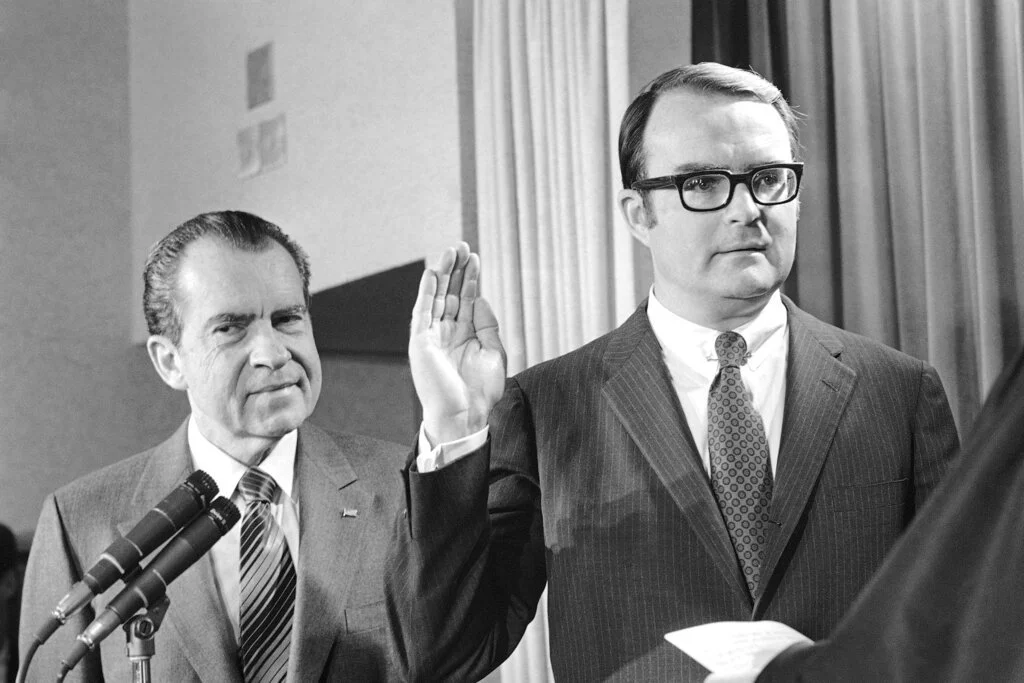
In this Dec. 4, 1970, file photo William D. Ruckelshaus is sworn in as administrator of the new Environmental Protection Agency with President Richard Nixon, left, at the White House ceremony in Washington. (AP Photo/Charles Tasnadi)
In the 1970s, the League of Conservation Voters evaluated environmental voting by party on a 1-100 scale. Republicans scored 20-30 and Democrats 50-60. However, in 2012 Republicans scored 0-20 and Democrats 85-95, reflecting extreme polarization. A study published in npj Climate Action found that in the early 1990s, Republicans first shifted towards an anti-environmental-protection stance. In comparison, in the 2010s, Democrats shifted further towards pro-environmental action. Scholars believe that the shift in environmental politics in the 1990s was driven by several events, including the end of the Soviet Union in 1991, during which conservatives shifted their focus from the “Red Scare” to the “Green Scare.” In addition, the 1992 Rio Earth Summit, a major international environmental conference, led conservatives to become concerned about government regulations. Polarization continued to intensify among politicians and spread to the American people as party sorting intensified.
Based on this historical shift, it’s unsurprising that former President Biden favored renewables and clean energy projects, while Trump has a fossil-fuel-driven agenda, including his recent changes to the ESA. However, partisanship hasn’t completely aligned with Trump’s alterations to the ESA. Since the removal of “harm” in July, the Administration has faced numerous lawsuits. In August, a bipartisan letter from former officials in previous administrations who implemented the ESA urged Trump to reinstate “harm” in the Act. In addition, a bipartisan bill was proposed in the Senate by Senators Adam Schiff (D-CA) and Pete Ricketts (R-NE) to improve the implementation of the ESA. While this bill has been discussed before the alterations to the ESA, the bipartisan support for environmental issues is surprising given the political climate.
While the past few decades have seen increasing polarization in the US over the environment, recent bipartisan discourse on the ESA shows that some environmental measures can continue to receive support across party lines. Support from both Democrats and Republicans in response to Trump’s changes to the ESA, indicates environmental action is still possible across the aisle.