
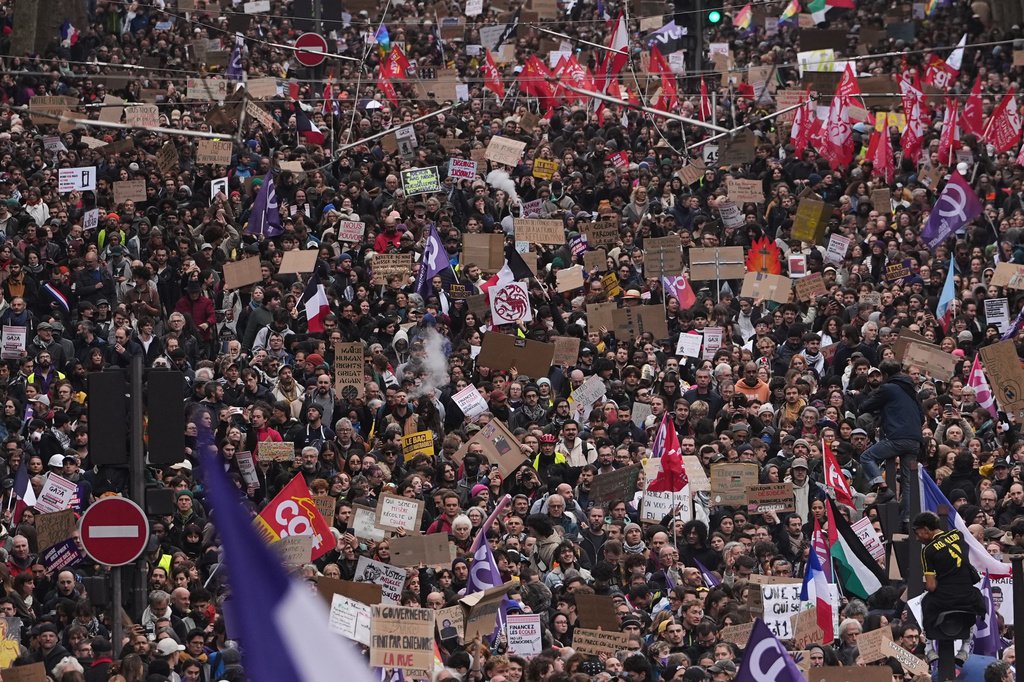
Protesters march during a demonstration against rising living costs in Paris, Saturday, Oct. 24, 2026. (AP Photo/Thibault Camus)
The European people are once again demanding change.
Over the past two years, the world has seen a wave of Gen Z protests sweep every continent. Paving the way, young people are frustrated at the economic state of the world, and intertwine these grievances with anger at often corrupt governments. And now, the youth of Europe are having their turn. While the messages and domestic contexts vary, protests have spread across the continent, echoing similar demands to their counterparts in places like Nepal and India.
But will their demands be met? The Middle East and North Africa (MENA) went through similarly dramatic protests in the early 2010s, the Arab Uprisings, that started out as economic anger but quickly reoriented to simultaneously demanding the toppling of certain authoritarian regimes. More than a decade later, the economic state of the region has not improved and authoritarianism still runs deep in many of the region’s countries, with the protests unsuccessful in taking the change for a democratic transition.
Looking into the similarities between the Arab Uprisings and the current protests from Spain to Serbia, Europe might also miss the boat on widespread change. While protesters are not dealing with the same authoritarian regimes – although Serbia and Albania might be witnessing democratic backsliding – the changes that the youth are demanding are systemic ones similar to MENA, which governments might not be able to deliver on. Simply put, protests will not be enough to spur on the political action needed to solve the current cost of living crisis in Europe.
In Western Europe this September, particularly violent protests began in France, demanding better funding for schools and action on the cost of living crisis, movements that have spread to places like Belgium and Italy. In Spain and Portugal, the messages hone in on housing, and the difficulty that the country’s youth are facing with being able to live in the cities they call home.
Over the summer, protests began in Albania in response to plans for the construction of a luxury resort along the country’s coast, backed by Jared Kushner. Now dubbed the Flamingo Revolution, in reference to the native species that live in the wetlands adjacent to the where the resort will be, demands have blown up to include a wider anti-government message, after Prime Minister Edi Rama backed the plans.
Nearby, Serbia has seen their own anti-government protests for the past two years, initially instigated by the collapse of a train station that killed 16 people, which, in turn, came to symbolize the government's corruption in the eyes of the protesters. The movement saw victory last month after it was able to end the 14-year-long rule of Aleksandar Vucic, after his party lost its parliamentary majority to the Student List-Student Win group.
But something this new Serbian movement lacks is any clear leader and effective organization. While decentralized movements can often lead to them spreading quicker and reaching a wider audience, it also led to their failures in MENA. The youth movements of the 2010s often quickly lost to decades older Islamic movements, because they lacked strong institutional organizations to represent their demands within politics. The movements faced deeply embedded corruption, with no government tools to root them out.
Now, while Serbia does have a brand new opposition movement representing the protesters in the Student List-Student Win group, it remains a very new party that will have to face corruption with decades of experience running rampant in Serbian bureaucracy and administration.
Ultimately, it was this deep rooted corruption that brought down the Arab Uprisings. It often manifested itself politically, but also went as far as appearing in people’s personal lives with concepts like “wasta,” using personal connections to bypass standard bureaucratic rule. The practice can be viewed positively as a form of communal support, but has also been criticized for undermining the rule of law.
Other European movements are more similar to the protests of 15 years ago, and do not have formal parties or institutions to represent them in politics. In a handful of European countries that were surveyed in a 2024 Pew Research poll, on average, 70% of respondents said they thought elected officials did not care what their voters thought. It is clear that people in Europe, like those in MENA, feel they have a political class not representing them. While the current movements demand political action, they have no direct institutional path that they feel can speak on their behalf, and this might hinder the protests from achieving their goals.
Additionally, around the issues are not only governments unwilling to solve them, but sometimes unable to. The demands that protesters are making are ones that would require deep institutional and systemic changes to bring about. While high school students in France want more funding directed at education, the government faces a financial problem with €3.5 trillion in debt. New leaders might shuffle in and out, but the systems and problems around them do not.
Egypt was one of the few examples of an initially successful movement. In 2011, after a year of protest, President Hosni Mubarak announced he would resign after nearly 30 years in power. After elections were held, Mohamed Morsi of the Muslim Brotherhood was elected as president, but was then deposed in a military coup in 2013 led by Defense Minister Abdel Fattah el-Sisi. el-Sisi remains president today.
Here, structural resilience managed to ward off any attempt at democratic transition. The influence of the deep state, mainly in the military, remained unchallenged by the electoral process. And elites in the country who had monopolized wealth used instruments of the state and the power they had gained under Mubarak, to resist change. It meant that while one dictator left, the systems that built them up as authoritarian rulers stayed to prop up new ones.
And these deep systemic problems manifest themselves in various ways in Europe. As mentioned above, the Balkans face a similar problem of deeply embedded corruption like in Egypt, that might put an end to real political action past protesting.
To add to this, the region is stuck between two geopolitical players, the EU and Russia, one that encourages democratic transition, the other not so much. As is argued in this piece from the Time, a regional environment that was not supportive of democracy is what in part brought down the Arab Uprisings. While Serbia, for example, will soon enjoy new leadership, the Student List-Student Win group has ruled out sanctions on Moscow and plans to remain economically tied to the country, like Vucic. Ties to Russia could likely mean that systemic corruption might still stick around, extinguishing hopes for a true democracy.
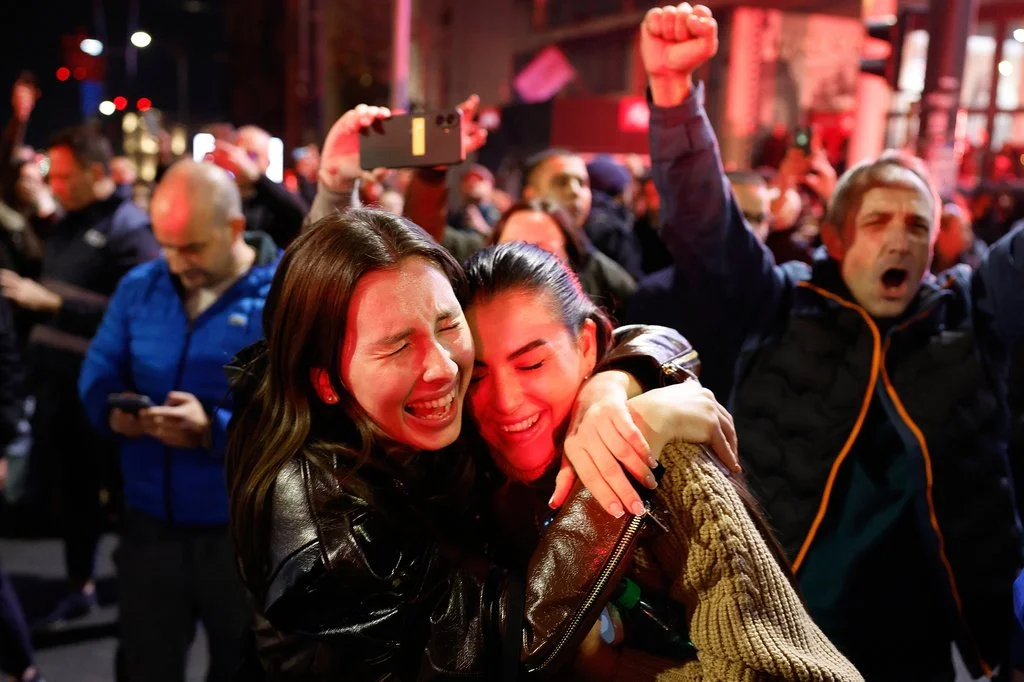
People celebrate after Aleksandar Vucic, leader of the right-wing Serbian Progressive Party (SNS) conceded defeat in the parliamentary election in Belgrade, Serbia, Sunday, Oct. 25, 2026. (AP Photo/Marko Drobnjakovic)
And, even though western European protests have a regional environment more favorable to change, the EU adds another layer of bureaucracy to stand in the way of making these wider changes possible.
Similarly to MENA during the Arab Uprisings, much of the systemic problems that will hold back governments from instituting change in Europe manifest themselves economically. In Spain, ‘vulture funds,’ private investment and hedge funds, are buying up real estate in cities, raising rent and pushing citizens out. The problem of affordability here has economic dimensions that reach outside of the government's hands. To add to this, the Spanish parliament rejected emergency housing decrees that would have helped to respond to protesters and broadly attack the housing crisis.
Both continents find themselves at a point in their histories of worsening economic standings as they are pushed to the periphery of the world economy, to varying degrees. In 2010, 25% of Middle Eastern youths were unemployed, and while the GDP of countries’ like Egypt went up 34% from 2005 to 2010, the proportion of people who thought of themselves as thriving fell by ⅓ to 12%. Lack of social mobility as well as poor public services meant the region was doing poorly economically.
And the Europe of today is seeing similar problems. According to an Al Jazeera report, prices increased by 12-15% from 2021 to 2025 in France, Italy, Portugal and Spain. While inflation did eventually slow down, prices never came back to their original point. And around 26% of EU residents from 18-24 were at risk of poverty or social exclusion in 2025. While the economic situation was worse in the MENA of 15 years ago, Europe is seeing a similarly worsening economic situation. A situation that MENA governments more than a decade later still have not been able to solve, and that European governments are unlikely to also be able to solve.
Different European countries are seeing their systemic and hard to solve problems manifest in different ways, either through corruption or affordability or often both. And it is in these differences that the protests will not be able to reach the same scale that the Arab Uprisings reached.
MENA enjoys pan-arabism, a nationalist and secular ideology/political movement that advocates for the economic, social and political unity of the Arab world. It was in part due to the shared culture and history, as well as the fact that the countries were all facing similar authoritarian regimes and economic problems, that the Arab Uprisings reached every corner of the region.
Europe does not have that same shared culture and the problems its different countries face, from housing, affordability and education to democratic backsliding, mean there is less unity and solidarity between movements that can propel them to greater heights.
But, the Arab Uprisings were not entirely failures. They managed to clearly voice the frustration of an entire region, and some authors argue that in the long term, they were an important step in public empowerment and fighting against political elites, processes that take decades. And so, Europe has a lot to learn from them if they want to hope for success past protesting.
The use of technology was a huge factor that pushed the protests to their scale and pushed them out to a wider audience. It gave tools to organize, document law enforcement and seek accountability by turning everyday people into citizen journalists. In Egypt, the Facebook page “We are all Khaled Said,” a man killed by Egyptian police in 2010, gained 70,000 members. And once the creator of the page, Wael Ghonim, was arrested, it led to massive solidarity and calls for collective action online and in person.
Decentralized movements were and are able to outpace bureaucracy and move around centralized and harsh responses from the government.
In France, social media has played a similarly important role. Images and videos of joy and solidarity are spread online and phrases like “battle d’aura” (“aura battle”) and “Bismillah, c’est les ténèbres” (“In the name of God, it’s the darkness”) have become staples of the protests because of social media. If there is anything to learn from the Arab Uprising, it is that youths should play into their youth and use technology to their advantage.
But, technology is not unidirectional or homogenous. While it can help create a massive movement, it has also been used by governments for their own agendas and created conflicting narratives between different platforms. Governments in Egypt and Syria shut down the internet and in Bahrain, for example, the government created hundreds of pro-government Twitter accounts that harassed activists and journalists, as well as spread propaganda.
In Albania, there have been reports of Meta blocking accounts that protest Kushner and the resort he backs. And with the rise of AI and facial recognition in our societies since the 2010s, technology has become a tool for governments and protesters alike.
The biggest difference between the two waves of protests is that the people of MENA were up against authoritarian regimes while in Europe much of the protests are taking place in mostly democratic countries. A huge part of what drives protests to then transform into calls for democratic transition or any kind of action is having viable, alternative options to government.
Having opposition parties and the opportunity for elections is something Europeans should nurture. Spanish Prime Minister Pedro Sanchez called for snap elections in response to the housing crisis and France has a presidential election in 6 months. In MENA, the situation was quite the opposite. Hereditary rule and oil revenues, as well as networks of elites, managed to stop the formation of any viable oppositions.
And a last point to make is about abstention from violence. During the Arab Uprisings, violence from protesters was often used by dictators and rulers to divert the narrative away from one about peace and regime change to one of unruly violence. Of the 6 countries studied in this paper, only 1 accommodated protester demands. The rest gave non-responses and mostly used violent ones to repress the protesters.
Europe is at a point in its history where it is waning in influence and economic strength. As it suffers from an affordability crisis and in some countries faces corruption, its people have gone out on the streets to demand change. But simply demanding it will not be enough. Just as the protests during the Arab Uprisings failed to achieve systemic change, European citizens lack the political support and regional unity to fight economic issues that are embedded deep in society.
As Europe now joins the rest of the world in Gen Z protests, it remains to be seen whether their political engagement will transform into political action.