
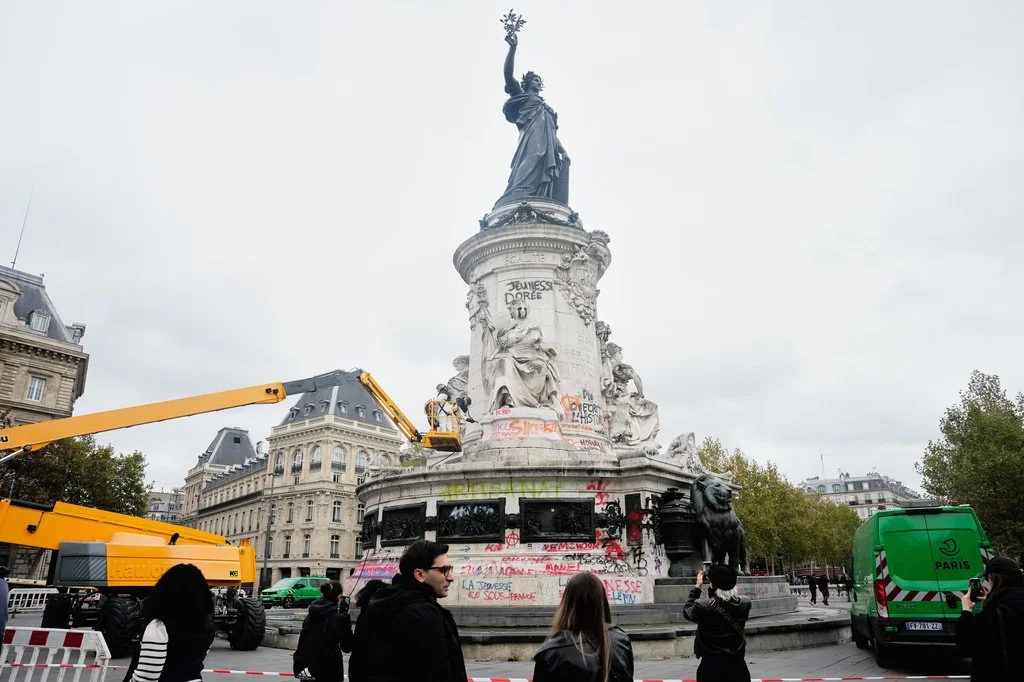
People watch and take photos of cleanup efforts after weekend protests over the cost of living turned into rioting and looting across France, in Paris, Wednesday, Oct. 21, 2026. (AP Photo/Teresa Suarez)
On Oct. 17 French students and union workers mobilized for a protest against school conditions, the high cost of living, and mounting frustration against the Macron Administration. Protests raising similar concerns have popped up in Italy and Belgium, and tensions have increased in the Albanian protests. The French protest movement started in early September, shortly after the start of the school year, when high school students began protesting over school conditions including poor infrastructure, widespread teacher absences, and large class sizes. In the past couple weeks it has expanded in scope to be a broader critique of the fiscal situation under the Macron Administration. This is part of a larger global movement of anger and frustration among young people about economic conditions, lack of representation, and corruption.
During the Oct 17 protests some protesters resorted to violence, rioting, and looting and a total of 2,400 people were arrested of the 550,000 protesters. Protesters have also attacked government buildings including the Lyon tourist office, the city hall in Limoges, and the office of the Prefect in Bordeaux. The French government views this as an existential threat with President Emmanuel Macron saying “Those who looted will have to pay back, and those who sought to bring down the Republic will be held accountable.”
In response to rioting, the French government has implemented partial curfews near the Place de la Republique, where the protests have been concentrated, and Les Halles, the luxury shopping district. Macron addressed the country on the evening of Oct. 18 offering few concessions except lowering gas prices. Laurent Nuñez, the French Interior Minister, acknowledged that the Police had been unprepared for the size of the protest and offered his resignation (which President Macron declined). Members of the French government, in particular Prime Minister Sebastien Lecornu, have blamed the Far-Left Party La France Insoumise (France Unbowed) for “...instilling violence and chaos in the country.”
In France and throughout Europe, cost of living is a major issue. Fuel and consumer prices have been significantly increasing since the start of the war in Iran. For instance, in France, Diesel prices have increased by 40% and Petrol prices have increased by 25% since March. Similarly, the price of food has increased by 25% since 2021. There is a feeling that older generations are prioritized over young people. CFR Senior Fellow for Europe Matthias Matthijs explained this contradiction saying “France spends 14 percent of its GDP on pensions, one of the highest shares in the world behind Italy, while its schools are crumbling and roughly one in five young people is out of work.” Many young French people feel that they simply do not have access to the same opportunities and jobs as the generations that came before them.
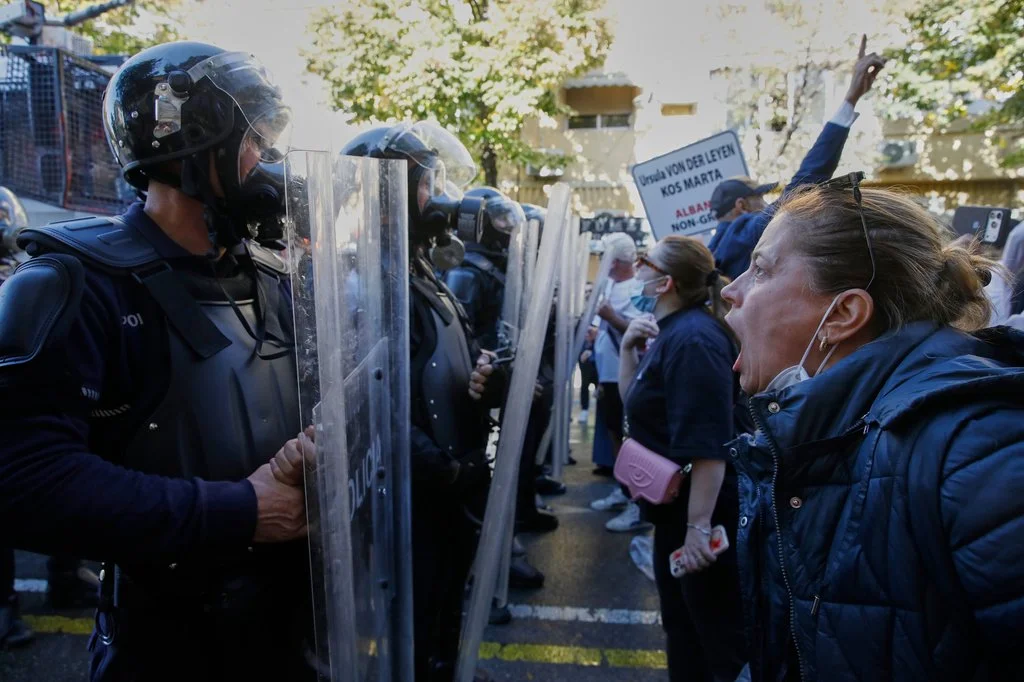
A woman shouts at riot police during an anti-government protest in Tirana, Albania, Tuesday, Oct. 20, 2026. (AP Photo/Boris Grdanoski)
In the past couple weeks these protests have spread to other countries in Europe. Over the weekend in Milan, protests over cost of living became violent. Italian students, as well as farmers and truck drivers, are particularly concerned about the cost of food because oil prices have increased and trade routes have been disrupted since the start of the war in Iran. Far Right Italian Prime Minister Georgia Meloni blamed the protests on people of “foreign origin,” saying that half the 330 people arrested were foreigners. In Italy this encompasses both people who are immigrants and people whose parents were immigrants. Similarly in Brussels, there were protests over the rising cost of education and access to French language education. Around 150 people were arrested in the protests, and of the 32 Judicial arrests, 15 were minors.
In Albania, peaceful protests began in opposition to luxury tourist development in a protected wildlife area pushed for by Jared Kushner, Trump’s son-in-law. This initial “flamingo revolution” has since expanded to be about cost of living, cost of education, and corruption mirroring the evolution of the French protests. Albanian anger has been primarily directed towards Prime Minister Edi Rama, who has held office for 13 years, and now, protesters are calling for him to step down. Rama has also taken to blaming “outside forces” for the protests including Iran and Russia.
Across these countries initial localized grievances have snowballed into concerns about broader issues like cost of living and access to a quality education. These protests follow in the footsteps of the 2025 Gen Z protests in Nepal, which demanded an end to corruption and were successful in overhauling the Nepali government. It is clear that Gen Z does not feel that their governments are meeting their needs.