
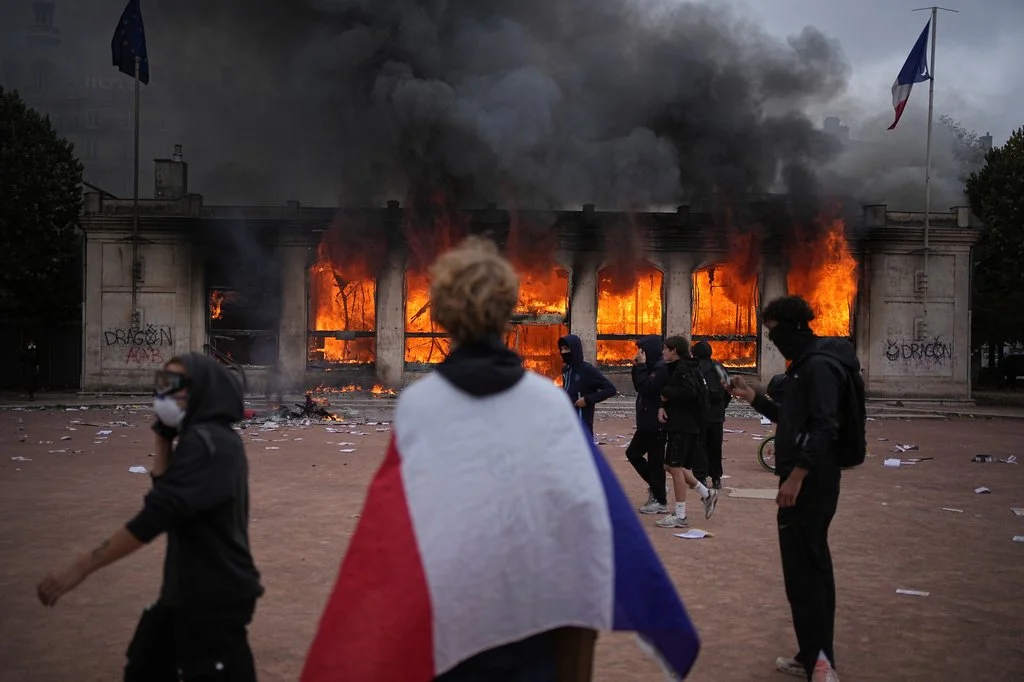
The tourist office in Lyon, France, burns as people walk across a square on Oct. 17, 2026. Photo: Laurent Cipriani / AP Newsroom.
A student protest over school conditions has turned into France’s worst unrest in years, about six months before the country’s presidential election. On Oct. 17, protests over the cost of living turned violent in cities across the country.
Protesters set fire to the town hall in Limoges, broke into town halls in Marseille and Lille, and looted shops in cities across the country. The unrest continued on the evening of Oct. 18, with more fires and looted shops reported in Paris, Lyon, and Marseille.
About 550,000 people marched nationwide on Oct. 17, according to the Interior Ministry, while the CGT union put the figure at 800,000. Authorities said around 2,400 people were arrested over the weekend. More than 600 police officers were injured, according to the Interior Minister. Paris Police Prefecture also said one person died of a heart attack during the protests, and prosecutors are investigating.
The violence grew out of a student movement that began in late September at a high school in Créteil, a suburb of Paris. Students there protested teacher shortages and poor conditions at the school. According to education ministry data, nearly 10 percent of teaching hours went untaught in public secondary schools in the 2024-2025 school year.
Interior Minister Laurent Nuñez offered his resignation on Oct. 18, saying he was responsible for everything that was happening. President Emmanuel Macron refused to accept it, emphasizing the need for continued command of law enforcement. He ordered Nuñez to ensure full transparency about failures in planning and intelligence. Nuñez admitted that authorities had lost control in parts of several major cities on Oct. 17.
Macron condemned the violence in a national address on the evening of Oct. 18. “Nothing justifies it, nothing explains it, nothing excuses it,” he said. He also called for new policing tactics on the ground as quickly as possible.
On Oct. 19, Prime Minister Sébastien Lecornu told regional authorities to impose limited, localized curfews. Night curfews have since been imposed in parts of Paris and other cities, and authorities have banned protests in several cities, including Lyon and Marseille.
The worst damage was in Limoges, where protesters set fire to the city’s 143-year-old town hall, and its roof collapsed. The regional prefect said the fire was set deliberately. Limoges Mayor Guillaume Guérin threatened to resign if the city does not receive funding to repair the building.
In Lyon, a fire broke out inside a tourist office. Nuñez said hundreds of businesses were looted in cities including Paris, Bordeaux, Strasbourg, and Nice. In Bordeaux alone, the mayor said up to 100 stores were looted. Economy Minister Roland Lescure promised support for business owners who suffered losses.
The government blamed some of the violence on radical far-left groups. Lecornu said ultraleft groups organized the violence in several cities and were later joined by people looking to loot. He also warned that limited public funds cannot keep covering the cost of the damage.
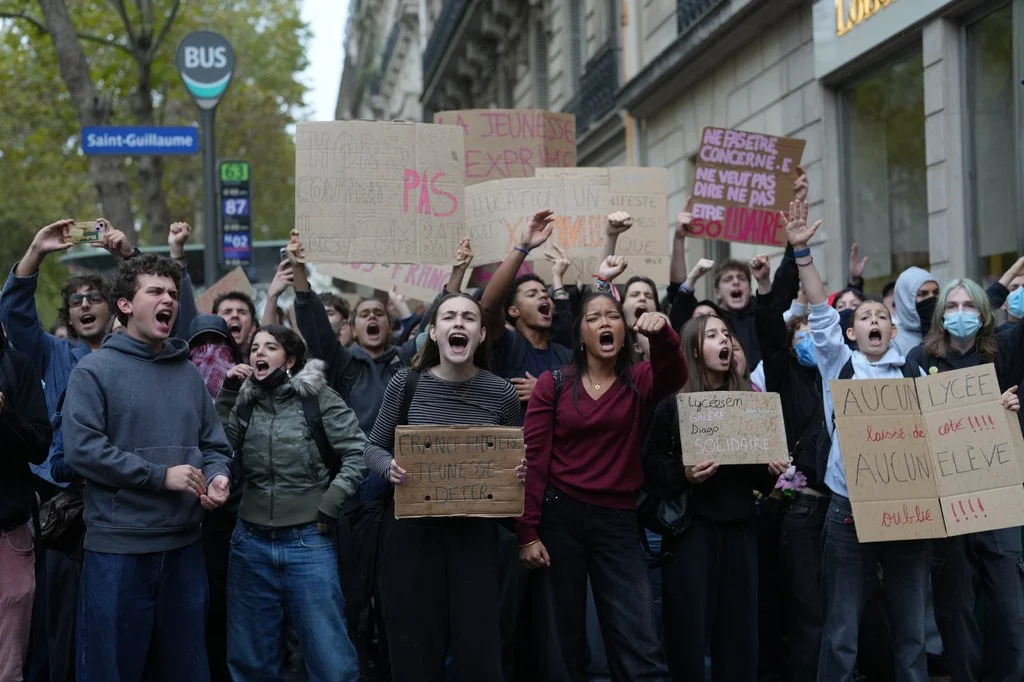
Students shout and hold handmade signs during a protest in Paris on Oct. 7, 2026. Photo: Thibault Camus / AP Newsroom
The movement spread quickly. By early October, students had disrupted more than 500 schools. Students also raised other complaints, including stress over Parcoursup, the national university admissions platform. Over the following weeks, the protest broadened into wider anger over inequality, spending cuts, and rising living costs.
Student protesters say the government has not done enough. A spokesperson for the high school movement said students would return to class only when their daily lives improve and they can study in better conditions. Their demands include scrapping Parcoursup and hiring more school nurses.
The protests add pressure on a government that has proposed spending cuts in its 2027 budget. France holds a presidential election next spring, and Macron is barred from seeking a third consecutive term.
National Assembly President Yaël Braun-Pivet has said she is considering a parliamentary inquiry into the violence. The mayors of Paris, Marseille and Lyon have also requested a meeting with the prime minister because of the scale of the damage. Unions have called for a nationwide day of action on Nov. 5