
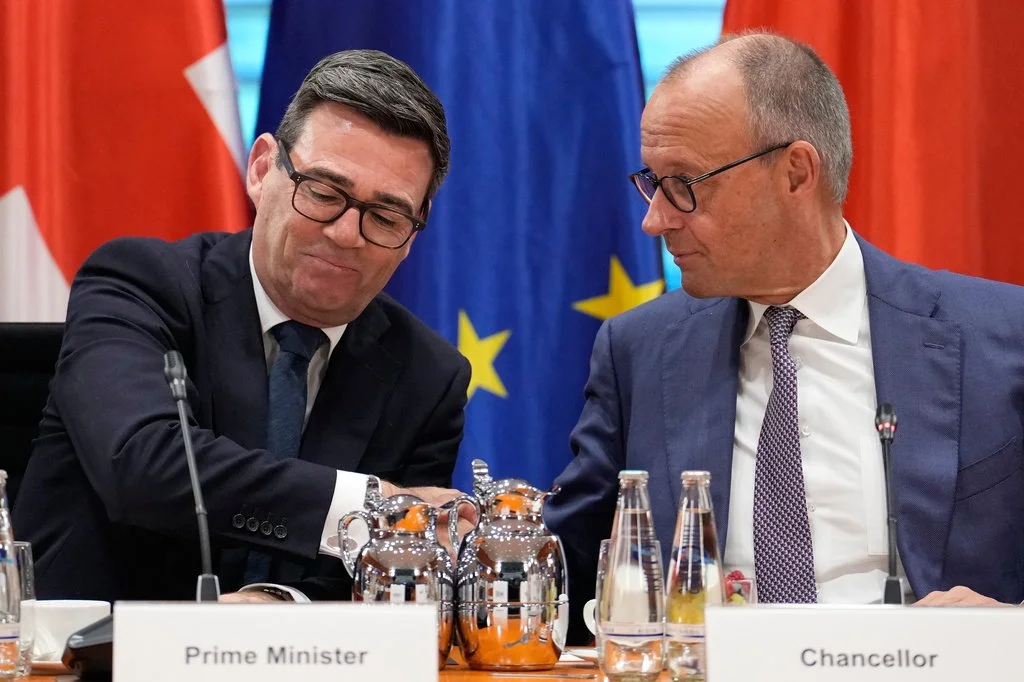
German Chancellor Friedrich Merz and British Prime Minister Andy Burnham participate in a Regional Growth Forum in Berlin, Germany, Thursday, Oct. 8, 2026. (AP Photo/Ebrahim Noroozi)
At the annual Labour Party Conference, Burnham laid out his plans for the future of the UK in different areas, ranging from electoral reform to actions on housing. But, among the announcements made in his speech, one stood out. The prime minister declared that he is looking to change the long term relationship the country has held with the EU. He followed this up in interviews by saying that he will be looking at all the options, one of them being the possibility of “going all the way.”
More than 10 years after the vote to leave was cast, the debate on rejoining the EU is now back in the air. The UK economy currently faces weak growth, pushing Burnham to consider greater economic cooperation with the bloc. And, as defense becomes a more important topic, the EU and the UK are looking to benefit from each other’s military strength, with a major defense partnership signed last year.
While the prospect of rejoining the EU is, for now, still just an idea, the statement received warm words from different European leaders. At a press conference with President Emmanuel Macron, Prime Minister Pedro Sanchez said “Spain would applaud it and once again open its arms to a brotherly people.” Germany’s ambassador to the UK, Susanne Baumann, told Telegraph reporters that she was “glad” to hear that Burnham was looking to renew relations. But Macron made sure to signal that rejoining would have to be conditional. "You cannot choose between the freedoms of the union and decide to take what suits us and not the rest," he said.
Choosing to change UK-EU relations could come under many different forms. Burnham could choose the status quo and maintain current relations with the bloc, or he could decide to join a select number of institutions like the single market or customs union, breaking from Starmer’s ‘red lines.’ But, according to a YouGov poll, rejoining is the most popular option, as 59% of Britons support it, a feeling reciprocated by two-thirds of EU citizens.
In his speech, Burnham transitioned to talking about the EU and immigration by stating that “Brexit hasn’t given us control.”
Economists and analysts have largely agreed that leaving has had a negative impact on overall trade with the UK’s second biggest trading partner, the EU. While a UK-EU trade deal from May of last year eliminated a lot of trade barriers, there still remains a lot of ‘non tariff barriers,’ time consuming and often complicated paperwork to fill out, that impedes greater economic mobility and cooperation.
Leaving, while not being the sole reason, has contributed to a stagnant UK economy. Studies have varying opinions on how bad Brexit has been on the UK, some suggesting UK exports are 30% lower than they would have been with the EU, and others saying that the figure stands at only 6%.
Two-thirds of economists believe that seeking closer ties to the EU now could address certain economic challenges faced by the country. In 2025, the EU accounted for 41% of UK exports and 50% of UK imports. Removing trade barriers could help make this trade much easier, even if some assert it could take a while.
In the face of Trump’s various trade wars and conflicts, such as the war in Iran driving the price of gas up, expanding the bloc could increase the economic possibilities of both sides. The UK has a powerful financial and service hub in London, is a leading global researcher in science and technology and currently accounts for 32% of Europe's fastest growing startups. Closer UK-EU ties could create opportunities for both sides to strengthen their economic competitiveness.
But further than money, security is also pushing the UK closer to the EU. The UK’s MI5 chief, in a recent announcement, said that the institution was allocating more resources to state threats than it had during the cold war, due to Russia, Iran and the increasing threat of AI. According to him, there have been over 50 Iran related arrests made in the country in the past year. With the war in Ukraine, Russia’s hybrid war with the EU, and reports of interference in the 2016 Brexit vote from Russia, defense has become an important topic in the debate over closer UK-EU relations.
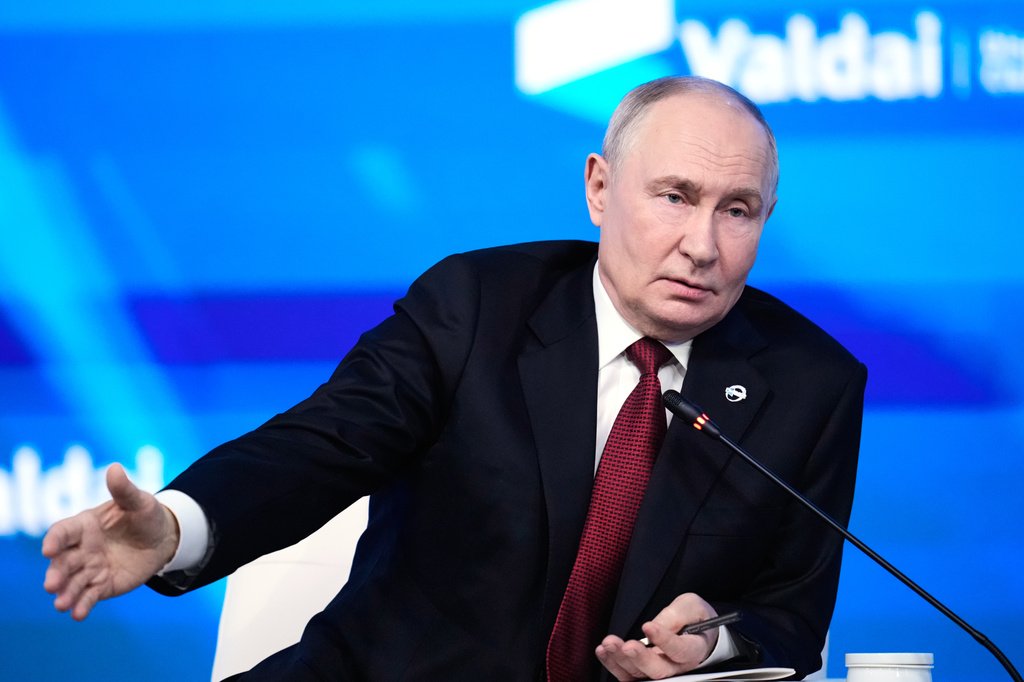
Russian President Vladimir Putin gestures while speaking at the session of the Valdai Discussion Club in Moscow, Thursday, Oct. 1, 2026. (AP Photo/Pavel Bednyakov)
The EU and UK are already aligned on many matters of defense through NATO and the Security and Defense Partnership that they signed in 2025. Amid uncertainty over US commitments to NATO and European security, closer UK-EU military cooperation could become more significant. Rejoining would mean that the UK would have better access to defense funding, like SAFE, an EU financial instrument that helps provide money for long term joint defense investments, that the UK was not able to gain access to last year.
A decade after the Brexit referendum, issues concerning defense and security as well as the economic strength of the EU have renewed the debate over closer ties with the bloc. And, with Canada potentially joining as an associate member, the UK could have its solution.
But, the timing of any move towards closer EU relations could be significant. With consequential elections lined up in Spain, France, Poland, Germany and Italy over the next months, the continent could see the increasing ascension of euro-skeptic parties that would be wary of adding to the EU’s numbers.