
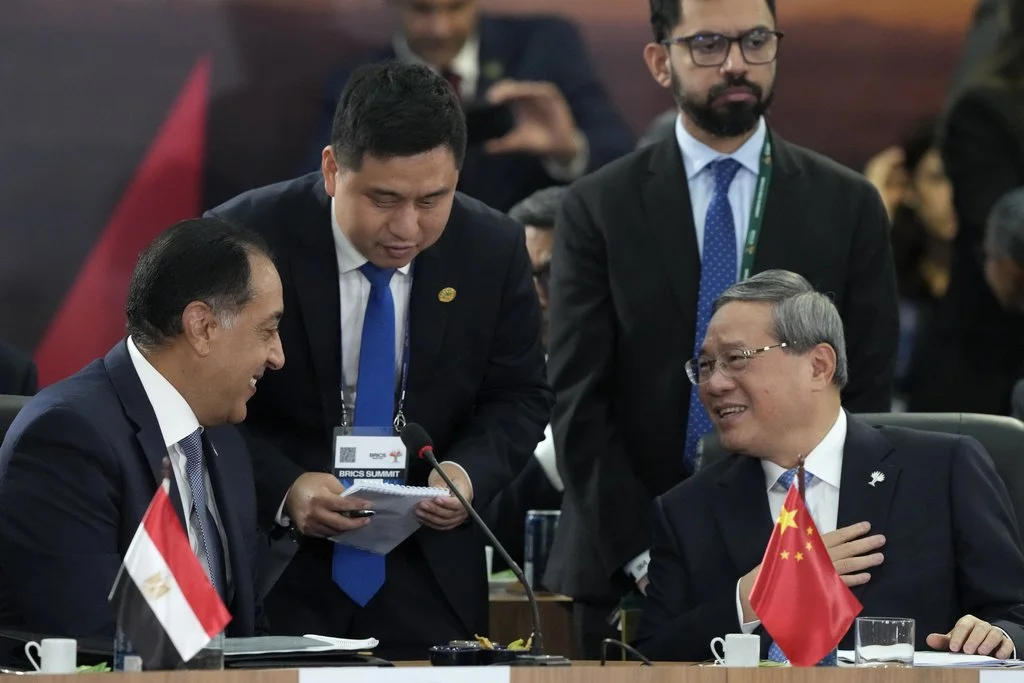
Egyptian Prime Minister Mostafa Madbouly, left, speaks with Chinese Premier Li Qiang at the BRICS summit in Rio de Janeiro on July 7, 2025. (AP Photo/Eraldo Peres)
When Chinese President Xi Jinping landed ≤in Cairo on Sept. 1, the visit marked 70 years since Egypt became the first Arab and African country to establish ties with the People’s Republic of China. It came at an awkward moment for Washington. The week before, the United States said it would cut off the UAE’s operations of Egypt’s Banque Misr from the US financial system over its Iran links. Washington had also been watching Cairo’s turn toward Beijing for some time. The same day Xi arrived, analysts at the Washington Institute for Near East Policy warned that some of Egypt’s new deals with China “may even come at the expense of further cooperation with the United States.” Yet one month after Xi’s visit, Washington released $320 million in withheld military aid to Egypt, citing Egypt’s critical role in the Iran war. Both the pressure and the reward make sense in light of Cairo’s strategy.
Egypt is running a two-supplier strategy: China for factories, finance and yuan liquidity, and the United States for security, diplomatic weight and access to Western markets. Neighbors from Riyadh to Abu Dhabi are running versions of the same play. It can work, but Egypt’s version will only pay off if Cairo forces Chinese capital to build exports, since China already sells Egypt nearly $20 billion in goods a year while buying back less than $1 billion
What China Is Building
The scale is real. Egypt’s Prime Minister Mostafa Madbouly said in August that Chinese investment in Egypt had passed $10 billion, spread across construction, textiles, electronics, energy, transport, and manufacturing. China State Construction Engineering Corporation built the 20-tower Central Business District in Egypt’s New Administrative Capital. During Xi’s visit, Madbouly and Egypt’s President, Abdel Fattah El-Sisi, agreed to launch the third phase of the China-Egypt TEDA industrial zone, which will target renewable energy, automotive manufacturing, textiles, and chemical fibers. The same day, China’s ZC Rubber signed an agreement for a $500 million tire complex in Ain Sokhna, and Egypt’s Mansour Group agreed to explore battery manufacturing with China’s Tianneng.
TEDA is the clearest test of the model. The zone in Ain Sokhna began operations in 2008, and by June it hosted more than 200 companies, over $4.7 billion in investment, and more than 10,000 direct jobs. It has paid $350 million in tax to date, and its managers are negotiating for 10 more square kilometers, which would nearly double its size.
The financial ties are deepening too. In June, the Chinese and Egyptian central banks expanded their three-year currency swap from 18 billion to 30 billion yuan, about $4.4 billion. Cairo has also allowed Chinese companies operating in Egypt to open yuan accounts and use the currency in local transactions. In 2023, Egypt also raised 3.5 billion yuan through Africa’s first sustainable panda bond. Panda bonds are loans that foreign governments or companies raise in yuan from investors inside China.
Beijing’s motives are commercial. Chinese manufacturers favor the Suez Canal Economic Zone, Mostafa Ibrahim of the Egyptian Businessmen’s Association explained, because Egypt’s trade agreements give them easier access to European and US markets. Ibrahim described Chinese firms treating Egypt mainly as an export-oriented manufacturing base, with investment concentrated in garments, textiles and bags.
In other words, Chinese firms use Egypt as a base to produce goods for markets elsewhere. That makes Chinese money different from Gulf money. In March, Gulf sovereign wealth funds have largely bought land and stakes in existing Egyptian banks and logistics firms. Chinese firms are building new capacity, which is exactly what Egypt needs.
The Catch: Who Pays for the Inputs
The problem is the trade imbalance. Egypt’s Ministry of Investment put bilateral trade with China at about $19.5 billion in 2025. Yet, Egypt’s exports to China that year were just $819 million, an investment official said, while China’s exports to Egypt neared $20 billion.
Chinese projects in Egypt rely heavily on production inputs imported from China, which is why Mostafa Ibrahim, vice chairman of the China Committee at the Egyptian Businessmen’s Association, expects bilateral trade to reach about $20 billion within two years. In plain terms, every new Chinese plant adds to Egypt’s import bill. Unless its output is sold abroad, the plant drains Egyptian finances.
There are encouraging signs. Egypt’s exports to China jumped 200 percent to $841 million in the first half of 2026, and Chinese imports of Egyptian agricultural products rose 82.6 percent in the first seven months of the year. But those gains are in the context of a massive Egyptian trade deficit.
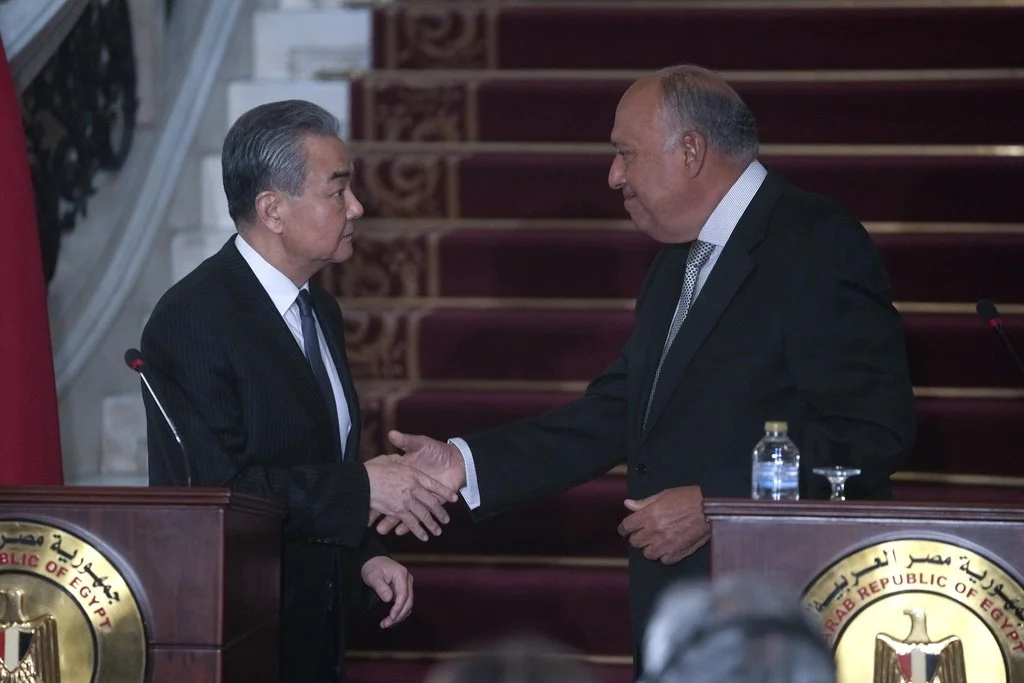
Then-Egyptian Foreign Minister Sameh Shoukry, right, and Chinese Foreign Minister Wang Yi shake hands after a joint press conference at Tahrir Palace in Cairo on Jan. 14, 2024. (AP Photo/Amr Nabil)
Pledges also run far ahead of cash. A University of Queensland report counted $12.2 billion in Chinese investment pledges to Egypt in the first half of 2026. Actual inflows over the same period were estimated at $1.5 billion to $2 billion, most of it for expanding existing projects. Announcements are cheap, and the gap between them and delivered capital is where scrutiny belongs.
What Washington Still Holds
The US relationship with Egypt rests on three pillars, and China can match none of them.
The first is security. Since the Camp David framework, Washington has provided Egypt about $1.3 billion a year in Foreign Military Financing, which lets Cairo buy American weapons. The two militaries also co-host Bright Star, one of the world’s largest multinational military exercises, which was most recently held again from Aug. 28 to Sept. 10, 2025.
The second pillar is diplomacy, where Cairo has positioned itself as a valuable intermediary for successive US administrations. In October 2025, Sisi and President Donald Trump co-chaired the Gaza peace summit in Sharm el-Sheikh, attended by leaders from nearly three dozen countries. During the Iran war, Egypt joined a four-country mediation mechanism with Pakistan, Saudi Arabia, and Turkey, while Egypt’s General Intelligence Service reportedly opened a back channel to Iran’s Revolutionary Guards. That work paid off on Oct. 1, when Secretary of State Marco Rubio waived human rights conditions on $320 million in military aid, citing Egypt’s “helpful role” in the war. As Jack McCormick wrote for IR Insider, the decision “highlights how Washington weighs human rights conditions against national security.” The Biden administration had issued a similar waiver in 2024, citing Egypt’s role in the Gaza ceasefire negotiations. Under both parties, Egypt’s value as a mediator has repeatedly outweighed concerns about its human rights record.
The third pillar is the one most often overlooked: markets. US goods exports to Egypt reached $9.4 billion in 2025, up 47 percent, while Egypt sold $2.8 billion worth of goods to the United States. Egypt still runs a deficit with Washington, but it sells more than three times as much to Washington as it does to China. US investment in Egypt is estimated at around $25 billion, most of it in oil and gas exploration and production. Cairo has proposed a dedicated American investment zone to attract more US investments in the country.
That last point exposes a quiet irony. Many of the Chinese factories in the Suez zone are there to reach Western consumers through Egypt’s trade agreements. Washington, in other words, provides much of the demand that incentivizes and valorizes Chinese investments.
The close relationship, however, has real strains. Egypt and China launched their Eagles of Civilization 2026 air exercise on Aug. 22, and reports that Cairo wants China’s J-10 fighter jet have circulated for years. Analysts at the Washington Institute for Near East Policy argue that so long as the United States is “unwilling or unable to pressure Cairo against deepening ties with Beijing,” Egypt will keep accepting Chinese offers. The State Department’s own reporting has also cited credible reports of torture and arbitrary arrest in Egypt. Yet cutting aid would be a mistake. Chinese factories in Sokhna would keep running, and Washington would weaken its security partnership with Cairo, the one area where China cannot yet compete.
Where China Falls Short
The Iran war showed the limits of Beijing’s influence. During the conflict, China declined to use its leverage to stop Iranian attacks on its Gulf partners, which especially troubled Saudi Arabia. Beijing had even skipped trilateral naval exercises with Iran and Russia in the weeks before the fighting began. Instead, China held direct talks with Yemen’s Houthi rebels to secure passage for its own tankers through the Red Sea. When the shooting starts, Beijing protects its own trade first.
For Egypt, that gap in security is expensive. Red Sea disruption has cost Cairo an estimated $10 billion in lost Suez Canal revenue since October 2023. The Hormuz closure then hit Egyptian farmers: urea fertilizer prices rose to as much as $750 a tonne, up from about $400 before the war, according to the head of Egypt’s Chemical Industries Chamber. A partner that negotiates safe passage for its own tankers does little to keep the canal open for everyone else.
The Regional Pattern
Gulf states still maintained close ties with Beijing. In July, Gulf governments turned to China to press Tehran over Hormuz and the Red Sea, aware that the war had exposed the limits of American power. Saudi Arabia’s approach, analysts at Israel’s Institute for National Security Studies note, is to keep its US alliance, deepen ties with China, and keep talking to Iran. Chatham House argues that China will not replace the United States as the Gulf’s security guarantor but could help shape a new regional order, and a senior UAE official summed up the mood in two words: “geography prevails.”
That is the regional pattern: American guns, Chinese capital, and exclusive alignment with neither. Egypt is the clearest case because it is poorer than its Gulf neighbors and needs both suppliers more urgently. It has also mastered the game better than most, earning Chinese investments and an American aid waiver within a single month.
What Cairo and Washington Should Do
For Cairo, the question is how to turn both partnerships into what Egypt needs most: industries that earn money by selling abroad. That means three things.
First, tie the Suez Canal Economic Zone incentives to export and local-content targets. Tax breaks should reward firms that sell to Europe, Africa, the Gulf, and the United States, while firms that only assemble Chinese kits for Egyptian consumers should get fewer tax incentives.
Second, publish delivered investment alongside pledges. Regular public figures for disbursed capital, jobs, and exports in each zone would let Egyptians judge whether the partnership is working.
Third, use the yuan to reduce dollar demand while keeping the Western anchor in place. The swap line and panda bonds can cover Chinese inputs, while the special relationship with Washington and the IMF program, the fund expanding to $8 billion in 2024, keep Western investors confident.
For Washington, the lesson is just as plain. Aid waivers buy diplomatic cooperation, but they do not shape where sources of Egyptian industry are. If the United States wants to limit China’s economic footprint in Egypt, its best tools are the ones it already holds: market access and capital. Backing Cairo’s proposed American investment zone, and tying preferential access for goods made in the Suez zone to genuine Egyptian content, would do more than any aid review.
Egypt’s two-supplier strategy is the most rational strategy available to a cash-strapped state in a fractured region. The real test is whether, a decade from now, it leaves Egypt with exportable industries or just a bigger import bill.