
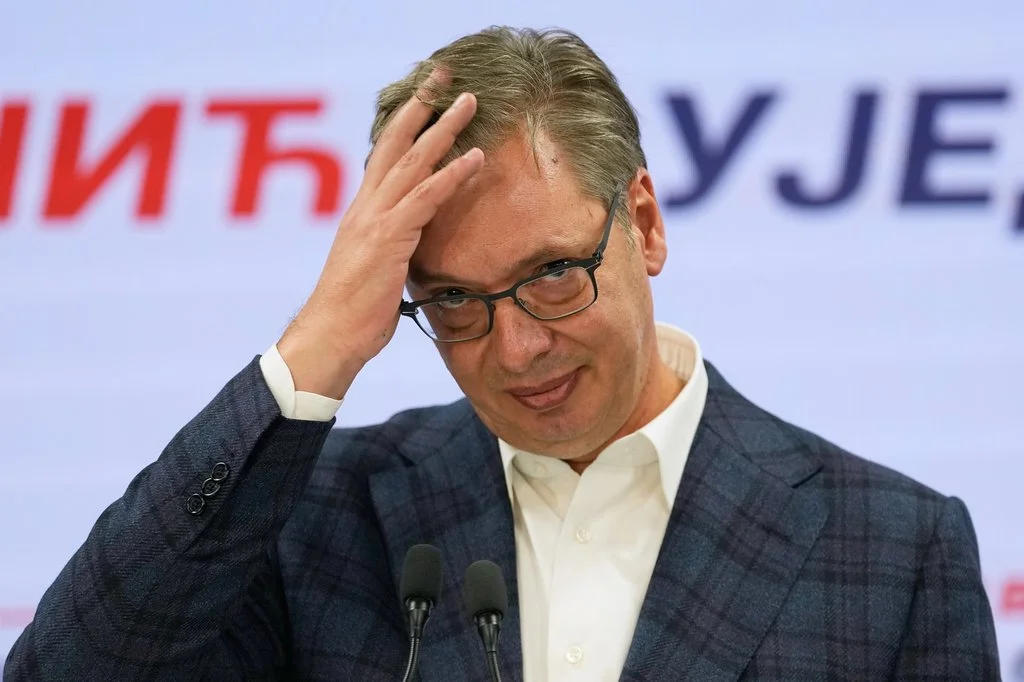
Aleksandar Vučić, leader of the right-wing Serbian Progressive Party (SNS) speaks at the party headquarters, after conceding defeat in the parliamentary election in Belgrade, Serbia, Sunday, Oct. 25, 2026. (AP Photo/Darko Vojinovic)
Late on election night, Oct. 25, European Commission President Ursula von der Leyen and European Council President António Costa congratulated the Student List and offered to help advance Serbia's path toward the European Union. Marta Kos, the EU's enlargement commissioner, declared that "the door to the EU is open." Within days she added the condition that matters more: Serbia cannot make significant progress toward membership without aligning its foreign and security policy with Brussels, sanctions on Russia included. The day after the vote, Jovo Bakić, one of the movement's best-known figures, answered that there would be no sanctions. Serbia, he said, respects Russia as a great power and, in many cases, a "protector." That exchange is the story of Serbia's new era. The Student List won a mandate against corruption, not against Moscow, and much of Europe is reading a domestic revolution as a geopolitical one.
The expectation is not new. In July 2022, the European Parliament asked Belgrade to "urgently align" with EU sanctions. In May 2025, one day after another Parliament resolution criticized Serbia's non-alignment, Vučić flew to Moscow for the Victory Day parade. This July, the Commission tried to open a new cluster of accession talks and eight member states blocked it, citing democratic backsliding and Serbia's failure to align on foreign policy. Throughout, Vučić's Serbian Progressive Party remained an affiliate of the European People's Party. The reflex is familiar. As experts told Al Jazeera after the vote, international observers tend to expect a quick pivot toward the West whenever an authoritarian government falls.
The reactions after the vote show how strong that reflex is. Volodymyr Zelenskyy said Serbia faced a "new chapter." Hungarian Prime Minister Péter Magyar was the first foreign leader to call the winners and compared their victory to his own in April. Headlines announced that Russia had lost its best friend in Europe and that Serbia's students had defeated a "Russia-backed leader." Reuters reported gloom in Moscow. The Kremlin itself was calmer. Its spokesman, Dmitry Peskov, said he hoped the new forces would understand that cooperation with Russia serves Serbia. He had reason for confidence. Before a single vote was cast, the Student List had said it would not sanction Russia, would keep Serbia's military neutrality and would not seek NATO membership. The claim that the students will turn on Moscow comes from two opposite camps, and neither rests on what the students say. Vučić's version is propaganda: on election night he predicted the new government would impose sanctions by March or April 2027, after accusing his opponents of doing dirty work devised by someone else. Europe's version is wishful thinking. When Brussels' hopes end up repeating the campaign line of the man it spent years criticizing, the problem is not Belgrade's clarity but rather European naivety.
To see why the students may fall short of what Europe expects, it’s important to examine where they came from. The movement grew out of the Nov. 1, 2024, collapse of the Novi Sad railway station canopy, which killed 16 people, and nearly two years of protests against corruption and growing authoritarianism. Its electoral list, headed by Novi Sad cardiologist Ilija Srdanović, included no students, only professors, doctors and public figures chosen by them. Its slogan was "Serbia or the Mafia." The list won 52.71 percent of the vote and 140 of 250 seats after most opposition parties stood aside to give it a clear run. Its platform, the 11-point Student Plan, is built around the rule of law, and during the campaign the movement deliberately avoided polarizing foreign policy questions. When pressed, it answered in ways that sound like the government it replaced.
The record since the vote is consistent. Bakić told RT that sanctions from a country as small as Serbia would change nothing for Russia but would be symbolically damaging. Radomir Saičić, an academician and one of the list's founders, told RIA Novosti that the list does not advocate sanctions on Russia and that problems must be solved through dialogue. Asked by Radio Free Europe whether the sanctions position could change, Srdanović said the citizens of Serbia would ultimately decide. Aleksandar Baucal, another representative, said in October debates that coordination with EU foreign policy is needed but that "all of this is a matter of negotiation." That is not a promise to align. It is an opening bid.
The rest of the program follows the same line. It supports continued cooperation with Russia, proposes bilateral agreements with individual EU member states alongside closer ties with the Union and seeks to deepen Serbia's "strategic partnership" with China. The movement regards Kosovo as an integral part of Serbia. On weapons, the signals are confused: Reuters reported that leading candidates wanted to end arms exports to war zones, including sales to intermediaries who pass weapons to Ukraine, while Hromadske later corrected its own report of a firm pledge. The list does recognize Ukraine's territorial integrity, as Vučić's government did. On foreign policy, the students' win continues a long tradition of Serbian cooperation with Russia.
Bakić's word, "protector," draws on that tradition. In March 1878, after its war with the Ottomans, Russia imposed the Treaty of San Stefano, which recognized Serbian independence but also created a Greater Bulgaria that Serbia feared. The Congress of Berlin dismantled that Greater Bulgaria months later and confirmed Serbia's independence. On July 30, 1914, Czar Nicholas II ordered general mobilization to deter Austria-Hungary from crushing Serbia. In January 1916, as the Serbian army collapsed on the Albanian coast, Russian pressure on the Allies accelerated its evacuation to Corfu.
Modern history matters even more. On May 30, 1992, UN Security Council Resolution 757 imposed comprehensive sanctions on what remained of Yugoslavia. By January 1994, monthly inflation had reached 313 million percent. Serbia's history with sanctions is the Student List's apparent reason for refusing them now: Bakić invoked the 1990s directly in his RT interview. In 1999, NATO bombed Yugoslavia for 78 days without U.N. authorization, which Moscow had made it clear it would veto.. On Dec. 26, 2007, the Serbian parliament declared military neutrality. After Kosovo declared independence in 2008, Russian Foreign Minister Sergey Lavrov made clear Russia could block its UN membership. As long as Serbia refuses to recognize Kosovo, it must rely on Russia's veto.
The most concrete tie is energy. In December 2008, Belgrade sold 51 percent of its state oil company NIS to Gazprom Neft for €400 million, without an international tender and well below Deloitte's valuation, as part of a broader energy deal tied to the South Stream pipeline. Eighteen years later, Gazprom entities still hold 56.15 percent of NIS. The company runs Serbia's only refinery and supplies about 80 percent of its fuel market.
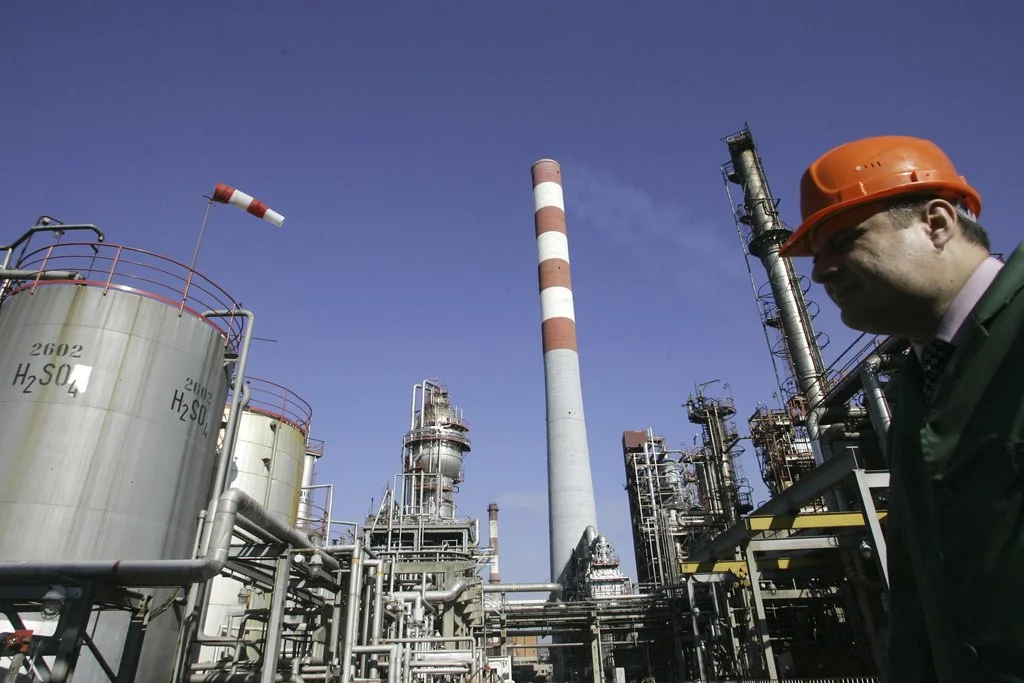
FILE - A worker is seen in the NIS Jugopetrol oil refinery, prior to a visit by Russian deputy prime minister Dmitry Medvedev, in Pancevo, some 16 kilometers (10 miles) north of Belgrade, Serbia, Monday, Feb. 25, 2008. (AP Photo/Darko Vojinovic, File)
Washington's sanctions on NIS took effect on Oct. 9, 2025, and forced a sale. Hungary's MOL signed a preliminary agreement in January to buy the Russian stake, but the deal still needs U.S. approval, and NIS has been functioning on short-term licenses from the U.S. Treasury’s Office of Foreign Assets Control, the latest of which run to Dec. 11. Forbes Serbia reported that negotiations had practically failed because Gazprom does not want to sell. Gazprom also supplies around 2.2 billion cubic meters of gas a year at below-market prices, a relationship the Student List calls an economic dependency rather than an alignment. A government that cannot keep its only refinery running without Moscow's consent and Washington's license is in no position to sanction either.
Nor will public opinion force a change. Student List supporters are more pro-European than the average Serbian: 75 percent want closer ties with the EU and only 10 percent with Russia. Yet only 42 percent of them see EU alignment as the best way to protect Serbia's national interests, and across the whole electorate neutrality is the most popular option, at 49 percent. Fewer than 40 percent of Serbians support EU membership. These voters want European institutions at home without European discipline abroad. They reject Vučić's capture of the courts and the media and they do not reject his view that Serbia belongs to no bloc.
The Oct. 25 vote weakened Vučić, not Moscow. Russia lost a personal partner; it kept the policy. Ivana Stradner of the Foundation for Defense of Democracies described the movement accurately: pro-Western, pro-Russian and neutral voices united only by the demand for the rule of law. That leaves Brussels with an uncomfortable choice. The EU accepted this foreign policy from Vučić for years. Now it expects the democrats who removed him to abandon it, and hopes the expectation will be enough. It will not be. If Brussels turns alignment into the price of progress, it will look like it is punishing reformers for positions it forgave in an autocrat. If it quietly lets the expectation go, it abandons the condition that has defined Serbia's accession since 2022 and invites every other candidate to bargain the same way.
Europe's leaders should stop reading the Oct. 25 vote as a defeat for Putin and start reading the students' program as written. Serbia has elected a government that wants to fix its institutions, trade with Europe while staying out of both Moscow’s and Brussels’ foreign policy arrangements.