
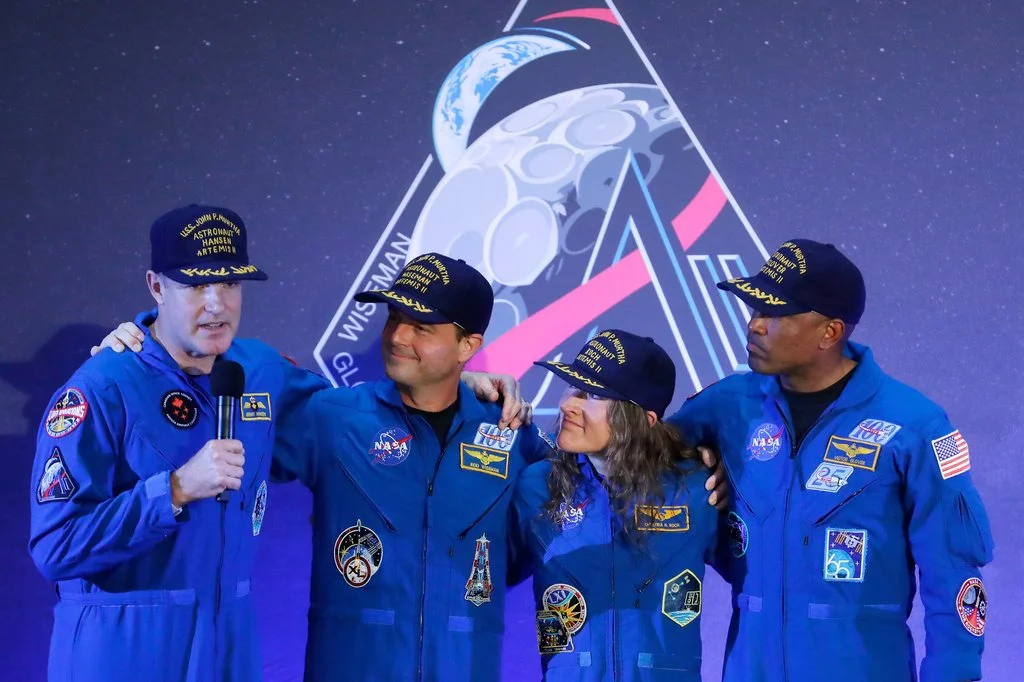
The Artemis II crew, from left, Jeremy Hansen, Reid Wiseman, Christina Koch and Victor Glover gather with Hansen as he speaks during a crew return event Saturday, April 11, 2026, at Ellington Field in Houston. (AP Photo/Michael Wyke)
The Artemis II Crew, NASA astronauts Reid Wiseman, Victor Glover, Christina Koch, along with Canadian Space Agency astronaut Jeremy Hansen, made history on Monday, April 6, becoming the first people to travel 252,756 miles from Earth. During a planned 40-minute communications blackout with NASA, they completed their lunar flyby, also becoming the first people to observe certain regions of the far side of the Moon.
The crew spent the blackout taking photos and recording audio observations. Their findings included the Orientale Basin, a massive impact crater. While on the far side of the Moon, they became the first to closely observe two small craters, one of which they proposed naming Integrity, after their spacecraft, and the other Carroll, after Reid Wiseman’s, wife who died after battling cancer in 2020.
Upon learning that the Artemis crew had set a record for fastest travel from Earth, Jeremy Hansen said, “we do so in honouring the extraordinary efforts and feats of our predecessors in human space exploration. We will continue our journey even farther into space before Mother Earth succeeds in pulling us back to everything we hold dear.”
Another key objective of the mission was to test the capabilities of the Orion spacecraft for future lunar landings. This includes preparations for Artemis IV, a mission currently slated for 2028 that aims to land astronauts on the Moon’s south pole. This all comes as an effort to maintain a human presence on the Moon in the future.

NASA's Artemis II moon rocket lifts off from the Kennedy Space Center's Launch Pad 39-B Wednesday, April 1, 2026, in Cape Canaveral, Fla. (AP Photo/Chris O'Meara)
After completing their historic flyby, the crew began preparing for their return to Earth, the riskiest part of their mission. During the Artemis I mission, an unmanned test flight of the Orion spacecraft, significant heat damage was observed upon reentry. Artemis II’s heat protection was similar to that of Orion I, raising concerns about the safety of reentry and potential risks for the crew.
While reentry always carries inherent risk, the crew remained determined to mitigate them and safely “splash down” off the coast of San Diego. "There's so much data that you've seen already, but all the good stuff is coming back with us. There's so many more pictures, so many more stories, and, gosh, I haven't even begun to process what we've been through,” said Glover.
This marks the first manned lunar mission since the end of the Apollo program nearly 50 years ago. Along with the major feats in space exploration, this mission made history in other ways, as well. Victor Glover became the first black man to travel into deep space, and Christina Koch became the first woman to do so. Jeremy Hansen became the first non-American to participate in a lunar mission. As Koch noted, “We are close like brothers and sisters, and that is a privilege we will never have again.”
Prior to launch, Hansen captured the mission’s broader significance, stating, "We are going for all humanity.”