
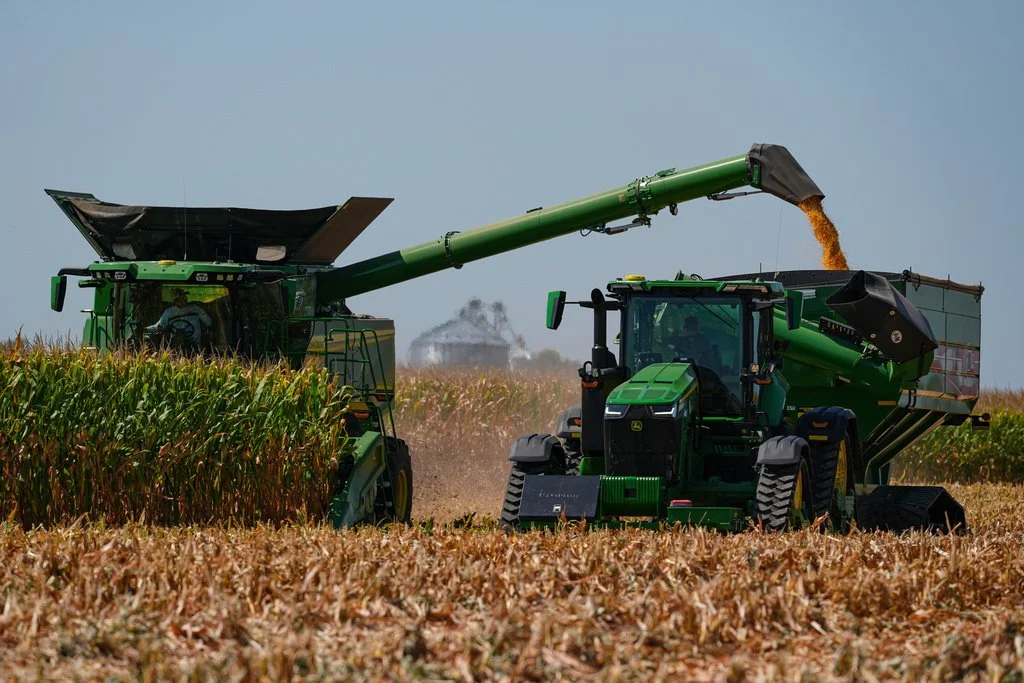
Brian Warpup offloads corn as he harvest on his farm in Warren, Ind., Thursday, Sept. 11, 2025. (AP Photo/Michael Conroy)
In August 2025, news reporter Hugh Cameron published an article in Newsweek titled “It’s the Worst Time to Be an American Farmer in Decades.” He cited a number of threats, including rising debt, declining commodity prices, and labor shortages. The struggle has only intensified since the US and Israel attacked Iran in February 2026. With the Strait of Hormuz closed, the crucial farming inputs of fertilizer and fuel have skyrocketed in price—adding to already difficult times for US farmers.
The US Department of Agriculture expects farm sector solvency and liquidity to worsen in 2026, as debt is forecasted to grow faster than assets, and farmers have less cash available to fund operations after covering their liabilities. John Boyd, a farmer and the founder of the National Black Farmers Association, warned that “Bankruptcies are on the rise and you will see many more on the auction block in the coming months.” The Kansas City Federal Reserve attributes rising debt in part to increased borrowing by small and mid-sized farms.
Boyd goes on to explain that, like many other farmers, he has recently been unable to secure an operating loan from banks—a necessity for covering daily expenses and maintaining working capital. He points to low commodity prices as the main cause. President Donald Trump’s tariffs have significantly disrupted trade with Mexico and China, the top importers of US corn and soybeans, respectively. As import costs have risen, foreign demand for these key crops has declined, driving prices down and further hurting farm profits.
Lastly, the US farm workforce appears to be shrinking. Michael Marsh, president and CEO of the National Council of Agricultural Employers, states that “The shortage of these workers is perhaps the most significant challenge facing US agriculture.” The California Farm Bureau attributes this to immigration enforcement, noting that “current immigration enforcement activity has caused disruptions to farming operations.” Recent raids conducted by Immigration and Customs Enforcement (ICE) have disproportionately affected farms, which rely heavily on a workforce that includes many unauthorized workers.
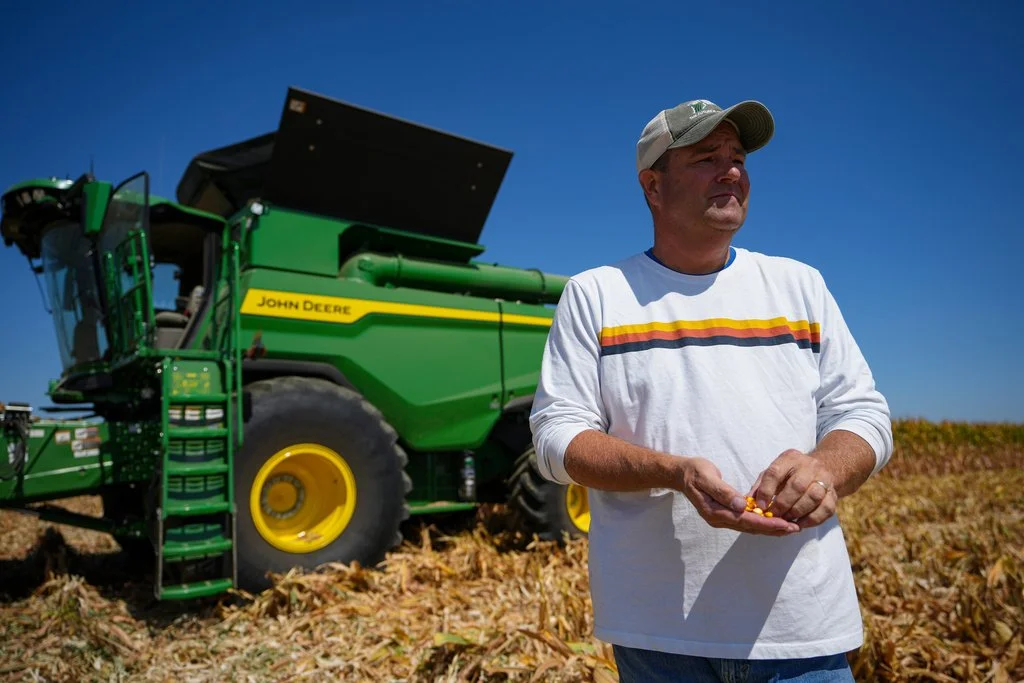
Brian Warpup pauses during harvest on his farm in Warren, Ind., Thursday, Sept. 11, 2025. (AP Photo/Michael Conroy)
With US farmers already under pressure, the Iran war has only exacerbated the situation
by driving up the cost of fertilizer and fuel. Fifth-generation farmer Doug Bartek explains, “Our biggest struggles are our inputs, be it fertilizer, seed, chemical, parts… There has been so much drastic markup in all of these.” Gasoline and diesel, both essential for farm equipment, have surged in price since the start of the war, only easing slightly after the ceasefire announcement in early April. The conflict has created a major supply crunch, as facilities in the Middle East critical for exporting fuel and chemical inputs have been damaged.
The outlook for fertilizer prices is even worse. When the Strait of Hormuz closed in late February 2026, the market reacted sharply. Nitrogen fertilizer, an essential input for corn, jumped more than 30% in price. The ceasefire did little to bring prices down, as the current price still reflects the war’s risk premium and uncertainties. Timing has made the situation even more difficult. With the Northern Hemisphere planting season already underway, farmers who did not purchase fertilizer in advance now have no choice but to absorb these elevated prices, further straining already limited liquidity across the sector. The farmers who use fertilizer expect to shift to growing mostly soybeans rather than corn to reduce input costs. However, soybean prices remain low, in part because China has increasingly turned to Brazil for imports, leaving US farmers with fewer profitable options.
US farming’s persistent challenges, now compounded by new ones, carry serious consequences, including higher food prices, reduced access, and a decline in both variety and quality compared to the American standard. Washington has responded, though critics argue not at a scale that matches the crisis. In December 2025, Trump announced $12 billion in emergency aid to farmers scheduled for distribution by late February 2026. However, farm advocates and policy experts say the relief is structurally mismatched to the realities farmers face. Much of the funding is directed toward commodity corn and soybean producers, largely bypassing specialty crop farmers—those growing fruits, vegetables, and nuts—whose products account for more than a third of US crop sales. Beyond the allocation problem, experts argue that it fails to address the root of the crisis. Jonathan Coppess, an associate professor of agriculture policy at the University of Illinois, explains, “The payments are not fixing the underlying problem.” Instead, government funding is often used to pay down existing debts rather than offset lost income or rising input costs. With no clear end to the Iran war, the Trump administration has begun exploring alternative fertilizer sources, including imports from Venezuela or Morocco.
Even if the Iran conflict ends cleanly, the damage to the 2026 growing season is already done. Although the Strait of Hormuz has reopened following a temporary ceasefire, fertilizer prices have not dropped accordingly. The risk premium built into input costs remains, and the supply chain damage from Iran's strike will take time to repair. The Iran war has revealed how fragile the nation's food security is, and how farmers who feed the country have been asked, for years now, to absorb the shocks.