
The Border Stops at the Bank: Washington's Cartel-Finance Blind Spot
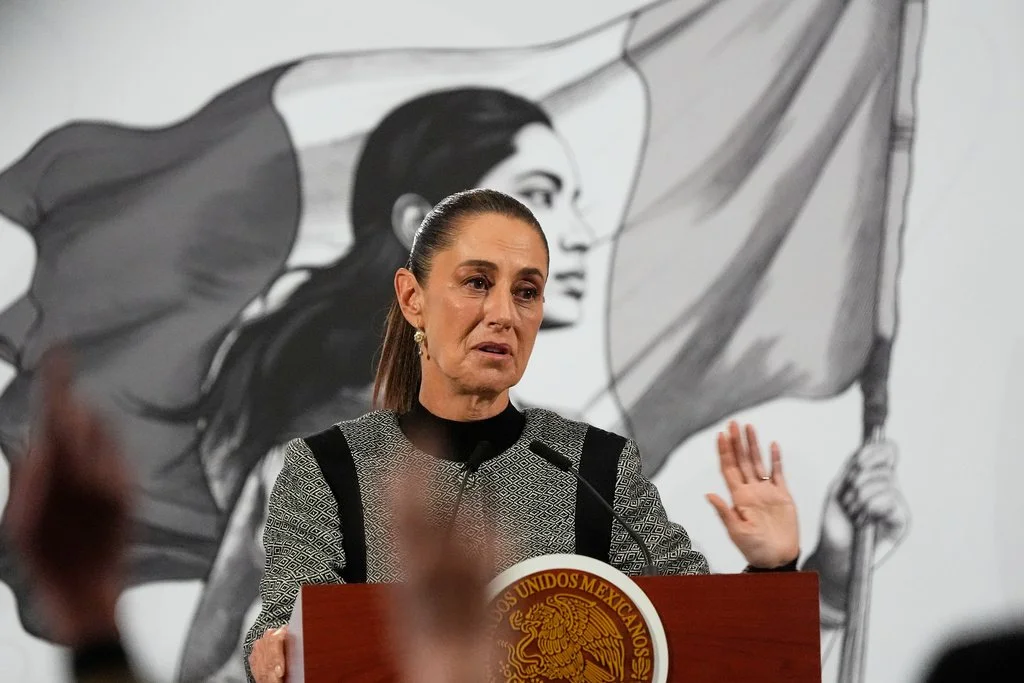
Mexican President Claudia Sheinbaum speaks during her daily morning press conference at the National Palace in Mexico City, Nov. 28, 2025 (AP Photo/Marco Ugarte)
“Where is the effort being made to stop the drug cartels and distributors in the United States? What’s going on with money laundering in the United States?” Mexican President Claudia Sheinbaum asked at her Sept. 17 morning press conference.
She was responding to a presidential determination that President Donald Trump sent to Congress two days earlier. The determination said Mexico’s security investments are “insufficient to sustain and expand its campaigns against narcoterrorists, their finances, and their criminal networks.” It also accused corrupt Mexican officials of having “betrayed their own country’s security and sovereignty.”
The exchange is part of a sustained US pressure campaign. Since January 2025, the US government has designated eight Mexican cartels as foreign terrorist organizations, while Secretary of State Marco Rubio has suggested the United States can and should act unilaterally against cartels on Mexican territory. Sheinbaum, who opposes any US intervention, denounced remarks from DEA head Terry Cole as a baseless ‘political statement’ about Mexico. Washington has already intervened in Mexico’s financial system.
On June 25, 2025, the Treasury Department’s Financial Crimes Enforcement Network (FinCEN) barred US financial institutions from moving funds to and from several Mexican banks: CIBanco, Intercam, and the brokerage Vector. The orders were the first use of new powers under the Fentanyl Sanctions Act and the FEND Off Fentanyl Act.
FinCEN found that the three firms are the “primary money laundering concern in connection with illicit opioid trafficking.”
Mexico’s National Banking and Securities Commission took temporary control of CIBanco and Intercam, and the government placed its own representatives in key management roles. CIBanco, which held nearly 28 percent of Mexico’s trust market, sued the U.S. Treasury in federal courts in Washington. It argued that the order was issued “without prior notice, without an opportunity to defend itself, and based on vague accusations.”
The bank later dropped the suit, and Grupo Financiero Multiva bought its trust business. In April 2026, FinCEN amended its order to allow CIBanco’s liquidation.
FinCEN’s own findings place much of the laundering north of the border. An August 2025 FinCEN advisory found that Chinese money laundering networks “play a vital role in laundering Cartels’ drug proceeds in the United States.” It described money mules depositing cash at US banks, networks recruiting bank employees as “complicit insiders,” and cashier’s checks made out to shell companies the networks secretly own.
The advisory also notes that Mexico’s 2010 limits on US cash deposits, which cap individuals at $4,000 a month, led cartels to seek out launderers operating in the United States. A FinCEN analysis of suspicious transaction reports filed from 2020 to 2024 flagged large cash deposits that did not match the depositors’ reported incomes.
At a House Financial Services subcommittee hearing in June 2026, Representative Zach Nunn (R-Iowa) said these networks include “over 40,000 shell companies that are operating right here in the United States today.”
The largest US enforcement case shows how such money moves. In October 2024, TD Bank, the US arm of Toronto-based TD Bank Group and the 10th largest bank in the United States, became the first US bank to plead guilty to conspiracy to commit money laundering.
A TD Bank location, Wednesday, June 24, 2026, in Boston. (AP Photo/Charles Krupa)
According to the Justice Department, the bank left 92 percent of its transaction volume, about $18.3 trillion, unmonitored from 2018 to 2024. One network moved more than $470 million through its branches after giving employees $57,000 in gift cards. TD agreed to pay about $3.09 billion in penalties and accepted an independent monitor and a cap on its US growth. Senator Elizabeth Warren (D-Mass.) noted that structuring the plea through the bank’s holding company meant regulators were not legally required to move towards terminating the bank's charter.
At the same hearing, witness Leland Lazarus urged Congress to “restore and strengthen beneficial ownership transparency.” Two months later, the Treasury moved in the opposite direction.
On August 11, Treasury issued a final rule permanently ending the requirement for US companies to report their owners to FinCEN under the Corporate Transparency Act, a 2021 law meant to eliminate anonymous shell companies. FinCEN also said it would delete ownership information already filed by US citizens.
Banks must still identify the owners of their business customers. But a May 2026 Government Accountability Office (GAO) report found the exemptions remove more than 99 percent of entities previously required to report to the federal registry. The GAO concluded that US shell companies can pose significant illicit finance risks and asked the Treasury to identify steps to limit that exposure. The Treasury disagreed.
Announcing the rule, Treasury Secretary Scott Bessent said that the department was eliminating a burdensome reporting requirement “without compromising our national security.” The policy shift comes a year after FinCEN, a bureau of the same department, had warned that cartel-linked networks were moving proceeds through US bank accounts and shell companies they secretly owned.