
Freedom Shield 26 Kicks Off Amid Growing Ally Unease Towards US Capability for Two-Theater Conflict in Iran and China
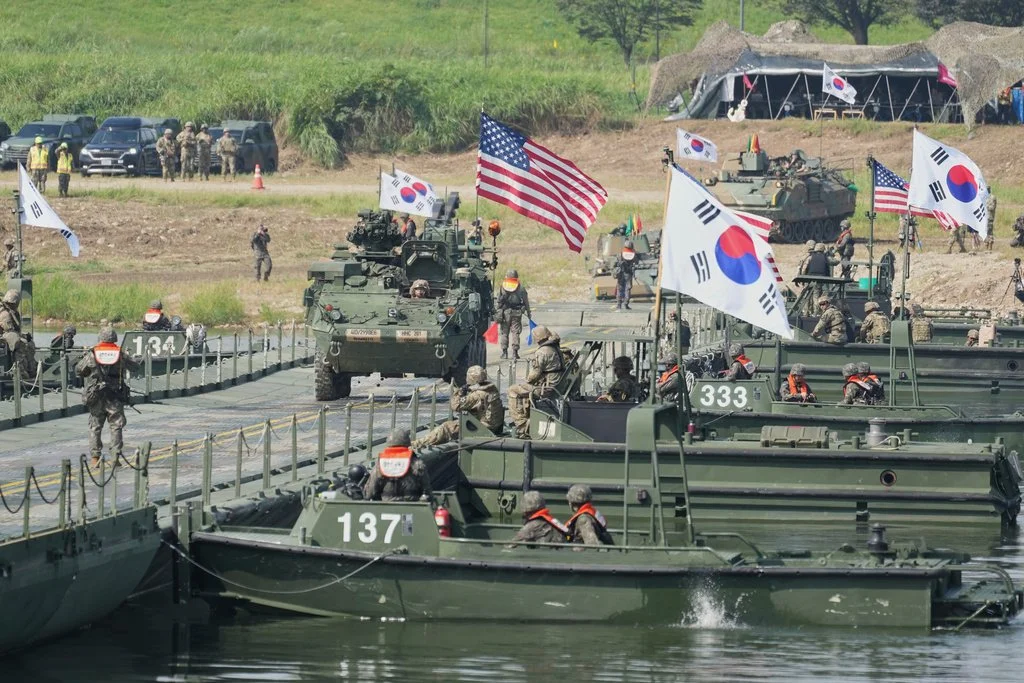
A vehicle from U.S. Army's the Stryker Combat Team crosses a floating bridge on the Namhan River during the combined river-crossing drill between South Korea and the United States as a part of the Ulchi Freedom Shield 25 in Yeoju, South Korea, Wednesday, Aug. 27, 2025. (AP Photo/Lee Jin-man)
Carrying from March 9 to March 16, Freedom Shield 26 is the annual US-South Korea military exercise that serves as a defensive drill meant to improve combined defensive military capabilities. South Korea’s Joint Chiefs of Staff has said about 18,000 Korean troops will take part, while USFK hasn’t confirmed the number of American troops. The operation, which is politically underscored to enhance defensive posture, is largely computer-simulated and designed to test the allies’ joint operational capabilities while incorporating evolving war scenarios and security challenges.
The military exercise takes place amidst continuing escalation in Iran as Washington increases funds to the region. The first week of fighting having already cost the US $11.3 billion, in turn causing Asian allies to question if Washington will be able to handle the Iranian War while maintaining a China-first defensive posture.
Freedom 26 now takes center stage to demonstrate to East Asia what exactly US military commitments will look like amid speculations that the US is "stretched thin.” These concerns intensified after The Korea Times noticed the absence of General Xavier Brunson, commander of the United States Forces Korea (USFK) and the Combined Forces Command (CFC), at the operational briefing of Tango bunker near Seoul for the first 45 hours of the exercise, which began Tuesday evening. A USFK representative said Brunson received the briefings remotely from USFK headquarters at Camp Humphreys, 40 miles south of Seoul in Pyeongtaek, and insisted the USFK remains committed in the region.
The unease in the reliability of US force is shared throughout the region. Japan has sought assurance from Washington that it would not shift US military assets away from the Indo-Pacific. During a meeting that gathered on Monday (Mar 2) at the ruling party's offices in Tokyo, Japanese officials questioned US bureaucrats about Iranian evacuation plans, energy stocks, and the legal basis for U.S. action. At the meeting, these concerns were reinforced by a report from the Center for Strategic and International Studies, which found about 40% of operation ready U.S. navy ships are currently stationed around the Middle East, and the only U.S. carrier deployed in Asia, the George Washington, is undergoing maintenance at its base in the Japanese city of Yokosuka. The lack of military power is further emphasized by delays in Japan’s delivery of hundreds of Tomahawk missiles ordered from the United States, as reported by the Center for Strategic and Budgetary Assessments. The ongoing Iran conflict is depleting reserves of US munitions, prompting Washington to ask defence firms to increase production.
Bryan Clark, a former US defense official specialising in naval operations at the Hudson Institute, adds “The U.S. Navy is stretched thin,” and that “The fleet ... is not sufficient to keep a steady presence in every theatre." Affirming the theory that if the Iranian conflict drags on, the US could draw down its naval strength in Asia to reinforce the Iran conflict.
Taiwan trumpets similar unease with Chen Kuan-Ting, a ruling party lawmaker in Taiwan, articulating “We hope this [Iran] operation is fast, limited, and that resources can be promptly shifted back to Asia” and that “A prolonged conflict could harm "stability and peace in the Indo-Pacific.”
The implications of the Iran conflict extend beyond the Middle East, as Beijing is now watching the region with the confidence of having previously taken advantage of US strategic distraction. Jennifier Parker, a former warfare officer with the Royal Australian Navy, pointed to China’s rapid militarization in the South China Sea islands, while the US was engaged with the Afghan War.
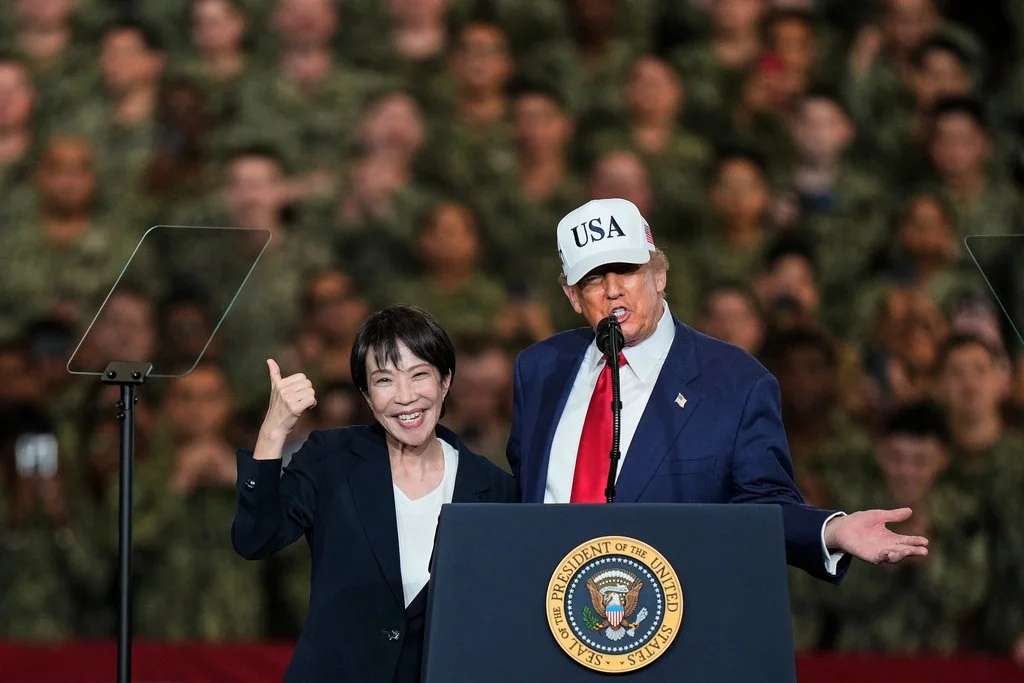
FILE - Japanese Prime Minister Sanae Takaichi gestures as U.S. President Donald Trump delivers his speech during their visit to the aircraft carrier USS George Washington at the U.S. Navy's Yokosuka base in Yokosuka, south of Tokyo, on Oct. 28, 2025. (AP Photo/Eugene Hoshiko, File)
However, as gas prices rise at home, pressure on oil resources is felt everywhere, with some analysts suggesting that by targeting Venezuela and Iran, Trump has weakened two of the cheap oil sources on which China previously depended. With some even suggesting the military actions are part of a master plan to contain China, following the Department of Defense's China First policy maintained at the beginning of the year.
Either way, as the US is being perceived as “stretched thin,” East Asian allies will continue to watch for concrete proof that Washington can uphold deterrence. The central question is whether US support will remain consistent or become more conditional and politically sequenced. As Freedom 26 continues, eyes will shift to Washington’s pending $14 billion US arms package for Taiwan, including PAC-3 and NASAMS air defense missiles, with an additional $6 billion in asymmetric capabilities. Observers are particularly watching whether approval of the package will be conditioned or delayed in light of Trump’s planned March 31 to April 2 trip to Beijing to meet President Xi Jinping.