
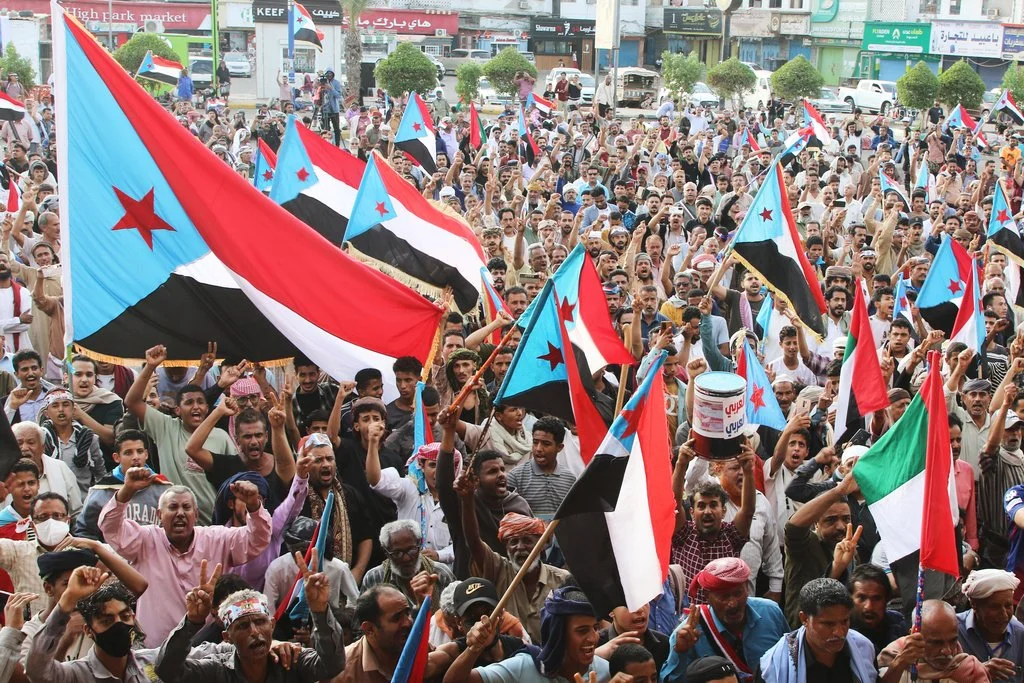
Supporters of the Southern Transitional Council (STC), a coalition of separatist groups seeking to restore the state of South Yemen, hold South Yemen flags during a rally, in Aden, Yemen, Friday, Jan. 2, 2026. (AP Photo)
ADEN, Yemen — Jan. 9, 2026 Following the collapse of its military positions, the Southern Transitional Council (STC), a UAE-funded proxy force in Yemen, announced its dissolution, while its leader, Aidarus al-Zoubaidi, charged with treason by the Saudi-backed, Yemeni Internationally Recognized Government (IRG), fled to Abu Dhabi. Riyadh launched strikes on STC positions in Wadi Nahb in Hadhramaut, striking UAE-linked weapons shipments in the port of Mukalla, and eliminating the STC forces, which had been an ally of the IRG just months earlier. The turn marked a stunning rupture in the Gulf alliance between the UAE and Saudi Arabia, which had been allies, as they have attempted to diversify away from oil economies. Over recent years, the UAE and Saudi Arabia have indirectly competed for power over the Arab world. Yemen has long been a battleground, where both have competed for control of the vital trade route and control of the Bab el Mandeb.
Both the United Arab Emirates and Saudi Arabia initially aligned in opposition to the Houthis, an Iranian-backed movement that rapidly gained control across Yemen. In 2014, Houthi fighters seized the capital, Sanaa, toppling the government of President Abd Rabbuh Mansur Hadi. By early 2015, Hadi had fled south to Aden as the group consolidated its hold on the north. On March 26, 2015, Saudi Arabia launched a military intervention, assembling a regional coalition aimed at eliminating Houthi gains and countering Iranian influence on the Arabian Peninsula. The UAE joined, viewing Yemen not only as a security interest but also as a strategic opportunity. Control over the Bab el-Mandeb and access to Red Sea shipping lanes have long been perceived as Yemen's most valuable resources, and offered the UAE the potential to expand its regional influence beyond oil. Over the following decade, Yemen fractured into distinct zones of control. The Houthis, aligned with Iran, entrenched their authority in the north, including Sanaa, governing the majority of the population. The internationally recognized government, backed by Saudi Arabia, maintained a foothold mostly in the east. Meanwhile, the STC, supported by the UAE, consolidated control along the southern coastline.
The war between the Houthis and the Saudi-backed government had largely stabilized since 2022, due to a UN-brokered ceasefire. In 2023, Houthi forces declared war on Israel in support of Hamas forces and the Palestinian cause. By October 2025, the Israel-Hamas ceasefire allowed Yemen to refocus on its ongoing civil war. While the Houthis had been gaining strength and support in Yemen, the STC and IRG had remained stagnant. The STC saw the opportunity to seize strategic positioning, launching an assault on the IRG’s eastern territories, seizing Hadhramaut, which is home to nearly 80% of the country’s oil reserves. On Dec. 2, 2025, the STC launched a large-scale offensive called "Operation Promising Future," sending troops against government positions in the Hadhramaut Governorate. STC forces advanced swiftly, and by Dec. 8, had seized control of nearly all the governorates that once formed South Yemen, including the entire southern coastline, the border region with Oman, and the oil fields in Hadhramaut Governorate. The STC's strategy was focused on consolidating power within the territory of the former South Yemen, while intentionally avoiding conflict with the Houthis. This decision collapsed the Gulf coalition against the Houthis.
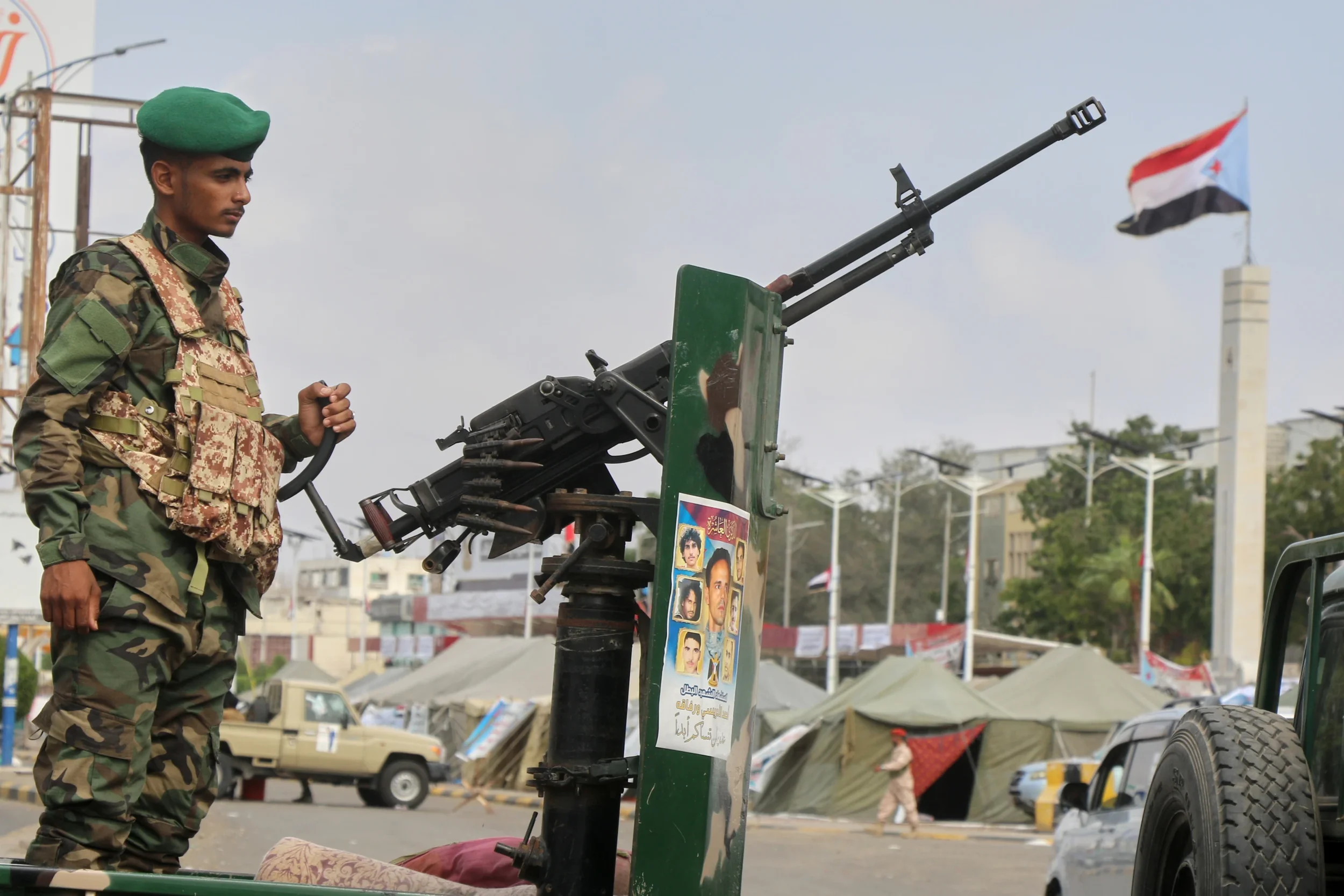
A Yemeni soldier of the Southern Transitional Council (STC) stands at a checkpoint in Aden, Yemen, Wednesday, Dec. 31, 2025. (AP Photo)
Following the attack, Riyadh demanded the STC withdraw, conducting airstrikes on STC positions, including strikes in Wadi Nahb in Hadhramaut and on the port in Mukalla, alleged to contain UAE-supplied weapons. On Dec. 30, 2025, the Saudi-backed Yemeni government canceled its joint security agreement with the UAE and ordered the withdrawal of all remaining Emirati forces within 24 hours. The Saudi military counter-offensive then dismantled the STC's gains and began advancing on STC territory held before the Dec. offensive. By Jan. 7, government forces had begun entering Aden, the STC's capital, and the force collapsed. STC leader Aidarus al-Zoubaidi was removed from the Yemeni Presidential Council, charged with treason, and fled to the UAE. On Jan. 9, the STC announced its own dissolution following the loss of all of its Yemeni territory. Some analysts argue that the separation between Saudi Arabia and the United Arab Emirates has weakened the Yemeni coalition, enabling the Houthis to consolidate control and potentially go back on the offensive within Yemen. As the Iranian link of proxies has weakened since Oct. 7, the Houthis stand as the only force stronger than they were before the conflict started. While the conflict has strengthened the Houthis, the current Iran-Israel-US conflict leaves the state of Iran in question. As Iran emerges weakened from the conflict, the shift in the Middle East’s balance of power will only further intensify the Saudi-Emerati rivalry