
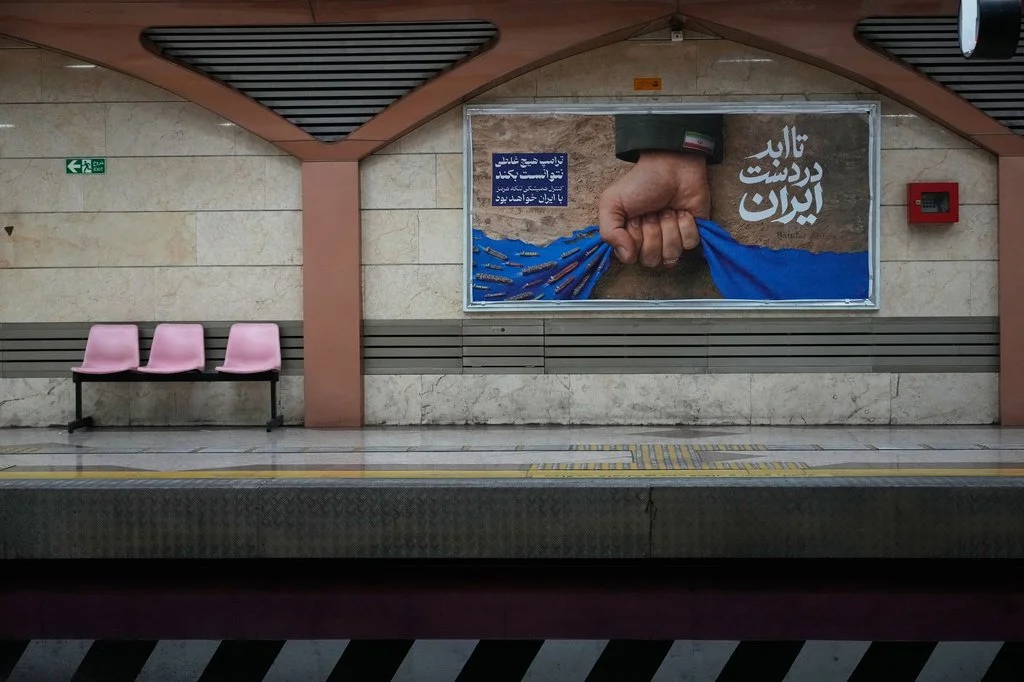
In an empty subway station, a billboard depicting a military hand gripping the Strait of Hormuz is displayed with Farsi text reading, "In Iran's hands forever," "Trump couldn't do a damn thing," and "Control of the Strait of Hormuz will be Iran's forever," in Tehran, Iran, Friday, April 17, 2026. (AP Photo/Vahid Salemi)
Iran does not have to win, it merely has to survive.
While the U.S. and Israel initiated the war with Iran anticipating a quick victory, Tehran has demonstrated that, despite its weakened odds, its ability to strategize over the long-term is more important than mere strength and capabilities. The U.S. is on a path to setting a dangerous precedent, one where blatantly aggressive foreign policy will result in the abandonment of the U.S. as a reliable global partner.
Iran’s Context
To the outside world, following a month-long wave of protests reaching every province of Iran, it truly appeared like the country was undergoing a domestically ignited revolution. The January 2026 protests did not occur in a vacuum, they were the culmination of frustration with record-breaking inflation and long-held civil discontent with the Islamic Republic. While unsuccessful in thawing the regime, the protest’s momentum did demonstrate to domestic hardline officials that Iranians were no longer willing to be complacent. They were prepared to risk their lives in the thousands for a government that was truly representative of their political aspirations. The mass killing of peaceful protesters only served to strengthen citizens’ desire to mobilize against the regime.
These existing political instabilities were exacerbated by the spiraling devaluation of the Iranian Rial, which was virtually worthless by late February. The U.S. administration took notice of these vulnerabilities within the regime. With so many issues at home requiring attention, on paper, if there was a time to strike Iran, it would be now—when Tehran’s resources are spread thin, and its domestic legitimacy is at an all-time low. This is what the U.S. administration likely thought in the days leading up to its “preemptive” strikes on Iran. While Tehran appeared weak on paper, it was these very conditions that led Iran to have the upper hand in the 2026 U.S.-Israel-Iran War.
The War and Its Impacts
On the morning of February 28, 2026, the U.S. and Israel launched an illegal preemptive attack on Iran, initiating what would develop into a broader regional war resulting in direct attacks on every Gulf State, a global energy crisis, and a disruption in roughly 20% of the world’s crude oil supply.
Shortly after the initial strike, Iran retaliated by launching missiles and drones at US military assets in the region. The US Navy’s Fifth Fleet in Bahrain, bases in Qatar, Kuwait, and the UAE were some of the first assets to be targeted, causing $800 million in damage within the first two weeks of the war. As the conflict escalated, civilian infrastructure was also targeted in the Gulf countries, with attacks extending to Saudi Arabia, Jordan, Israel, Oman, and Iraq. Bader Mousa Al-Saif, a professor at Kuwait University, said that “It behoves all the countries in the region to rethink the model,” echoing the sentiments of Gulf States amid these attacks, as many reconsider whether having a U.S. military presence in the region genuinely leads to greater regional stability.
As of early April, analysts at think tanks predict the war will have lingering repercussions defining decades to come for U.S. foreign relations and the global energy sector. The effects of Tehran’s near-full closure of the Strait of Hormuz have been felt in nearly every part of the world through rising oil, gas, and consumer good prices, most notably in Asia, which receives roughly 90% of its oil through the Strait.
Ceasefire Developments
On April 7, Donald Trump released a statement, warning that “a whole civilization will die tonight, never to be brought back again.” Most world leaders and leading figures criticized the administration’s threats, which made no distinction for civilians. Some critics even argued that the statements amounted to a declaration of intent to use nuclear weapons. One thing remains indisputable: “threatening genocide works,” journalist Judith Levine best iterated. Whether Trump intended to act upon this threat of genocide or not is of no relevance. What is of importance is his unpredictable nature. It is perhaps a strategy, never affording full certainty of the extent to which he will follow through with his statements. This unpredictability is what brought Iran to the bargaining table, with a ceasefire having been instated just hours before Trump’s civilization-ending deadline. According to Trump, “The reason for doing so is that we have already met and exceeded all Military objectives, and are very far along with a definitive Agreement concerning Longterm PEACE with Iran, and PEACE in the Middle East.”
Pakistan, serving as the intermediary between the U.S. and Iran, hosted peace talks later that week. Crucial to the failure of these talks was Israel’s absence. As a key actor responsible for initiating the conflict, and when many of Iran’s demands in its proposed 10-point peace plan hinged on Israel’s cooperation, Tel Aviv’s absence from these discussions almost made the Pakistan talks bound to fail.
The two-week ceasefire is still officially in place and from the U.S. perspective, has been abided by all parties since this agreement was reached on Apr 7. However, fighting in Lebanon between the Israeli Defence Forces (IDF) and Hezbollah has continued amid this ceasefire. Since Iran views the Lebanese front as part of the broader US-Israel-Iran war, Tehran considers Israel to have violated the ceasefire agreement through its continued bombardment of Southern Lebanon.
Most recently, on April 13, Trump imposed a blockade on Iranian ports, followed by a statement warning that “if any of these ships come anywhere close to our BLOCKADE, they will be immediately ELIMINATED. As long as the U.S. Navy prevents any ships intending on using Iranian ports from passing through the Strait due to “Iranian extortion,” tensions will continue escalating without a definitive end.
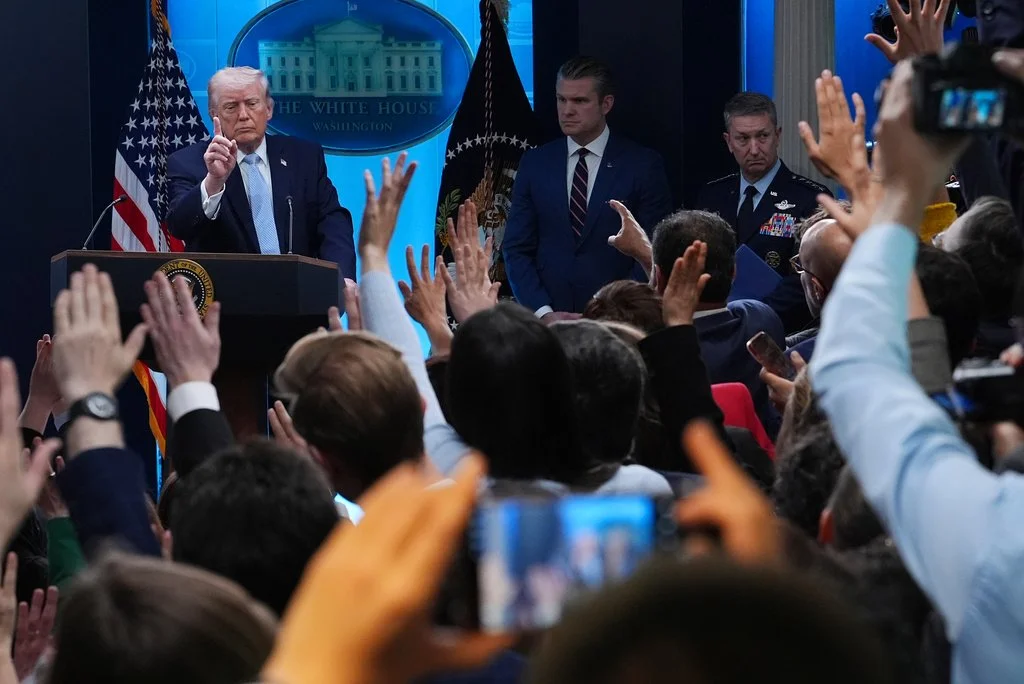
President Donald Trump gestures while speaking with reporters in the James Brady Press Briefing Room at the White House, Monday, April 6, 2026, in Washington. (AP Photo/Julia Demaree Nikhinson)
On the Lack of US Strategy
Clarity and consistency are critical for building audience-wide political support for military objectives, constants which the Trump administration has been incapable of providing over the last few weeks in their scramble to put together a rationale for the war. This is just one of the factors leading to the war’s overwhelming disapproval among U.S. Americans. One Atlantic piece by Marie-Rose Sheinerman and Isabel Ruehl found that the administration provided 10 different reasons for initiating the war in just six days. Among those reasons for initiating the war, Trump cited an imminent threat, nuclear weapons, the elimination of proxies, regime change, election interference, and peace in the region. While some of these rationales may justify government action, each situation is unique and therefore requires a different approach. There is not a one-size fits all for achieving all of these objectives in one fateful sweep. Despite the rhetoric that the administration has been pushing, it is not shooting two birds—or in this case 10—with one stone. Instead, the administration’s shifting rationales are indicative of a lack of strategic planning, one where new objectives were raised in the effort to justify continued attacks, rendering the U.S.’s long-term strategic planning infeasible. Americans feel this chaos and disorganization. To compensate for these domestic and global audience costs, the U.S. administration must constantly adjust its reasoning for continuing this war, each time in a manner that will make the U.S. position appear more favorable and, most importantly, in a way that will subtly quell U.S. voters’ discontent.
Perhaps the U.S. administration’s only strategy was bombing Iranian civilian infrastructure from its regional bases, a tactic that has emboldened Iranians, most of whom are not hardliners, in their animosity with the U.S., despite its intent to crush morale. By aiming to collapse the Islamic Republic, the U.S. has bombarded Iran’s intellectual hubs—Isfahan, Tehran, Mashhad, and every other major urban center—where the most prominent figures resisting the regime reside. Trump has ingrained resentment among the very population he needs in order to actually have an organic regime change. There is little that can be said for how U.S.-Israeli attacks on Iranian infrastructure will lead to a permanent cessation of attacks on Gulf countries and the securing of the Strait, inherently giving Iran the upper hand in strategy.
Iran’s Strategy
When domestic morale is low, Tehran has nothing to lose, placing all its bets on the table, a calculation the Trump administration either failed to make or severely underestimated when bypassing congressional approval on Feb 28, initiating the war. The US administration likely underestimated Iran due to its domestic instability stemming from its crippled economy and public discontent. However, it was these very conditions that led Iranian hardliners to hedge their bets, meticulously formulating a long-term strategic response in a way that could legitimize the Islamic Republic and strengthen their financial circumstances.
In retaliation against the illegal U.S.-Israeli preemptive strikes, Tehran targeted U.S. military assets in the Gulf States as well as civilian infrastructure. In these attacks, Iran launched thousands of drones and ballistic missiles, each drone costing not more than $50,000 to manufacture and each missile costing not more than $2 million, by some estimates. Despite 80-90% of missiles and drones being intercepted by Gulf States, Tehran maintains a strategic advantage by exhausting the defense systems and revenue streams that finance them. The Patriot air defense system, used by the UAE, Saudi Arabia, Qatar, Kuwait, and Bahrain, can cost over $3 million per shot, and oftentimes, it takes multiple interception launches to down one comparatively cheap Iranian missile or drone. Despite the current Gulf ceasefire, there are concerns that if strikes in the region were to resume, Gulf States would be vulnerable because they are running low on defence interceptors.
Tehran has also strategically leveraged the Strait in a manner that not only serves to weaken the position of its adversaries but also to strengthen its own standing. While the U.S. tries to garner a semblance of a strategy, Iran has turned the Strait into a unilateral economic generator. Despite popular rhetoric, the Strait is not entirely closed. Allies or those deemed neutral to Iran, such as Pakistan, India, the Philippines, and China, among others, have been granted safe passage. For those countries which Iran does not deem as friendly, there is a $2 million toll in exchange for crossing the Strait. This fee, paid in Chinese Yuan, serves to weaken the U.S. Dollar while building up the severely weakened Iranian economy. Though few ships have thus far paid the fee, the strategy signals long-term thinking, a muscle yet to be flexed by the U.S. administration in this war.
Looming Outcomes
A little over a week into the ceasefire, there are growing concerns about the parties’ inability to come to a permanent resolution. Some fear Trump might mobilize the 50,000 troops (and counting) in the region for a ground invasion. Others predict that Tehran will more aggressively respond to the US blockade at the conclusion of the two-week peaceful period.
Former director of the National Counterterrorism Center, Joe Kent’s resignation on March 17, validated long-held sentiments regarding the unnecessary nature of the conflict. Kent stated in his resignation letter: “I cannot in good conscience support the ongoing war in Iran…Iran posed no imminent threat to our nation, and it is clear that we started this war due to pressure from Israel and its powerful American lobby.”
There is no going back to before the U.S. launched its act of aggression. The U.S. must manage to the best of its ability the consequences that result from this policy decision, both internally and externally. Domestically, the government will have to pursue policy objectives that quell rising inflation and the prices of consumer goods, and the incumbent party will suffer in the next elections. In the sphere of foreign policy, if the U.S. wants to strengthen its relationship with its allies, it would have to put in a lot of work to show it is a stable and reliable partner. This comes after the major blow to European countries following Trump’s resurging threat to leave NATO when members did not agree to Trump’s request for countries to cooperate with military engagements against Iran.
Now, the U.S. is essentially negotiating for the conditions that existed before the war, including the opening of the Strait and the cessation of strikes on U.S. assets in Gulf States. Meanwhile, Iran has seized upon this opportunities to fulfill objectives it has sought for decades, including the lifting of all sanctions, U.S. military withdrawal from the Middle East, the release of frozen Iranian assets, and continued Iranian control over the Strait of Hormuz, among other points found in Iran’s proposed 10-point ceasefire plan. While prior geopolitical conditions would have rendered the U.S. budging on any of these propositions inconceivable, the current situation has weakened the U.S. stance on Iran and what it is willing to bargain in order to see an end to the ramifications of the conflict. Pressure from Gulf allies and audience costs incurred domestically from the continuation of this conflict are factors that have led to the weakening U.S. position.
Due to the externalized effects of this war, the impacts of unrestrained aggression in U.S. foreign policy are more evident than perhaps ever before. Iran recognizes this and is using the U.S.’s waning international legitimacy against it, strengthening Tehran’s odds.
With little to lose, Iran is going all in. Now, for the U.S., it is just a matter of whether it is willing to recognize that it has committed a grave error and take steps to amend its relationship with the Americans who put their trust in the system. The administration will also have to rebuild trust with the international community, which, for over half a century, viewed the U.S. as an exemplary model. On the contrary, if the U.S. continues on this path of blatantly aggressive foreign policy, it will be setting a devastating historical precedent for the future, poorly impacting its relations with the world and domestic stability.
There are a myriad of ways this war could end. While perhaps none of these scenarios will result in an objectively victorious Iran, its ability to merely survive, exhaust U.S. assets, prolong global energy disruptions, and weaken the U.S.’s global image constitutes a win for Tehran, demonstrating how strategy trumps strength.