
China Expands Economic and Diplomatic Role in the Middle East
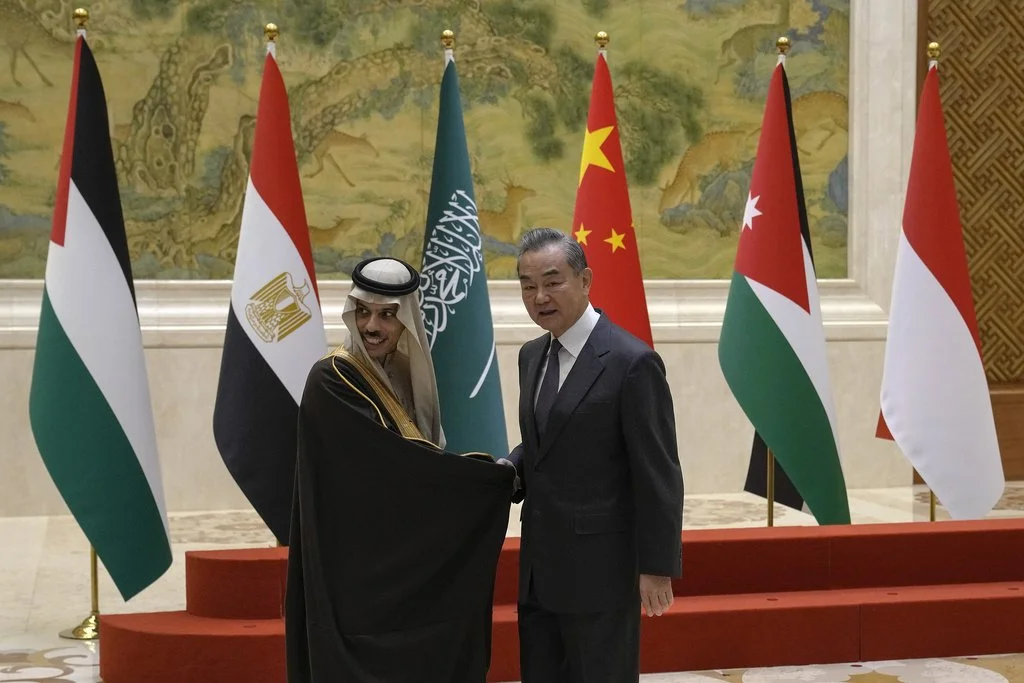
Chinese Foreign Minister Wang Yi, right, shakes hands with Saudi Arabia's Foreign Minister Faisal bin Farhan Al Saud as he welcome five Arab and Islamic counterparts at the Diaoyutai state guesthouse in Beijing, Monday, Nov. 20, 2023. China's foreign minister welcomed five Arab and Islamic counterparts to Beijing on Monday, saying his country would work with "our brothers and sisters" in the Arab and Islamic world to try to end the fighting in Gaza as soon as possible. (AP Photo/Andy Wong)
In March 2023, China brokered an agreement between Saudi Arabia and Iran to restore diplomatic relations. This marked a shift from China’s traditionally economic role toward a more visible diplomatic presence in the region, demonstrating Beijing’s increasing diplomatic presence in the Middle East.
In recent years, China has increased its presence in the Middle East through infrastructure investment, energy partnerships and trade. As part of its Belt and Road Initiative, Beijing has financed ports, industrial zones and transportation networks across the region. According to The Brookings Institution, Beijing has expanded its economic engagement in the region while maintaining a limited security presence. In this way, Beijing has expanded its influence without assuming the costs associated with military commitments.
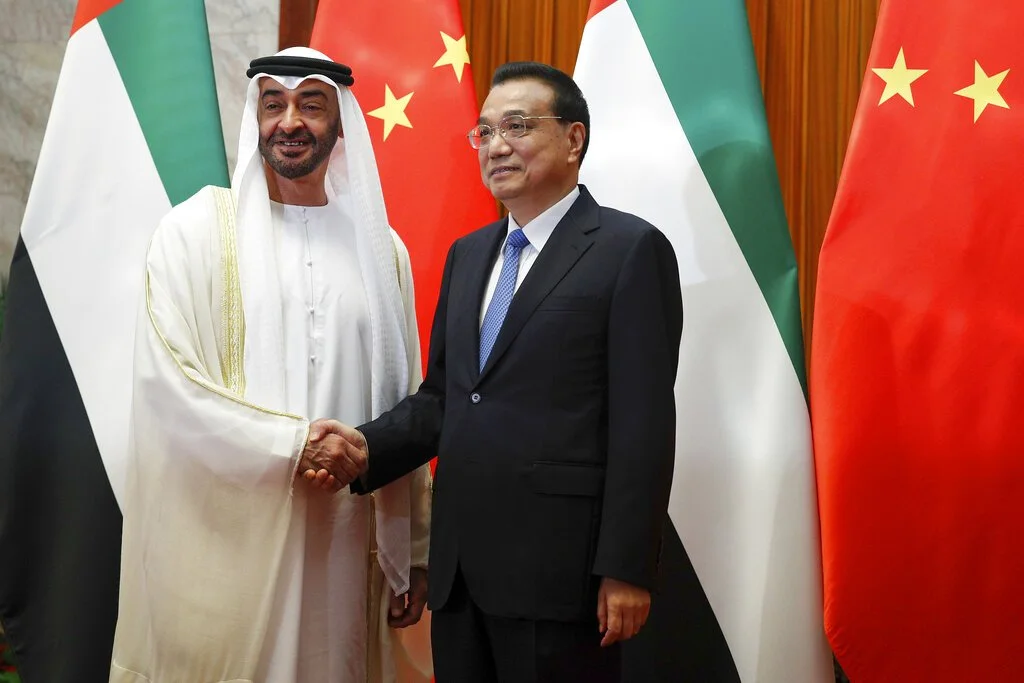
Abu Dhabi's Crown Prince, Sheikh Mohammed bin Zayed Al Nahyan, left, and Chinese Premier Li Keqiang pose for journalists before a meeting at the Great Hall of the People in Beijing, Monday, July 22, 2019. (AP Photo/Andy Wong, Pool)
Energy remains central to China’s strategy in the Middle East. The Middle East supplies a significant share of China’s oil imports, and Beijing has strengthened ties with major producers such as Saudi Arabia, the United Arab Emirates and Iran. These long-term agreements deepen interdependence, positioning China as a critical partner for regional energy producers. Beijing has also pushed to internationalize its currency through the incorporation of the yuan in energy trade transactions, reflecting China’s efforts to reduce reliance on the US dollar. This may create incentives for regional producers to deepen economic ties with China, further integrating Beijing into the region’s energy and financial systems.
China’s diplomatic activity has also increased. Mediation, traditionally associated with Western powers, is a role Beijing has shown willingness to assume, as demonstrated by the Saudi-Iran agreement. This model of engagement contrasts with Western approaches by prioritizing economic cooperation over political conditionality. Analysts note that China’s diplomatic approach emphasizes economic cooperation and non-interference, aligning in part with broader international engagement strategies, but differing from the United States by prioritizing economic ties over security commitments and political conditionality.
The United States has maintained a longstanding security presence in the Middle East through military bases, defense partnerships and direct involvement in regional conflicts. In contrast, China has avoided deep security involvement. This limits Beijing’s ability to shape outcomes in active conflicts, where military leverage remains decisive. At the same time, this restraint allows China to avoid the financial and political costs associated with direct military involvement. According to the Brookings Institution, Beijing has expanded its economic footprint while maintaining limited security commitments. This division of roles suggests that China benefits from regional stability largely maintained by US security commitments.
For regional actors, this creates a more complex environment in which they must balance economic ties with China and security partnerships with the United States. Rather than replacing existing alliances, China’s expanding presence adds an additional layer of engagement. This reflects a hedging strategy, where states diversify partnerships to maximize economic and security benefits. This highlights that regional states are not passive recipients of influence but active actors shaping external engagement.
China’s growing role in the Middle East does not yet challenge US security dominance, but analysts note that it reflects an emerging model of influence rooted in trade, investment and diplomacy. This suggests a regional order shaped by coexistence between economic and security powers rather than outright replacement.