
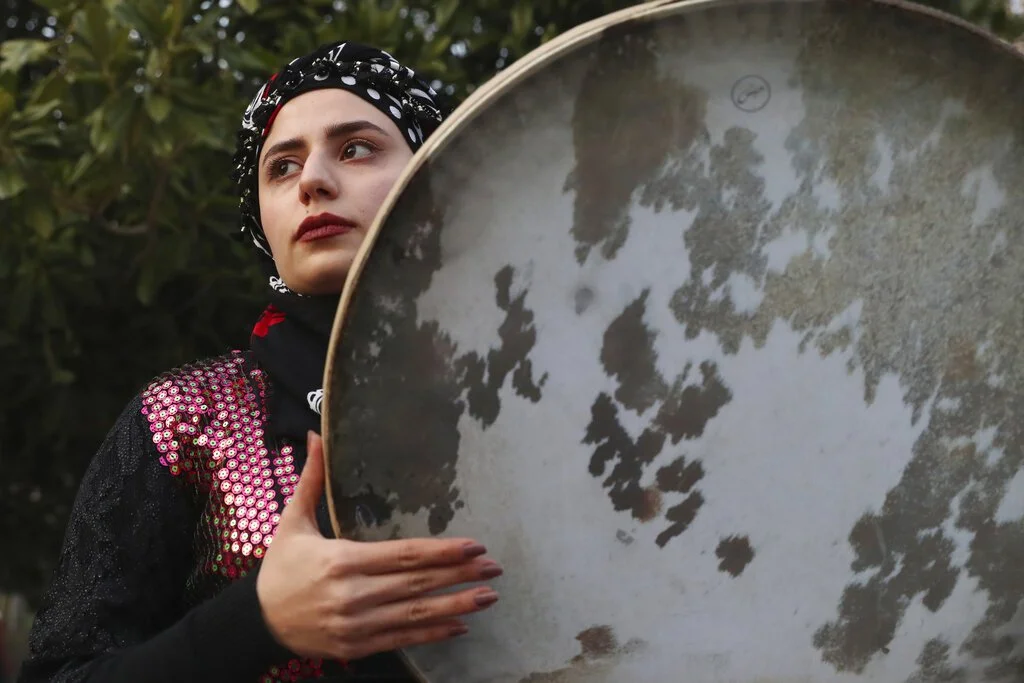
An Iranian Kurd musician in traditional attire plays a Daf, a hand-held Persian drum, in a public celebration of the ancient feast of Yalda, at the Saadabad Palace in northern Tehran, Iran, Saturday, Dec. 21, 2019. Every year on Dec. 21, Iranians commemorate the ancient and auspicious winter solstice, also known as Yalda Night, which is regarded as a felicitous farewell to fall. People munch on nuts and eat fresh fruits, especially pomegranate and watermelon, at extended family gatherings while marking the longest night of the year, a recognition of the symbolic victory of light over darkness. In the past, people listened to tales and poems recited by elders, which rarely happens in recent years. (AP Photo/Vahid Salemi)
Since the beginning of the US-Israeli war on Iran in February 2026, the campaign faced a major hurdle in its attempt to dislodge the Islamic Republic: the regime still had the monopoly of force within Iran’s borders. Yet, a potential Kurdish insurgency in Western Iran could either be the decisive factor in helping the US and Israel overthrow the Islamic Republic of Iran or risk further repression of the Kurds, potentially dragging Turkey into the conflict and escalating regional tensions.
The Zagros Mountains of Western Iran have been home to the majority of Iranian Kurds who resisted the rule of the central government. Iranian Kurds are a part of the Kurdish People, the world’s largest stateless nation, and a major ethnic group in the Middle East. Iranian Kurds, in their aspirations for autonomy, have long been the most vocal and organized opposition to the Islamic Republic, as well as victims of the regime’s worst repressions. The massacre of protestors in January 2026 that killed more than 30,000, after a nationwide uprising in Iran caused by political repression and hyperinflation, was most severe in the Kurdish regions of Iran. Resulting from decades of repression by the Islamic Republic, elements of the Iranian Kurdish population have waged an insurgency against the state for decades. For Iranian Kurds, the 2026 Iran War presents a unique opportunity in their quest for independence: The Iranian regime, for the first time, appears to be too embattled to suppress a Kurdish armed uprising. Public opinion polling shows that many Iranian Kurds believe that a Kurdish success could inspire other minority and opposition groups within Iran to rise against the Islamic Republic, taking advantage of its weakness from the war to challenge its hold on the country. For the Kurds, this war is the best chance they have to break free from the Iranian regime’s rule. Yet, the greatest opportunity often accompanies the greatest risk, and for Iranian Kurds, Iran as a country, and the wider region, turning an air and naval war into a war on the ground poses real risks.
As the US speculates whether to arm the Iranian Kurds or not, distrust between the Iranian regime and Iranian Kurds, as well as Kurdish groups in other countries, inevitably emerges. The government in Tehran, knowing that it’s distracted and in a relatively weak spot domestically, is keen to prevent the eruption of a Kurdish uprising. In the early days of the war, commanders of Iran’s IRGC traveled to Iraq to warn Baghdad’s government about the involvement of Iraq’s autonomous Kurdish region in helping channel US and Israeli support to Iranian Kurdish militants. The relationship between Iranian Kurds and the US-Israeli war effort has the potential to backfire on the project of overthrowing the Iranian regime, as Iran’s ethnic Persian majority may be compelled to “rally around” the regime in fear of Iranian Kurdistan splitting off from Iran. Iraq is also concerned about the prospect of being dragged into the war. Baghdad has tried to maintain its delicate independence in an increasingly volatile region, and it is keenly aware of the risk of Iranian reprisals on Iraqi Kurds if they were found to cooperate with Iranian Kurds to try to overthrow the regime. Therefore, both Iraq’s central government and its Kurdish autonomous polity are deeply conflicted. On the one hand, due to a shared sense of kinship and US pressure, Iraq’s Kurds may feel prompted to support Iranian Kurds, but on the other hand, Iraqi Kurds may not want to risk their hard-won autonomy and Iraq’s delicate stability for the sake of their neighbours. Therefore, Iraqi Kurds are likely to declare formal neutrality.
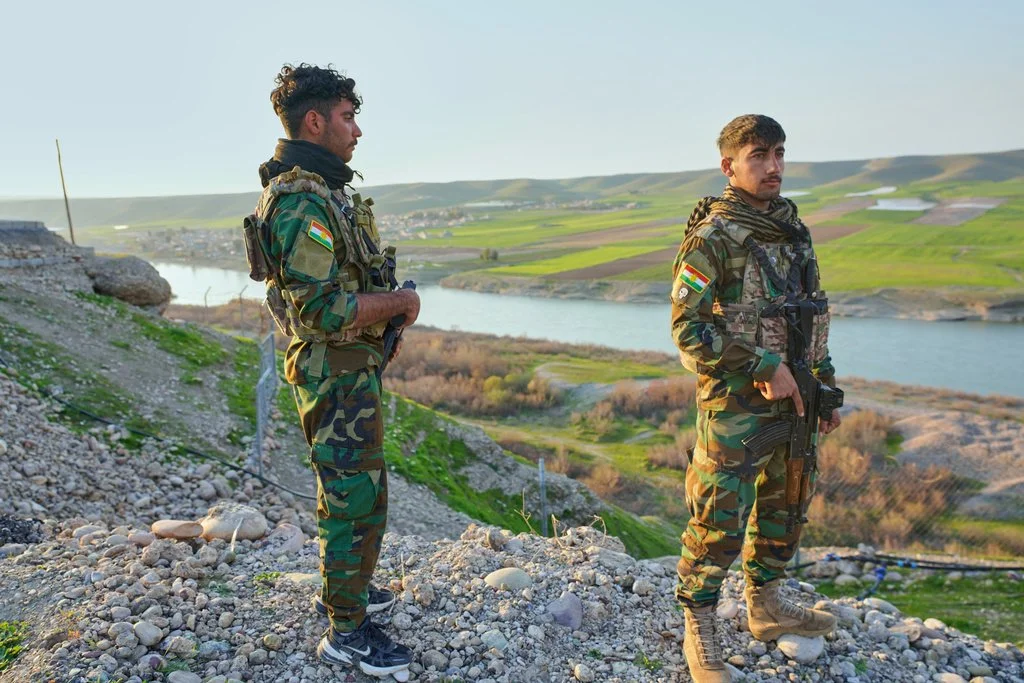
Members of the Kurdistan Freedom Party PAK stand guard in Irbil, Iraq, Thursday, March 5, 2026. (AP Photo/Rashid Yahya)
For the Middle East, a Kurdish rebellion in Iran risks drawing in the region’s biggest military powerhouse: Turkey. Home to the largest Kurdish population in the world, the Kurdish question is especially sensitive for Turkey, which has faced its own Kurdish insurgency. To prevent the Kurds from establishing a stronghold in neighbouring countries that could strengthen Turkey’s Kurdish rebels, the Turkish military launched repeated incursions in Iraq and Syria to strike Kurdish forces. The worst-case scenario for Turkey would be state collapse and fragmentation in Iran, as an autonomous Iranian Kurdistan risks becoming a source of Kurdish insurgency that will cross the border into Turkey and reignite the dormant Kurdish insurgency there. In May 2025, Turkey’s main Kurdish insurgent group the PKK (Kurdistan Workers’ Party) disbanded under a ceasefire deal with the Turkish government, but tensions remain as members of the PKK could splinter and continue their armed resistance to the Turkish state. This ceasefire also shows that though facing volatile economic and political conditions, the Ankarae still has the ability to mount an effective armed suppression of its Kurdish insurgency, making Turkey’s Kurdish conflict much similar to that of Iran. Therefore, fearful of any security implications resulting from a revitalized Kurdish insurgency in Southeastern Turkey, Ankara will likely not refrain from military intervention in Iran if there were to be a Kurdish revolt.This would undoubtedly escalate the war by drawing a regional powerhouse into it. Turkey’s intervention, armed or not, would escalate tensions in an Iran already battered by economic and ethnic clashes, raising the possibility of an all-out civil war that will potentially be an unprecedented humanitarian disaster.
Iran’s Kurds have suffered decades of repression by Iran’s clerical regime, and some of them see the 2026 war as a potential turning point towards self-rule. Yet, a Kurdish rebellion in Iran may pose significant risks for Kurds inside Iran as well as those in the wider region.