
Global Push to End Child Labor Stalls as Funding Cuts Threaten Hard-Earned Progress
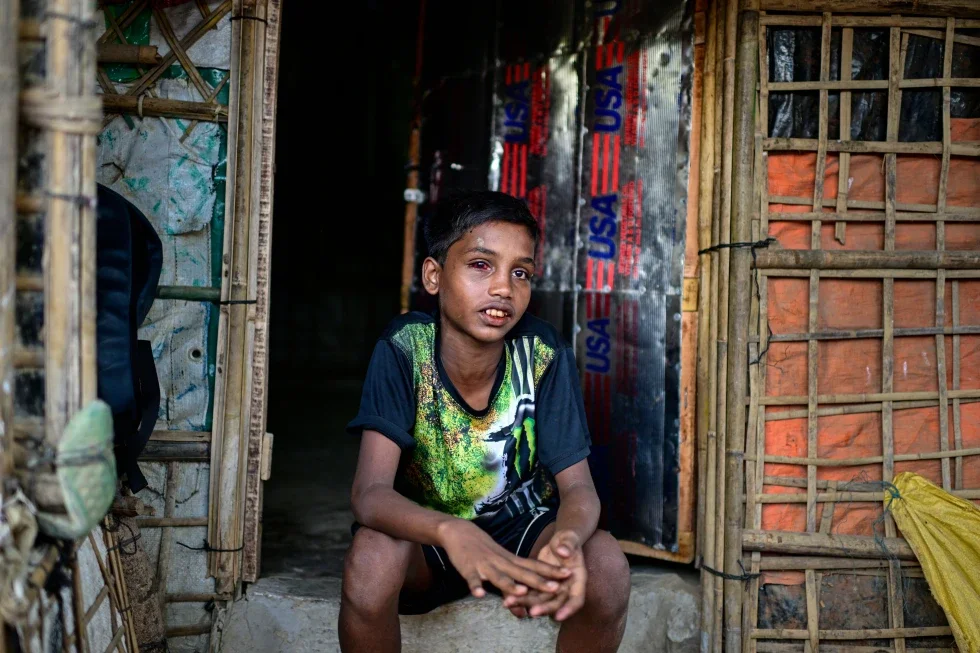
Thirteen-year-old Rohingya refugee Rahamot Ullah, his eye hurt after being struck by a bamboo stick while making his way through difficult conditions, speaks with The Associated Press at the Rohingya refugee camp in Cox’s Bazar, Bangladesh, on Friday, November 21, 2025. (AP Photo/Mahmud Hossain Opu)
The United Nations’ Sustainable Development Goal 8.7 set 2025 as the deadline to end all forms of child labor — a target the international community has now missed. Nearly 138 million children worldwide remain trapped in exploitative work. The international community remains divided on what actions should be implemented in response — with a sweeping new European Union trade regulation now at the center of this debate.
A joint report published June 11 by the International Labour Organization and UNICEF confirmed that the 2025 deadline has passed with the goal still unmet. The number of children working has almost halved over the span of 25 years, yet progress has stalled, and funding cuts by donor countries now threaten to undo these strides. Some 54 million children remain doing hazardous work in conditions that could harm their health and development.
In April 2024, the European Parliament approved the EU Forced Labor Regulation with 555 votes in favor and only six against. The law prohibits the sale, import, and export of any goods made using forced labor, including child labor, anywhere in the EU single market. It applies to all companies regardless of size or origin and takes effect in December 2027.
Under the regulation, EU member state authorities and the European Commission can investigate suspicious supply chains based on tips from whistleblowers, international organizations, or cooperating governments. Products found to involve the use of forced labor must be withdrawn accordingly from the market, and manufacturers must donate, recycle, or destroy them. Non-compliant companies face getting fined.
“This is a historic day,” said Samira Rafaela, rapporteur for the International Trade Committee, following this vote. “We have adopted a ground-breaking piece of legislation to combat forced labour worldwide.”
Human Rights Watch, which published a detailed analysis of the regulation in April 2025, said the law “can end the economic incentives that allow forced labor to persist by imposing significant financial and reputational risks” on companies that fail to act.
The ILO-UNICEF data paints a clearer picture of where child labor is concentrated and why. Agriculture accounts for a majority of cases, while about a quarter of working children are in services such as domestic work or street vending. Two-thirds of all child labor takes place in sub-Saharan Africa — approximately 87 million children — with prevalence declining only slightly over four years.
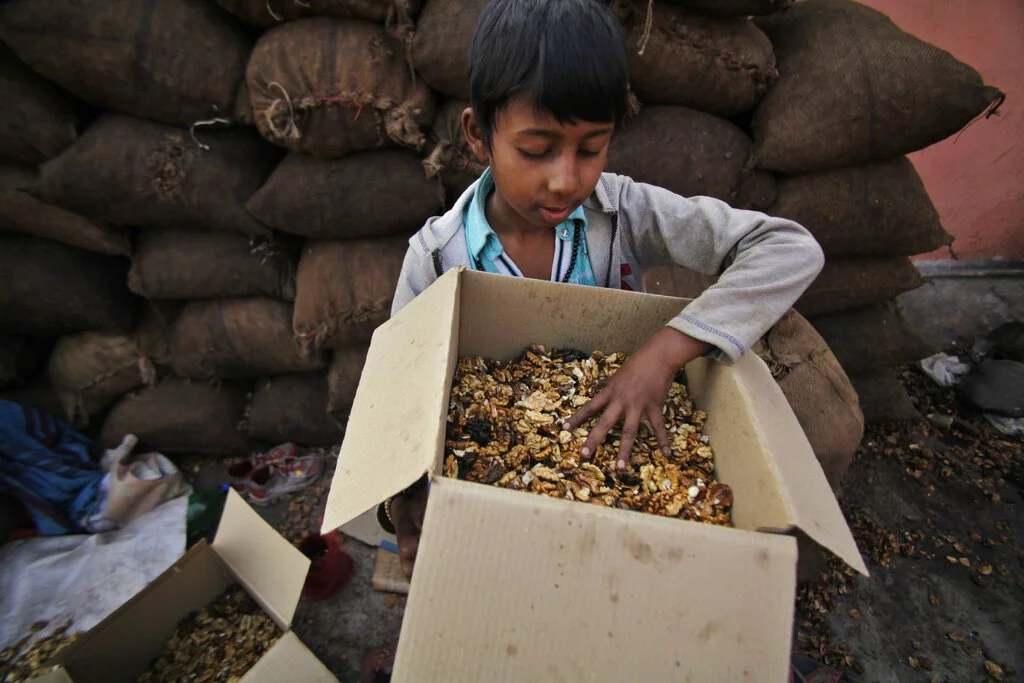
An Indian boy sorts walnuts as he works at a wholesale market on the outskirts of Jammu, India, Monday, Dec. 16, 2013. India's worrisome inflation rose to 7.52 percent in November, driven by soaring food and fuel prices, data showed Monday. Higher prices for food and fuel hit the hundreds of millions of poor Indians living on $2 per day particularly hard because they spend roughly half of their income on the staple items. (AP Photo/Channi Anand)
Although child labor has decreased by 22 million since 2020, ILO Director-General Gilbert F. Houngbo cautioned against blind complacency. “The findings of our report offer hope and show that progress is possible,” he said in a statement. “We still have a long way to go before we achieve our goal of eliminating child labour.”
UNICEF Executive Director Catherine Russell warned that donor funding cuts are placing those gains at risk, saying, “Reductions in education and livelihood support programmes risk forcing more vulnerable families to send their children to work.”
The Trump administration’s foreign aid cuts have prompted widespread alarm among UN agencies over their impact on development programs worldwide. While the ILO-UNICEF report stopped short of naming those cuts explicitly, the connection is difficult to ignore: Russell called on governments to recommit to “legal safeguards, expanded social protection, investment in free, quality education” — the very livelihood programs now being scaled back.
The contrast is stark: while the EU is tightening trade rules in an attempt to hold companies accountable, the international financing that supports the schools, cash transfers, and rural development programs, which actually reduce child labor, is shrinking.
The EU regulation has broad support among human rights organizations, but experts caution that trade restrictions alone cannot solve this problem, which is ultimately driven by poverty. The ILO and UNICEF have consistently framed child labor as a consequence of inadequate social protection and limited adult employment, which are conditions that import bans fail to directly address.
HRW acknowledges this reality, noting that the regulation is designed to complement, not fully replace, broader labor, development, and social protection frameworks.
Economists and development experts warn that removing a child’s income without providing an economic alternative does not eliminate the underlying poverty: it redirects it. Abraham Maslow identified food, shelter, and physical safety as the foundation of human survival, which is the baseline that must be met before anything else becomes viable. In low-income countries where a child's wages are what secures that foundation, a trade ban does not address the economic conditions that drive families into poverty in the first place. It removes the mechanism families are using to survive, and when that income disappears, some turn to informal or illegal economies, trading one form of exploitation for another. Enforcement measures originating in wealthy nations fail to account for these economic realities. With 138 million children still working and aid funding shrinking, the gap between ambition and resources remains wide.