
One Small Step for Abortion Rights in the EU
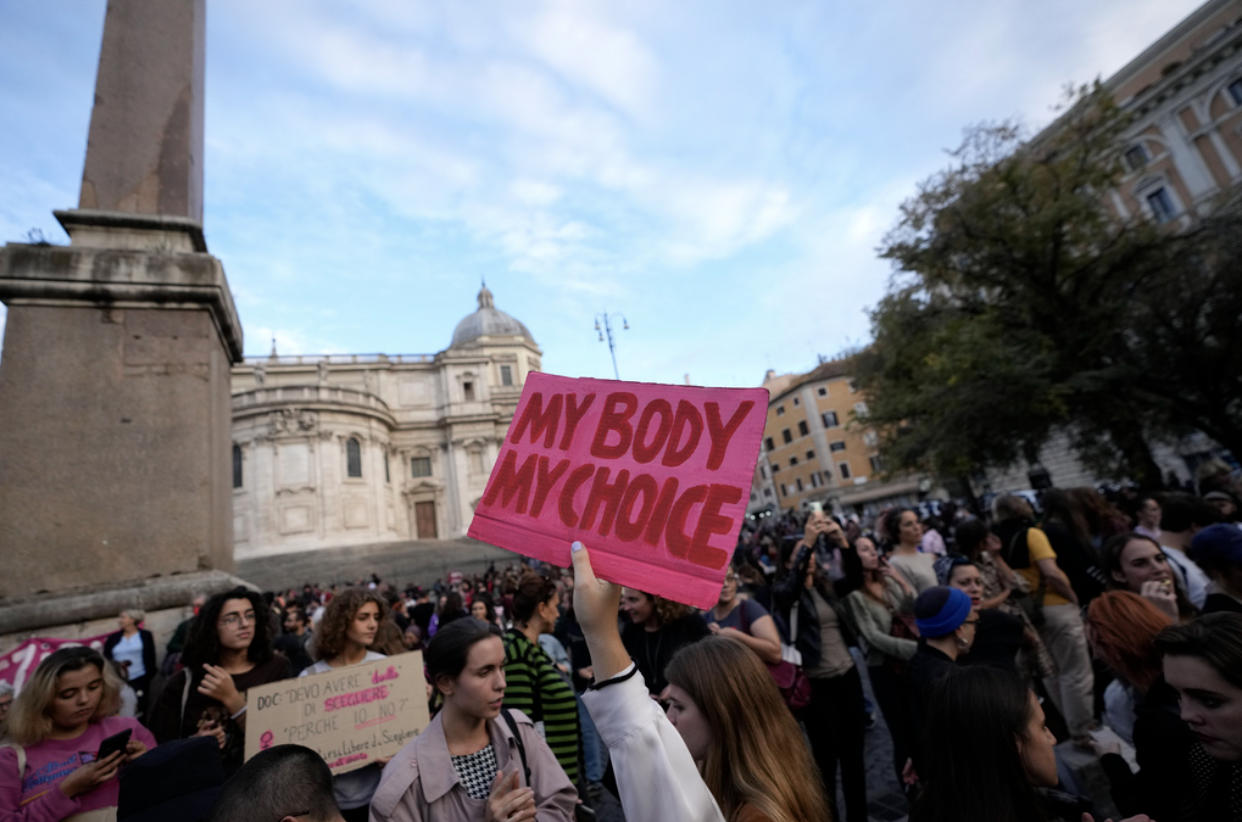
People stage a protest on 'International Safe Abortion Day' to ask for more guarantees on the enforcement of the abortion law in Italy, Apr 23, 2024. Photo: (AP Photo/Alessandra Tarantino)
On Feb. 26, the European Commission sanctioned the use of the European Social Fund by member states to fund safe and accessible abortions throughout the bloc. This ruling follows a petition from the European Citizens’ Initiative campaign, My Voice, My Choice, which requested that “the EU does what is in its power to ensure safe and accessible abortion for all.”
Bringing together more than 300 organizations and thousands of volunteers, My Voice, My Choice advocates for reproductive rights throughout the EU. The group estimates that more than 20 million women across the EU do not have access to safe abortion care. Finding it necessary to address this gap, they actively demand that everyone in the EU be able to have access to safe abortion care. Their latest petition, signed by over 1.2 million EU citizens across the 27 member states, inspired the European Commission’s newest legislation.
Under the landmark decision, member states may use the European Social Fund to support abortion services for women visiting from EU nations that restrict access to safe abortions. The services will be administered free of charge, in addition to costs allocated for transportation and accommodations. The funding derives from the Commission’s European Social Fund, the EU’s main instrument for investing in its citizens. With a budget of almost 99.3 billion euros for the period 2021-2027, the fund serves as an important agent for employment, education, and, now, abortion access for the member states.
This decision stops short of enforcing universal abortion access throughout the EU bloc. Because health policy rests at the national level, the responsibility now lies with member states to ensure these funds translate into meaningful improvements. Member states primarily enforce EU legislation by incorporating directives into national law and applying regulations domestically. The European Commission acts as the “guardian of the treaties,” monitoring compliance and initiating “infringement procedures” through the Court of Justice of the European Union if a state fails to implement laws correctly.
EU member states have the choice, not a requirement, to use existing European Social Funds to support access to safe abortions. This decision carries particular significance in the context of EU nations like Poland and Malta, which maintain highly restrictive abortion laws, permitting the procedure only in circumstances of medical emergency. Now, women in countries with abortion bans or limited access could seek help abroad in member states with broader abortion access, like the Netherlands, Sweden, and France, though many permit widespread conscientious objection by medical professionals, which can limit availability and delay care. Still, EU officials see the decision as a step in the right direction for expanding access.

European Commissioner for People, Skills and Preparedness Roxana Minzatu, right, and European Commissioner for Preparedness and Crisis Hadja Lahbib address the media on the Commission's response to the European Citizens' Initiative 'My Voice, My Choice' at EU headquarters in Brussels, Thursday, Feb. 26, 2026. Photo: (AP Photo/Virginia Mayo)
The Commissioner for Equality, Hadja Lahbib, states that the decision means “support for women who need to travel; support for women in their own country; support for women in remote areas; support for women without financial means, and that, in practice, “it means women will have better access to safe abortion care. Any vulnerable woman. Anywhere in Europe.”
Critics like Oliver Bault, director of communications at Ordo Iuris, a Polish anti-abortion legal advocacy group, argue that the policy undermines national sovereignty. He states, “Using the European Social Fund, arguing that it can be used for healthcare purposes, means making a joke of Europeans’ national laws."
Supporters counter the opposition by highlighting that the decision seeks to prioritize women’s health and access to care across the bloc. As conflicts and humanitarian crises continue to strain Europe, the ruling signals renewed attention to women’s rights.