
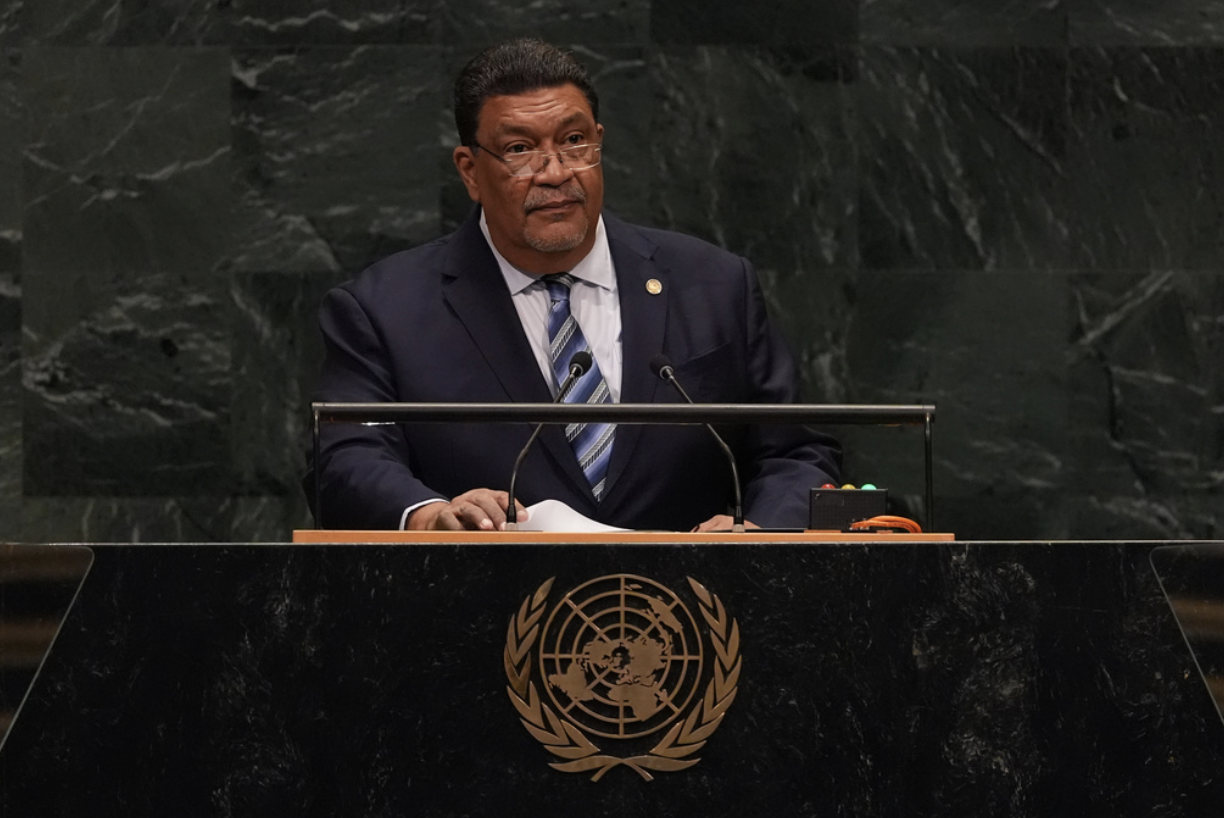
Nicaragua Foreign Minister Valdrack Ludwing Jaentschke Whitaker speaks during the 81st session of the United Nations General Assembly at United Nations headquarters, Saturday, Sept. 26, 2026. (AP Photo/Heather Khalifa)
United Nations experts have raised concerns surrounding Nicaragua’s government by stating that the co-presidents Daniel Ortega and Rosario Murillo run a dictatorship that there are “reasonable grounds to believe that crimes against humanity have been committed.”
This statement was presented to the UN Human Rights Council on Oct. 28 by the Group of Human Rights Experts on Nicaragua. The panel urged governments to pursue legal accountability for the government's actions dating back to events that occurred in April 2018, when protests ended in violence with an estimated 68 deaths according to local human rights groups. The Human Rights Watch said “The Nicaraguan government appears to have engaged in serious abuses against protesters and arbitrarily shut down media outlets covering the recent protests”. Nicaragua’s government rejects the allegations.
Ortega led Nicaragua from 1985 to 1990, and returned to the presidency in 2007, where he has remained since. In February 2025, constitutional changes made his wife, Murillo, co-president. An act which extended presidential terms and removed key checks on executive power, such as, legalizing a two-headed presidency, which allows the leaders to appoint an undetermined number of vice presidents. Ortega also stated that Nicaragua would never hold elections again. This new constitution altered 93.4% of the original, according to Confidencial Digital.
In the 2021 election, Ortega declared himself the winner after jailing every candidate who could have beaten him. A controversial act in which the international community described the vote as “illegitimate”, supported by the United States who does not recognize his presidency.
The situation in Nicaragua drew United Nations attention in April 2018, when protests over cuts to the social security system turned into broader demonstrations against the government. The response was a violent police crackdown that left hundreds dead and sparked global discussion on the force taken against protestors by the government.
The Human Rights Council created the Expert Group in 2022 to examine abuses since the 2018 protests. In examination, its reports have grown more severe. In February 2025, the experts warned that the constitutional redesign had gutted basic rights protections, saying “the regime of President Daniel Ortega and Rosario Murillo has deliberately transformed the country into an authoritarian state where no independent institutions remain.” The experts called for urgent international action.
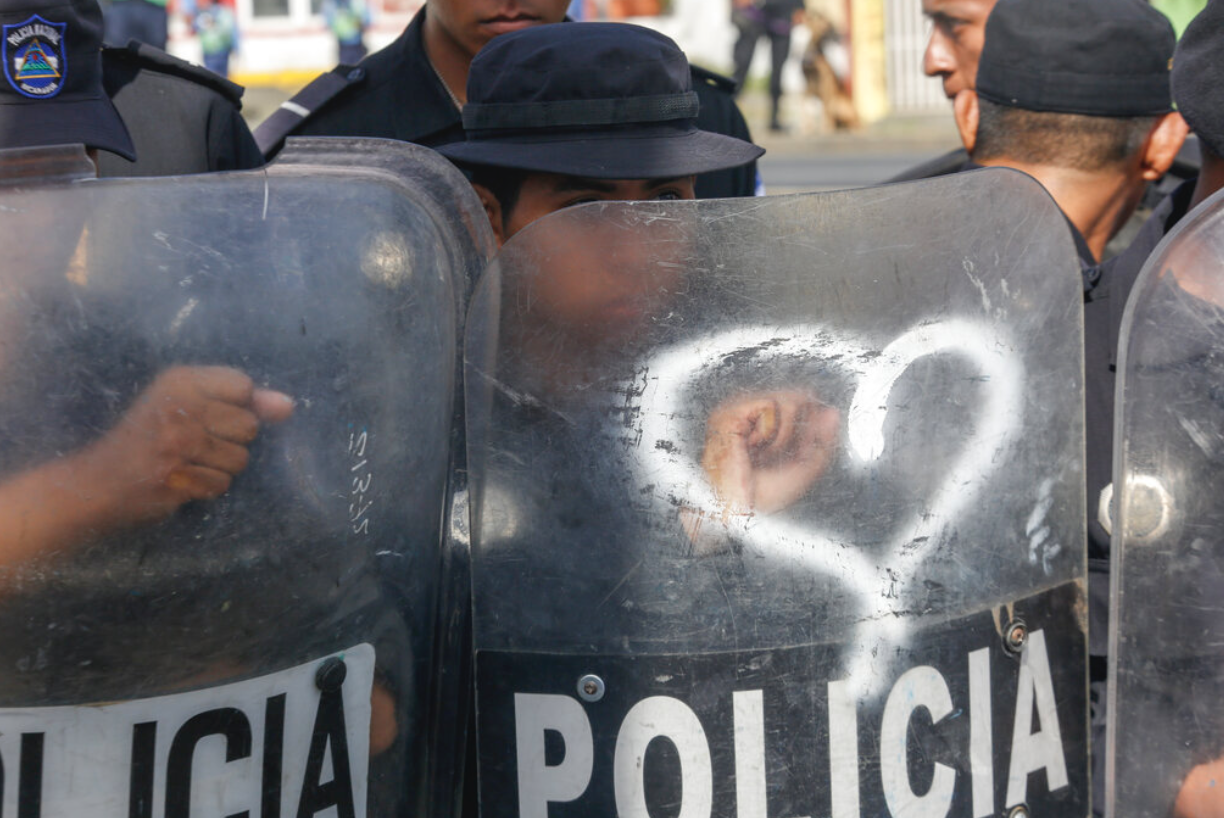
Nicaraguan riot police set up a shield wall as a group of doctors, nurses and medical students protest against the government of President Daniel Ortega, in Managua, Nicaragua, Saturday, Aug. 3, 2019. The Central American nation has been in crisis since April 2018, when protests erupted demanding Ortega's exit from office and early elections, with demonstrators accusing him of consolidating power and ruling in an authoritarian manner. (AP Photo/Alfredo Zuniga)
Nicaragua’s withdrawal from the Human Rights Council in early 2025 and its cutoff of cooperation with UN human rights mechanisms have left the experts building their case without access to the country. Despite this, the panel continues to make its claims.. The panel said Ortega and Murillo have run a systematic campaign to eliminate opposition. It cited arbitrary detentions, forced disappearances, political persecution and the stripping of citizenship from critics.
Additionally, a September UN report documented 161 cases of enforced disappearance since 2018 and at least eight deaths in custody among people held for political reasons, according to Latin Post. Among them was Brooklyn Rivera, a 73-year-old Miskito Indigenous leader whose death in detention was announced in May. In February, the panel had already named Ortega, Murillo and 52 other senior officials as apparently responsible for documented crimes, according to the same account.
Jan-Michael Simon, chair of the expert group, called the government a full dictatorship aimed at permanent dynastic rule. He said accountability “will come, whether inside or outside Nicaragua,” according to Latin Post. Reed Brody, another member of the panel, has urged governments to bring Nicaragua before the ICJ (International Court of Justice) over violations of the conventions on torture and statelessness, as he did in 2025. Nicaragua’s government dismissed the Human Rights Council as “manipulated, obsolete, and interfering”.
As the case against Nicaragua continues to develop, the international community awaits the outcome of the allegations brought by the United Nations.