
Hungary’s Divide Over Ukraine Outlasts Orban
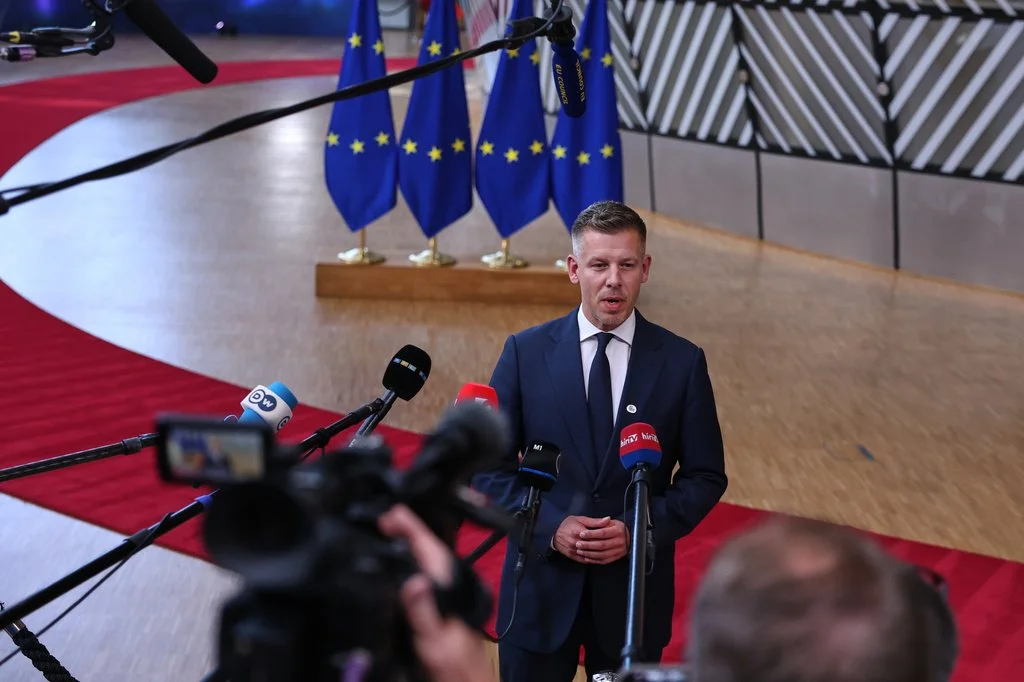
Hungary's Prime Minister Peter Magyar talks to journalists as he arrives for the EU summit in Brussels, Thursday, June 18, 2026. (AP Photo/Omar Havana)
When the Tisza party, led by current prime minister Peter Magyar, won a supermajority in Hungary’s national elections in April, ending Viktor Orban’s 16-year rule, many in Brussels and Kyiv hoped that Budapest’s hostility towards Ukraine would also come to an end. However, nearly six months after the election, not much action has been taken, and while the Hungarian government may have changed, Hungarian public opinion on Ukraine has largely remained the same.
Specifically, a post-election survey by the European Council on Foreign Relations (ECFR) conducted in late April found that only 27 percent of Hungarians support resuming Ukraine’s accession talks with the European Union (EU); meanwhile, 54 percent oppose them. Even Magyar’s own supporters are divided on the issue. The Kyiv Independent reports that 41 percent of Tisza voters support unblocking the talks, while 43 percent would oppose such a measure. Support for direct assistance to Ukraine is even slimmer, with just 12 percent of Hungarians backing military aid to Kyiv. However, simultaneously, 93 percent of Tisza voters expect relations with Ukraine to improve under Magyar, which may suggest that they want more favorable ties without real commitments.
Indeed, these numbers reflect years of cultural and political conditioning rather than any recent change under Magyar. Analysis from Euronews highlights that Hungarian attitudes towards Ukraine were largely formed in a media environment where Orban’s anti-Ukraine messaging was a daily occurrence, leaving a long-lasting impression that isn’t restricted to supporters of Orban’s Fidesz party.
Nonetheless, Magyar has softened Hungary’s approach to foreign relations with Ukraine. In early June, he removed Hungary’s veto on Ukraine’s accession to the EU, after reaching a deal with Zelenskyy on the rights of the large ethnic Hungarian minority in the Ukrainian province of Zakarpattia. This allowed the EU to swiftly open its first negotiating cluster. While a second cluster followed over the summer, Budapest has renewed objections to the remaining four. It has insisted that Ukraine codify the agreement it made regarding its Hungarian minority, as estimated 80,000 to 100,000 people, into formal law.
Magyar has also claimed that Hungary’s objections include an element of fairness to Balkan candidate states to the EU, arguing that fast-tracking Ukraine would be sidelining nations that have spent years pursuing their membership. However, there are notable skeptics to this line of reasoning. Daniel Hegedus, deputy director of the Institute for European Politics, said it is “very difficult to argue that the Hungarian government is acting in good faith,” questioning why Budapest did not raise similar concerns during Ukraine’s talks earlier that year.
Importantly, the divide has made Ukraine a political liability that Magyar must carefully handle as he navigates his first year in office. For instance, when Hungarian energy company MOL signed a memorandum in September to store Ukrainian oil in Hungary, Fidesz accused the prime minister of considering Ukrainian interests over Hungary’s. This led to Magyar ruling out the project. This incident coincided with Magyar’s snub of a regional summit that Ukraine hosted, which led to Ukrainian Foreign Minister Andrii Sybiha to criticize his “unnecessarily confrontational statements.”
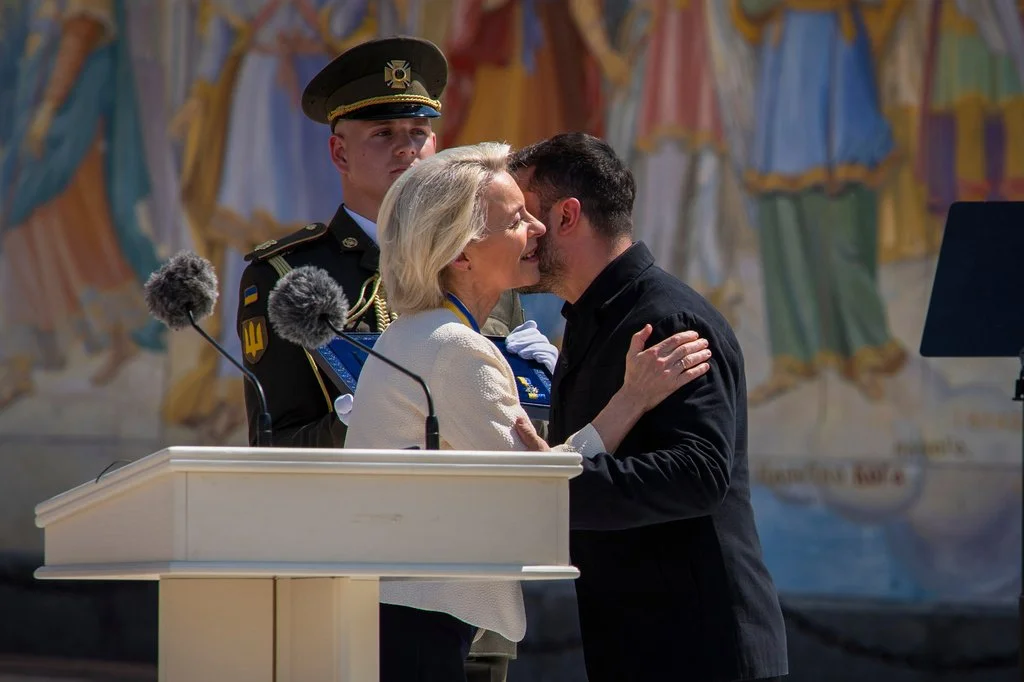
Ukrainian President Volodymyr Zelenskyy, right, greets European Commission President Ursula von der Leyen in Kyiv, Ukraine, Wednesday, July 15, 2026. (AP Photo/Dan Bashakov)
These incidents are especially interesting considering that Magyar has reversed course on many other Orban-era foreign policies. For instance, Hungary expelled 10 Russian diplomats in September and secured a deal to unlock 16.4 billion Euros in previously-frozen EU funds. However, analysts say he sees little to gain regarding Ukraine. Zsuzsanna Vegh of the German Marshall Fund argued that voter skepticism influenced his refusal to send military aid. In contrast, defending ethnic Hungarians abroad appears to be a popular interest of many conservative Hungarian voters.
Additionally, the divide shows how influential and deep-rooted Orban-era messaging has become. Ahead of the April election, Orban claimed that Hungarians would be conscripted and sent to Ukraine if his party lost. He had previously linked Kyiv’s attempt at EU membership to existing distrust of Brussels, which is prevalent among many conservative Fidesz voters in Hungary. The effects can be observed through recent data. A 2024 GLOBSEC survey found that Hungarians who trusted mainstream media were half as likely as the general public to see Ukraine’s future in the EU or NATO, which is the opposite of the pattern in other countries in the region. In other words, the Hungarians status quo prior to Magyar was skewed against Ukraine. It also draws attention to the political capital Orban and Fidesz held before their defeat in the election this year.
Ultimately, the gap between Hungary’s new government and the general public will matter the most in the long run. Kyiv reportedly hopes to bring its new minority education bill to parliament in the next few months. This may allow them to progress further in talks with the EU. However, Magyar has also pledged to put Ukraine’s eventual membership to a referendum. Ukraine may have won over Budapest for now. Winning over Hungarians will be much harder.