
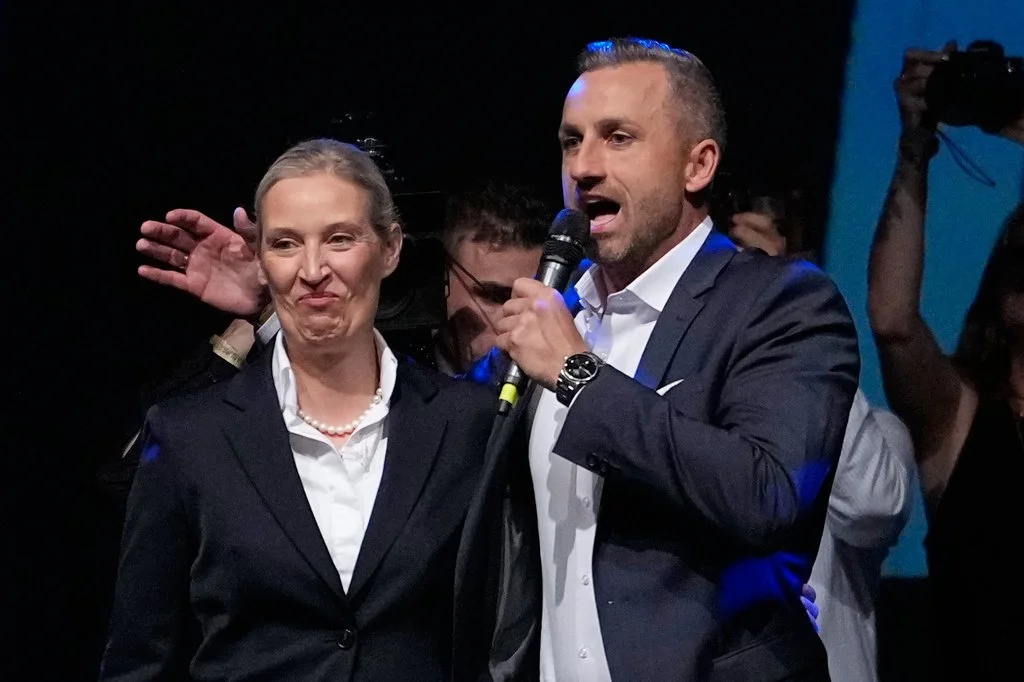
Top candidate Ulrich Siegmund speaks beside party leader Alice Weidel at an election party of the "Alternative for Germany" (AfD) after the Saxony-Anhalt state elections in Magdeburg, eastern Germany, Sunday, Sept. 6, 2026. (AP Photo/Matthias Schrader)
The Sahra Wagenknecht Alliance (BSW) has become the first party in a German parliament to agree to exploratory talks with the right-wing Alternative for Germany (AfD), breaking the cross-party refusal to cooperate with the AfD known as the Brandmauer, or firewall.
The talks follow the Sept. 6 state election in Saxony-Anhalt, where the AfD won 43.8 percent of the vote and 39 of 83 seats, just three short of a majority. The BSW's state board voted unanimously to open exploratory talks.
BSW state leader Thomas Schulze said the firewall is not in their interests and that it will talk to all parties. Party founder Sahra Wagenknecht has gone further, calling the firewall a failure and arguing that the BSW should back a government in the state with the AfD if it were led by an independent minister-president.
The declarations follow splits inside the BSW. In Thuringia, Deputy Minister-President Katja Wolf and her allies left the party in early September after a dispute with the federal leadership. In Brandenburg, the BSW's coalition with the Social Democratic Party (SPD) ended in January after several BSW lawmakers quit.
The AfD, founded in 2013 in opposition to eurozone bailouts, shifted toward a strong anti-immigration platform 2 years later, gaining support in part through its opposition to Chancellor Angela Merkel's refugee policy. The party won 20.8 percent of the vote in the February 2025 federal election.
The BSW, being founded in January 2024, by Wagenknecht and former members of The Left (Die Linke). A group that political scientists describe as left-conservative, combining higher taxes on wealth and inheritance with tighter immigration rules. It narrowly missed the 5 percent threshold for the Bundestag in 2025.
The two parties' positions are closest on foreign policy. The AfD's 2025 program calls for "the immediate lifting of economic sanctions against Russia" and the repair of the Nord Stream pipelines. It rejects eastward enlargement of NATO and the European Union, describes Ukraine's future as a neutral state outside both, and opposes the planned stationing of long-range US missiles in Germany.
The BSW also opposes weapons deliveries to Ukraine and sanctions on Russia, attributes the war in part to NATO enlargement and calls for negotiations with Moscow. When Ukrainian President Volodymyr Zelenskyy addressed the Bundestag in June 2024, the entire BSW group and all but four AfD lawmakers did not attend. The BSW said Zelenskyy was contributing to an escalation that risked nuclear conflict.
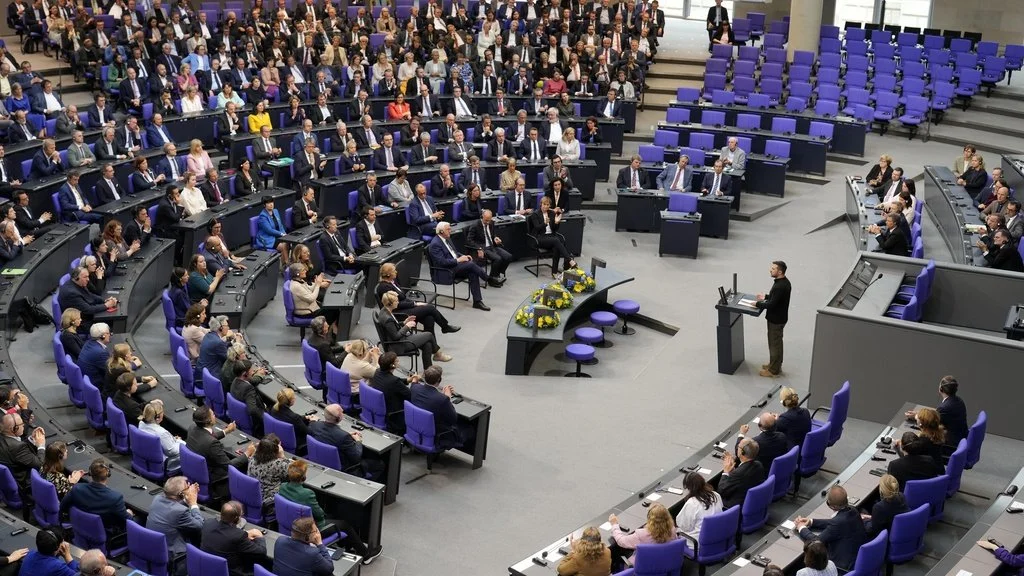
Ukraine's President Volodymyr Zelenskyy delivers a speech at the German parliament Bundestag at the Reichstag Building in Berlin, Germany, Tuesday, June 11, 2024. Germany is hosting a conference to gather support for Ukraine's recovery from the destruction wreaked by Russia's war, sending a new signal of solidarity with Kyiv at the start of a week of intense diplomacy. (AP Photo/Markus Schreiber)
The AfD's contacts with Russia and China have drawn official scrutiny. In June, several senior AfD figures attended the St. Petersburg International Economic Forum despite advice from Germany's Foreign Office not to do so. AfD European Parliament member Petr Bystron also lost his Bundestag immunity in 2024 over allegations that he received money from a pro-Kremlin network. In September 2025, a Dresden court sentenced Jian Guo, a former aide to AfD lawmaker Maximilian Krah, to four years and nine months in prison for spying for China.
On domestic policy, however, significant differences remain between the AfD and BSW. The AfD wants to abolish wealth and inheritance taxes, while the BSW wants to raise them. Schulze has also cited disagreements over the AfD's family model and support for conscription as reasons a formal coalition is ruled out. A majority in Saxony-Anhalt requires 42 seats; together, the AfD and BSW hold 44, while the Christian Democratic Union (CDU), SPD, Greens, and The Left hold 39. The BSW says it will abstain in the vote for minister-president but support an AfD candidate for parliamentary speaker. AfD lead candidate Ulrich Siegmund, meanwhile, has said he will stand for minister-president in December but will not lead a conventional minority government.
The December vote in Magdeburg will show whether the firewall’s first crack puts the AfD in power for the first time.