
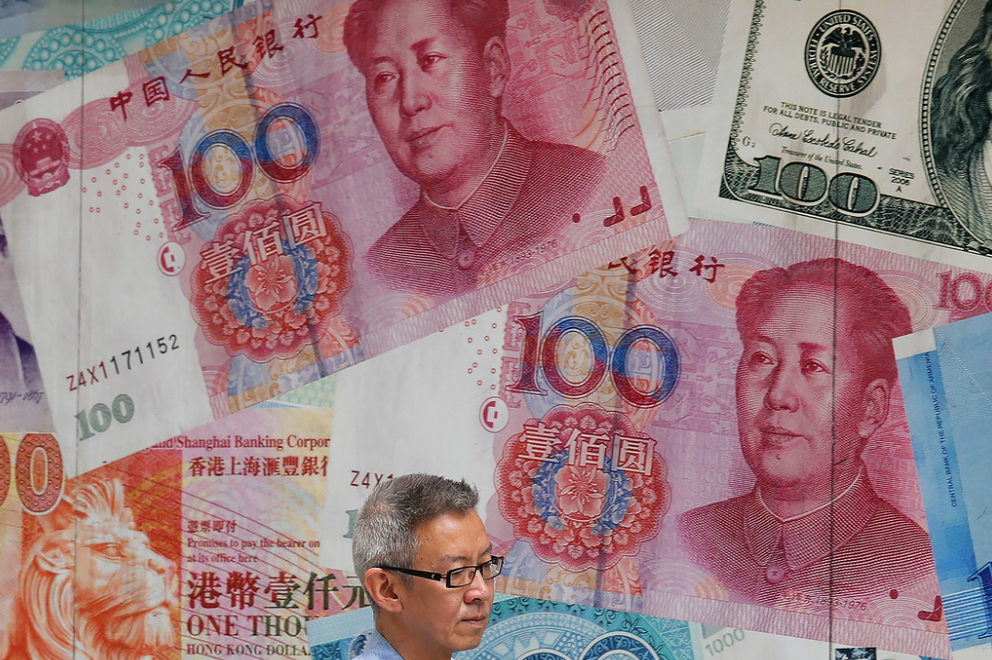
A man walks by a money exchange shop decorated with Chinese yuan banknotes and other countries currency banknotes at Central, a business district in Hong Kong, Aug. 6, 2019. (Source: AP Photo/Kin Cheung)
The Chinese yuan has been showing an interesting pattern: domestic demand remains relatively weak, but the currency has continued to strengthen against the dollar. Inflation numbers give some context here: China’s consumer prices increased 0.9 percent year over year in September, while core inflation, which excludes food and energy, was 1 percent.
So, what is supporting the yuan when domestic demand is still soft? The reasons mostly include strong exports, companies converting their foreign-currency earnings into yuan, and the central bank allowing more room for gradual appreciation.
The first reason behind the currency’s strength is China’s exports. Recent data showed that exports increased 36.3 percent year over year in September, while imports increased 31 percent. This gave China a trade surplus of around $133.5 billion for the month. These overseas sales bring foreign-currency revenue into Chinese businesses, giving the yuan some support even when domestic spending is not growing as strongly.
The process is pretty direct. Companies receive foreign currency from overseas sales, and some need yuan to pay workers, suppliers, and other domestic expenses. When they sell dollars and buy yuan, they push up demand for the Chinese currency. ING has also pointed to exporter conversions and trade-related inflows as reasons supporting the yuan. As year-end approaches, seasonal corporate dollar selling could add to this support if companies convert more of their accumulated earnings. However, companies can also keep their dollars overseas or use them to cover foreign expenses, so the amount they actually convert matters for the currency.
The central bank of China also plays a role. In September, the People’s Bank of China appeared to ease some resistance to yuan appreciation, as its daily reference rate moved closer to market expectations. This gave the currency more room to strengthen. However, the central bank is still managing the pace, and its governor’s latest comments suggest it remains cautious about allowing the yuan to appreciate too quickly.
A stronger yuan could also benefit oil imports, since oil and many other commodities are priced in dollars. Chinese importers would need fewer yuan to pay the same dollar bill. However, exporters face the other side of this, because their foreign-currency earnings would become worth fewer yuan. This gives policymakers a reason to watch how quickly the currency moves.

A man with an umbrella passes by China's central bank, or the People's Bank of China, in Beijing, Thursday, July 25, 2024. China ratcheted up its effort to reinvigorate its economy Thursday by cutting a key policy rate and interest paid on bank deposits. (Source: AP Photo/Ng Han Guan)
On the US side, Treasury yields have recently shown some weakness. The 10-year Treasury yield fell about14 basis points, from 5.24 percent on Oct. 9 to 5.10 percent on Oct. 15. This gives new investors a lower yield, potentially reducing some of the dollar’s appeal. However, lower yields also mean higher bond prices, so the decline does not necessarily mean investors are moving away from Treasuries.
Meanwhile, CoreWeave’s debt concerns could matter beyond the company itself because technology has a large weight in the US stock market. Information technology accounts for more than 30 percent of the S&P 500, making the broader market sensitive to confidence in the sector. If investors start doubting the AI growth story, they could become less willing to keep their money in US stocks. If they move that money overseas and sell dollars to buy other currencies, this could put pressure on the dollar and give the yuan more room to appreciate.
On the Chinese side, CXMT’s progress with its fifth-generation DRAM technology platform, which increases chip density and could lower per-chip production costs. could draw more attention to China’s semiconductor industry. If this interest brings foreign investment into yuan-denominated Chinese assets, it could also create demand for the yuan. So, these developments could support the yuan by attracting more foreign investment into Chinese assets.