
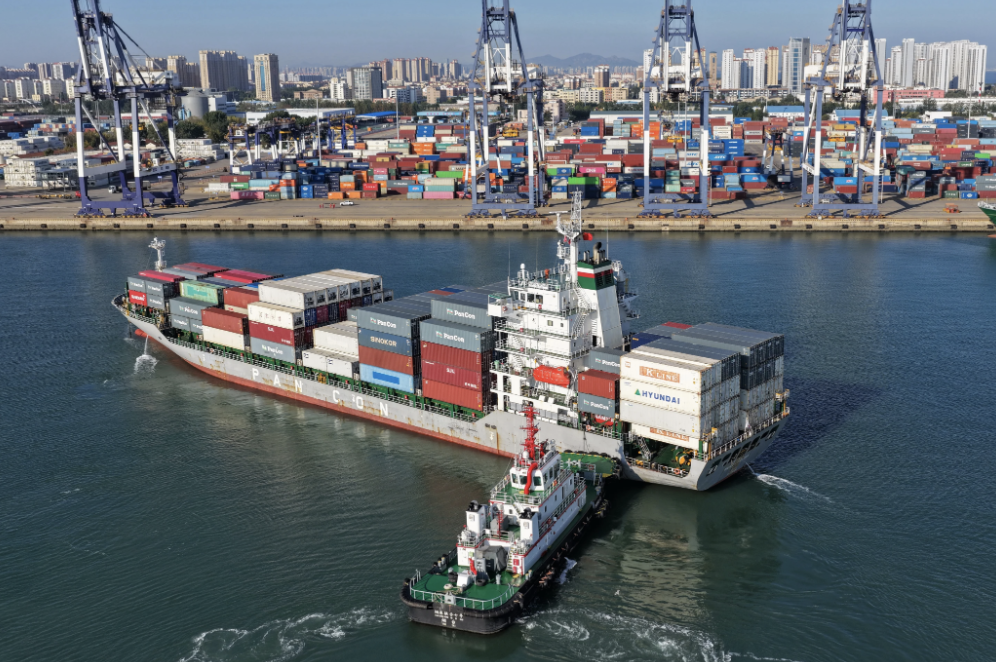
A tugboat pushes a container ship to a port in Yantai, eastern China's Shandong province on Oct. 14, 2026. (Chinatopix via AP)
China’s gross domestic product grew 4.5 percent year on year in Q3, up from 4.3 percent in April to June, the National Bureau of Statistics (NBS) said. Exports rose 36.3 percent year on year in September, driving the pickup and putting the country on course to exceed last year’s record trade surplus of about $1.2 trillion. Wang Jun, vice-minister of the General Administration of Customs, told a press conference in Beijing on Oct. 14 that foreign trade growth in the first three quarters was “the fastest in the past five years.” He attributed the export gains to technology products such as chips and electronic components, as global demand for AI computing power and electricity infrastructure rises.
Despite the large export surplus, domestic indicators were weaker. Retail sales rose 1.1 percent year on year in September, up from 0.4 percent in August and marking the strongest pace since March. Growth over the first nine months reached 4.6 percent, at the lower end of the government’s 4.5-to-5 percent target.
Investment remained a weak spot. Fixed-asset investment fell 7.2 percent in the first nine months, while private investment fell 10.4 percent, reflecting companies’ reluctance to invest. Tianchen Xu, senior economist at the Economist Intelligence Unit, said September’s rebound “salvaged” a lukewarm July and August, crediting improved government investment.
The property downturn is a major drag on demand. Falling home prices have eroded household wealth, leading many households to save rather than spend. Property market investment fell by 20.6%, further indicating a slowdown. Sheana Yue, senior economist at Oxford Economics, said the “prolonged housing slump” will continue to limit how far stronger industrial activity spreads to the wider economy.
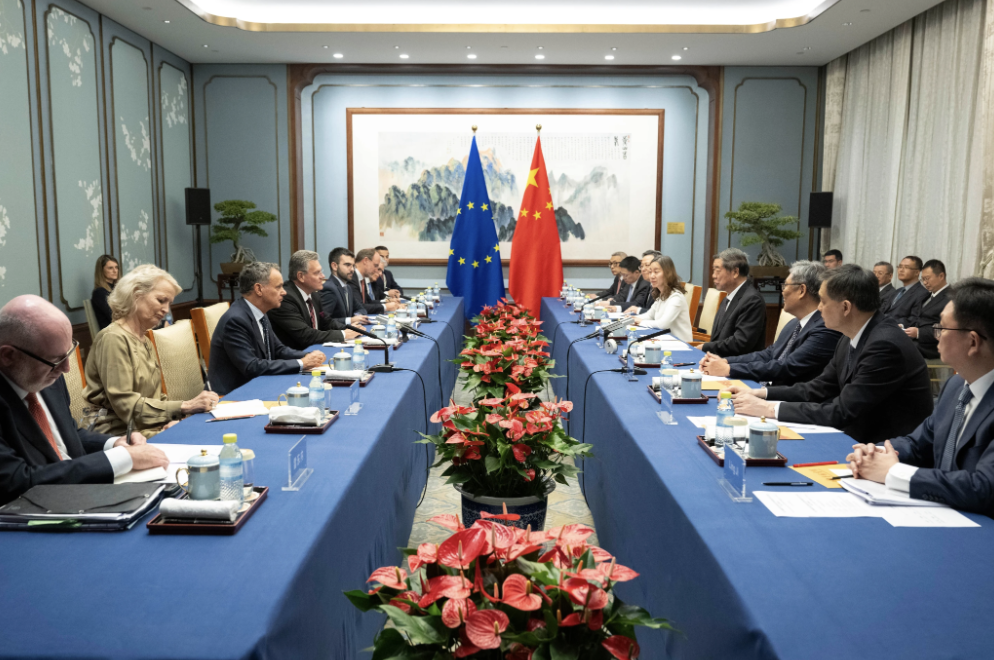
In this photo released by the Xinhua News Agency, Chinese Vice Premier He Lifeng, fourth right, meets with European Commissioner for Trade and Economic Security Maros Sefcovic, fourth left, in Beijing, Friday, Oct. 9, 2026. (Tian Yu/Xinhua via AP)
Beijing is also stepping in to shore up the domestic economy through a series of fiscal measures, including targeted support for selected industries, infrastructure and household consumption. Authorities have tapped an 800 billion yuan ($119 billion) policy-based financing tool to spur infrastructure investment, while modest mortgage subsidies for eligible homebuyers aim to underpin housing demand.
Looking ahead, many experts believe exports will continue to sustain the economy. Xing Zhaopeng, senior China strategist at ANZ, said sustained AI demand and easing China-EU trade tensions should keep supporting exports, though oil price uncertainty remains a risk for imports. Yet much apprehension remains about China’s future: Cornell University economist Eswar Prasad warned that “domestic imbalances” between supply and demand in China are continuing to grow.
China’s two-speed economy also has international implications, particularly for the European Union, whose trade deficit with China exceeds 1 billion euros a day. On October 9, the two sides agreed to roughly halve Chinese hybrid vehicle shipments to Europe over the coming years, and the European Commission signaled that further restrictions are likely.