
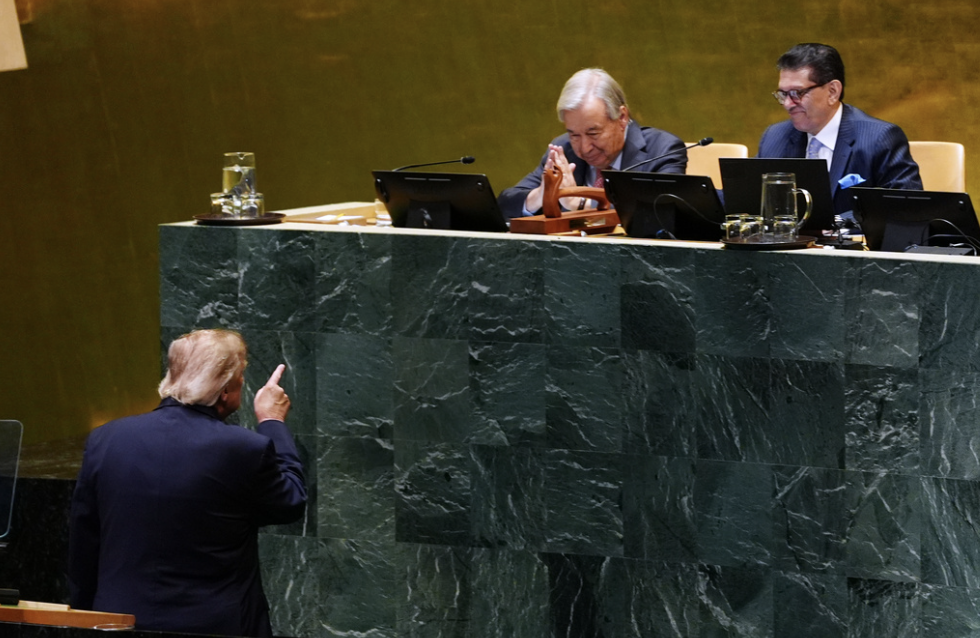
President Donald Trump points to United Nations Secretary-General Antonio Guterres, with Foreign Minister of Bangladesh Khalilur Rahman, top right, after speaking to the United Nations General Assembly, Tuesday, Sept. 22, 2026, at the UN headquarters. (AP Photo/Julia Demaree Nikhinson)
Developing countries face a downward spiral of decelerating growth and rising vulnerability, while also being burdened by high food, fuel, and debt-servicing costs. Average debt service costs have more than doubled since a decade ago, even as developing countries’ overall debt burdens have, in fact, eased, largely due to higher interest rates from developed economies. Rising costs are squeezing public spending in three-quarters of developing countries, as resources are diverted away from investments in public infrastructure, education, and healthcare, further feeding the vicious cycle of slow development.
As the developing world faces growing fiscal pressures, access to financial assistance becomes increasingly important, but America and China’s multilateral funding has been allocated unevenly.
China’s overall contribution to multilateral development institutions has doubled since 2016 and risen more than tenfold since 2010. Its contributions to multilateral development banks’ concessional windows (extremely favorable financing terms for developing countries) have grown the fastest. All the while, it continues to participate in newer multilateral institutions that it helped build, such as the Asian Infrastructure Investment Bank (AIIB). Nevertheless, China has been prioritizing contributions to multilateral development banks (MDBs) and seeking institutional representation. Its contributions to the UN have risen at only half the pace, and finance for vertical funds has remained small and uneven. Its assessed UN contributions are now the second largest; but its voluntary contributions, which more clearly demonstrate Beijing’s policy priorities, rank only 19th, even when including agencies where Chinese nationals held senior positions in 2024. China actively argues for reforms in international organizations, including the World Bank and the UN, relating to the fact that its contributions have not been proportionately translated into institutional representation. It holds only half of the shareholding that the World Bank’s formula suggests based on its economic weight and contributions, and its senior leadership presence in the UN has declined since 2020.
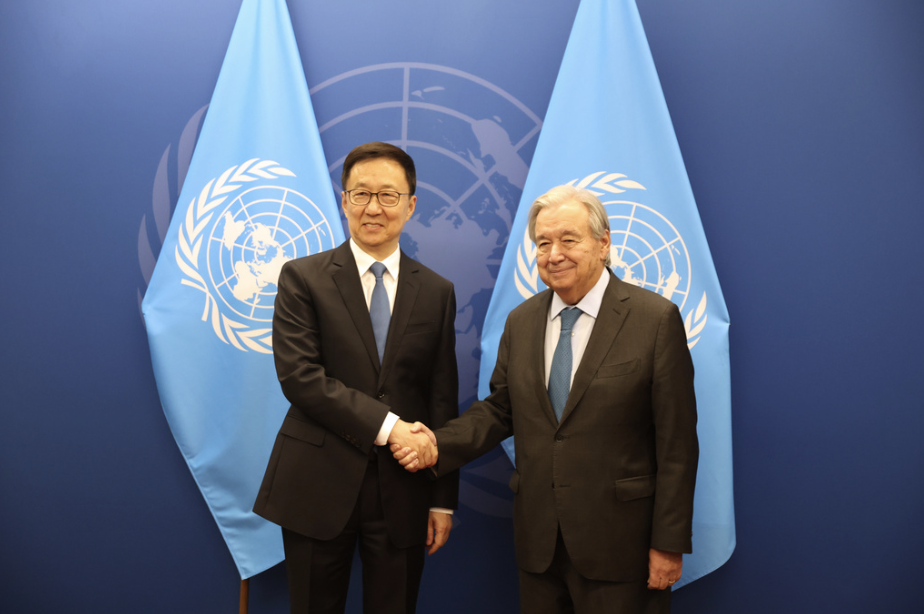
Chinese Vice President Han Zheng, left, shakes hands with United Nations Secretary-General Antonio Guterres during the 81st session of the United Nations General Assembly at United Nations headquarters, Friday, Sept. 25, 2026. (AP Photo/Heather Khalifa)
The US, on the other hand, has withdrawn from 66 international organizations, agencies, and commissions under the Trump administration, and continues to call for further cuts in UN spending on daily operations. The UN Secretary-General has warned that the organization faces “imminent financial collapse” due to unpaid fees, mostly owned by the US, disrupting the UN’s regular budgeting and daily operations. Meanwhile, where it concerns China, the US also aims to curb China’s contributions to projects under the UN’s development trusts, potentially to prevent future expansion in Chinese institutional influence without needing formal changes to leadership positions and voting power.
The US and China have both withheld or delayed due payments to the UN, despite the organization relying on the US and China for 42% of its basic funding. This will further affect the organization’s engagement across its program areas.
Patterns in Chinese and US contributions demonstrate an emphasis on leveraged institutions, particularly multilateral development banks, which are able to use their existing financial resources to borrow from capital markets. This shifts attention away from grant-based institutions, which are especially vulnerable to reduced contributions because they cannot rely on borrowing and financial reserves the way MDBs can. The impact of deemphasizing grant-based institutions would be clearest among groups such as United Nations Development System (UNDS) entities, including the World Health Organization, United Nations Development Program, and World Food Program, which all saw steep reductions in financing.