
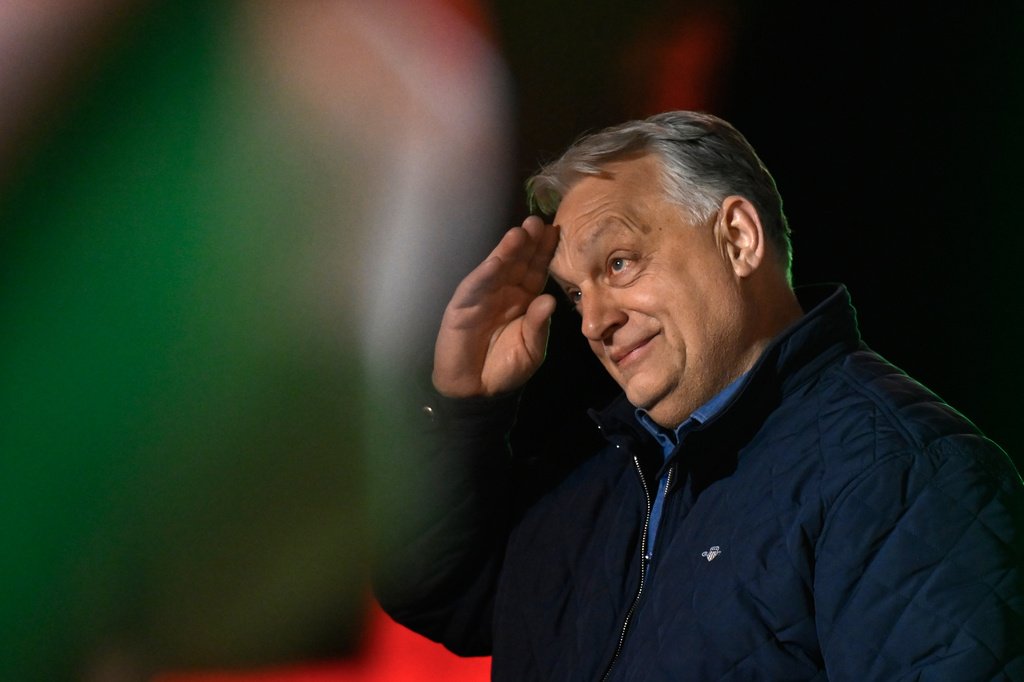
Hungary's Prime Minister Viktor Orban attends the electoral campaign closing rally of the governing Fidesz in Budapest, Hungary, Saturday, April 11, 2026. (AP Photo/Denes Erdos)
On Sunday, Hungarian voters ended Viktor Orbán’s 16-year grip on power in a landslide vote. Péter Magyar’s Tisza party won 138 seats in the 199-seat parliament, securing a two-thirds majority that will allow him to rewrite the constitution Orbán built his system on. Orbán conceded defeat on election night, calling the result “painful” but “clear.” Turnout reached nearly 80 percent, the highest in Hungary’s post-communist history.
The result was widely celebrated across Europe as a victory for democracy, with European Commission President Ursula von der Leyen saying, “Hungary has chosen Europe.” Former U.S. President Barack Obama echoed von der Leyen’s comments, calling it “a victory for democracy, not just in Europe but around the world.” But these reactions, while understandable, miss something important. Orbán did lose the election, but the political logic that sustained him for 16 years will not disappear with him.
That logic is what scholars of populism call enemy construction: defining national identity not through shared values or policy goals, but through opposition to a designated threat. Orbán was a master of this. Over 16 years, he cycled through a long list of enemies: George Soros, NGOs, the LGBTQ movement, the European Union, refugees, and most recently, Ukraine. Each one served the same function, giving voters a reason to rally behind Orban’s Fidesz party. Although the party wasn’t delivering the results it promised, it gained support by claiming to be the only force standing between Hungary and an existential danger.
This model worked for a long time. Orbán won four consecutive elections by stoking fears and constructing crises. But enemy construction has a built-in expiration date, with each new “enemy” delivering diminishing returns. When voters start to sense that the government is manufacturing threats rather than addressing real problems, narrative fatigue sets in. The propaganda loses its power, not necessarily because people stop believing in the enemies, but because they begin to prioritize their own lives.
This mindset shift is what happened in Hungary. Orbán’s final campaign was centered on Ukraine, where he framed President Zelensky as an existential threat who would drag Hungary into war. Budapest was covered in posters of Zelensky with captions such as “Danger!” intended to spread notions of fear. But with unemployment at a 10-year high, economic growth at just 0.4%, and a healthcare system in crisis, foreign enemies could hardly pique voters’ interest. Orbán’s politics has always involved a kind of tension between “the television” and “the refrigerator” and by 2026, the gap between the two had become unbridgeable.
The escalation to Ukraine also revealed a deeper contradiction. Enemy construction requires constant escalation, because each round raises voter expectations. If the next wave of propaganda does not feel bigger than the last, it registers as nothing at all. This forced Orbán to look outward for enemies because domestic problems were impossible to spin into threats. But in doing so, he abandoned the very terrain where elections are won: everyday life. Magyar simply had to point to Orbán’s record at home and ask voters whether they were better off.
There was also an irony in Orbán's final act. A leader who built his brand on national sovereignty and opposition to foreign interference ended up relying heavily on foreign backers to survive. U.S. Vice President JD Vance flew to Budapest days before the election to campaign for him, Trump posted “GET OUT AND VOTE FOR VIKTOR ORBÁN” on Truth Social and Russia’s GRU sent political operatives to support his campaign as well. But in the end, none of these efforts made a significant difference. As Bulgarian political scientist Ivan Krastev observed, “The irony is that if he’s going to lose, he’s going to lose like a globalist.” The failure of outside intervention also carried a broader lesson, with Steven Levitsky, a Harvard political scientist, noting that the result showed “oppositions can win despite a tilted playing field.”
Hungary is not an isolated case. In 2023, Poland’s Law and Justice party (PiS) lost power after about eight years of a similar playbook: using refugees, the EU, and “gender ideology” as enemies to mobilize voters, while presiding over declining public trust and rule-of-law violations. Like Orbán, PiS was not necessarily defeated by a liberal movement but rather by a broad coalition united less by ideology than by exhaustion with the incumbent. Together, the two cases suggest a pattern: illiberal populism in Europe has an internal expiration date. When enemy construction can no longer compensate for failed governance, voters move on.
For the EU, Magyar’s victory brings immediate relief. EU officials arrived in Budapest on Friday for high-stakes talks aimed at reshaping the bloc’s relationship with Hungary. Magyar has pledged to lift Hungary's veto on the €90 billion loan to Ukraine and to repair ties with Brussels. His first foreign visits are expected to be to Warsaw and then Brussels. Roughly €32 billion in frozen EU funds that the Commission held back over Orbán’s rule-of-law violations are on the table, and ECFR has argued that Brussels should use this leverage to push for a broader geopolitical realignment, not just institutional reform.
But there is a fundamental tension in this question, and it has nothing to do with populism. Magyar’s legitimacy rests on domestic delivery: fixing corruption, improving healthcare and education, and reviving the economy. These are the promises that won him a supermajority. If EU demands on defense spending, energy transition, or Ukraine support create pressure that slows down those domestic reforms, Magyar may find himself caught between Brussels’s expectations and his voters’ patience. Poland’s experience since 2023 has already shown how quickly that patience can thin. Hungary’s foreign policy will almost certainly become less obstructive and whether it becomes fully aligned is a different question. If Magyar’s domestic constraints push him toward positions that resemble Orbán’s, particularly on Ukraine or energy dependence on Russia, he risks validating the very narrative he ran against. Orbán, who has said he will lead Fidesz from opposition, would have every incentive to claim that his approach was right all along, and a base of 2.4 million voters ready to listen.
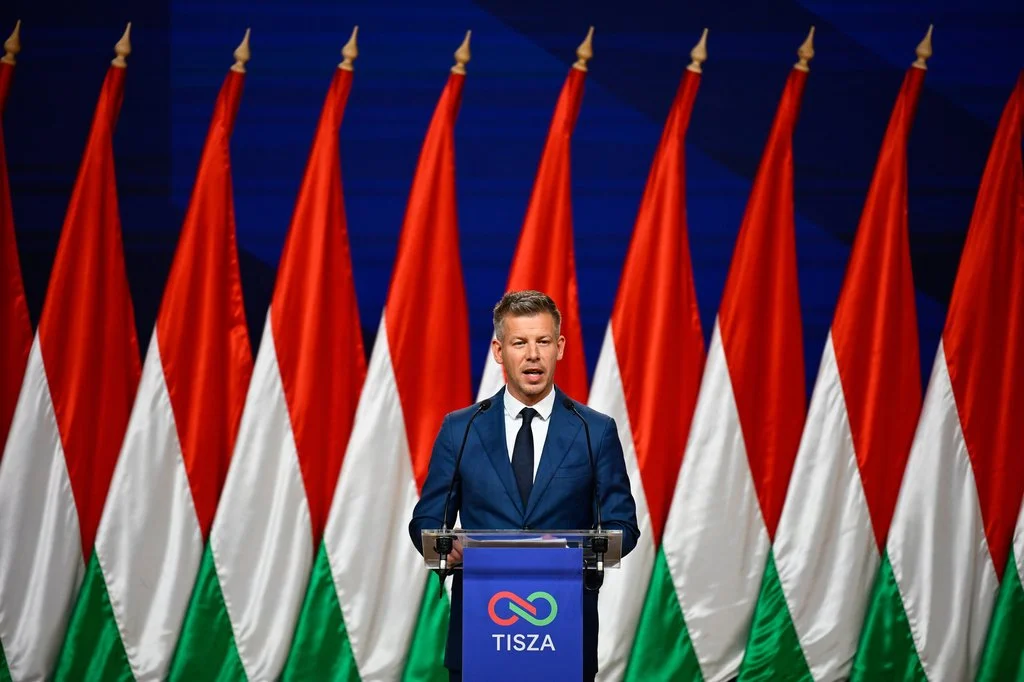
Peter Magyar speaks to the media in Budapest, Hungary, Monday, April 13, 2026, after defeating Prime Minister Viktor Orban's party in the country's parliamentary elections. (AP Photo/Denes Erdos)
This tension is not just structural, it is embedded in Magyar himself. He is not a liberal reformer in the traditional sense, he’s a former Fidesz insider who was part of Orbán’s system until 2024. His campaign was built on anti-corruption and anti-elite rhetoric, and in his victory speech, he called on leaders of Hungary's judiciary and prosecution to step down, telling them: "Leave, leave! Do not wait for it.” Liberal and leftist voters backed him, not necessarily because they agreed with his politics, but because he was the only viable path to removing Orbán. As political scientist Péter Krekó put it, Hungary’s liberal voters “did not allow the perfect to become the enemy of the good.”
In other words, Magyar defeated a populist by running as a populist. The difference is that his version of enemy construction is more subtle and more sustainable. His enemies are corruption, institutional decay, and Orbán’s patronage networks. These are not manufactured threats, they are real, documented, and the effects are felt by ordinary Hungarians every day. His legitimacy comes not from conflict but from a promise of better performance. That makes his brand of populism harder to exhaust than Orbán’s, because it is grounded in tangible problems for Hungarian citizens.
This is the paradox of Hungary’s election. In the short term, it is a story about democratic resilience. The system worked, voters used the ballot box to remove a leader who had spent 16 years tilting the playing field in his favor. That is worth celebrating, especially after Poland’s similar transition in 2023.
But in the longer term, the picture is less straightforward. Voters did not reject populism, they rejected an ineffective version of it and replaced it with one that promises to work better. The underlying demand that fueled Orbán's rise, which includes distrust of elites, frustration with institutions, and a desire for leaders who claim to fight on behalf of ordinary people, has not gone anywhere. Chatham House noted that the traits Orbán relied on, such as a preference for a strong state, skepticism of external constraints, and transactional politics, “are deeply embedded in Hungarian political culture and do not vanish on election night.” Even Orbán himself appears to recognize that the old model has run its course. In his first interview after the defeat, he said Fidesz would require a “complete renewal” and that “in its former form, the right-wing community cannot continue to exist.”
Although Orbán is gone, the cycle that produced him is not. And the man who ended his rule may yet prove that the most effective form of populism is the kind that no longer looks like populism at all.