
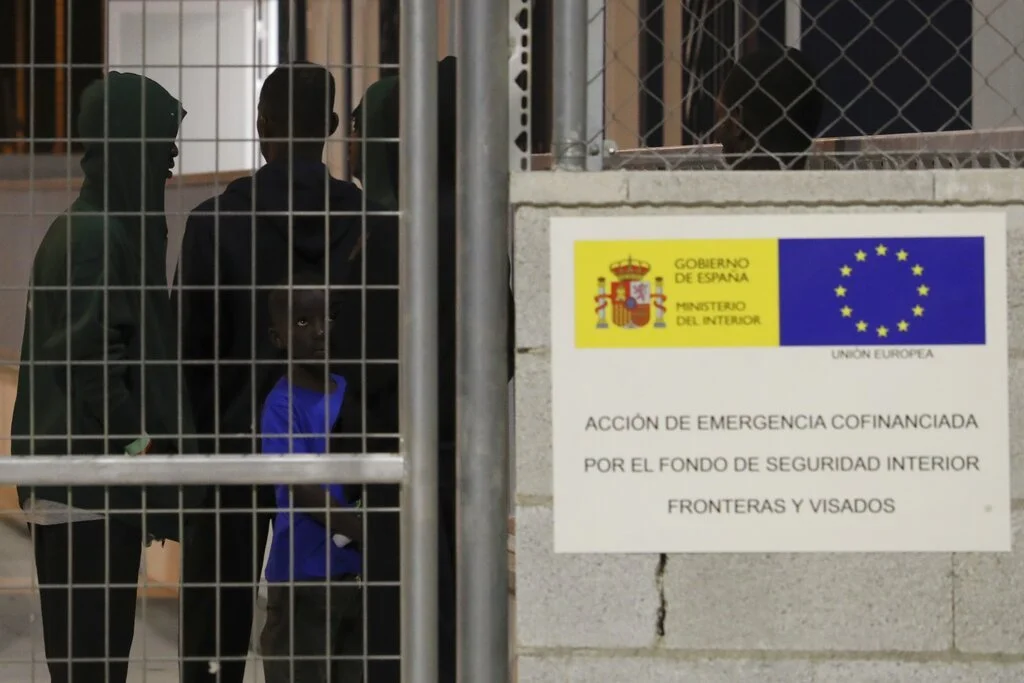
Newly arrived migrants gather inside a temporary handling facility in Malaga, southern Spain, early Thursday, Aug. 29, 2019. Spain's maritime rescue service says it has rescued 208 migrants from the Mediterranean Sea in 24 hours. The agency said Thursday the migrants were in three boats and were picked up in the so-called Alboran Sea, an area east of the Strait of Gibraltar and one of the most common routes for crossing to Europe from North Africa. (AP Photo/Sergio Rodrigo)
Every summer, the Madrid sun is harsh and unforgiving. The heat traps you indoors until late afternoon, but when it finally loosens, the city comes alive. The terrazas fill up, the taste of tinto de verano sweet on our tongues, and the laughter of madrileños spills into the verbenas, the traditional summer festivals. Beneath all of it, however, lie the headlines we have grown numb to since 2015, a reality playing out just a few hours drive from our sunlit streets.
Spain remains one of the primary gateways for irregular migration into the European Union. In 2025 alone, nearly 34,000 arrivals were recorded along the Western migration route, crossing the Atlantic Ocean and Mediterranean Sea to reach Spanish shores. It is a deadly crossing for migrants, who make the journey in flimsy and overcrowded boats known as ‘pateras’ in Spain. Last year, an estimated 3,090 people (including over 400 children) died or disappeared at sea, leaving hundreds of shipwrecks in their wake. Thousands continue to take the risk, driven by hunger, violence, and the hope that whatever awaits them in Europe cannot be worse than what they are leaving behind.
Year after year, the scenes unfold on our screens: pateras intercepted by NGOs, bodies recovered from the waters, children left orphaned. It is a tragedy profound enough to shake the most cynical observer, yet it does not. Instead, fueled by right-wing populism, anti-immigrant sentiment has surged across Europe, and Spain is no exception. European politicians have weaponized this crisis, twisting a humanitarian disaster into a threat against a “white” Europe that they claim is slipping away.
It is exactly this rhetoric that paved the way for the Return Regulation, the new law endorsed by the European Parliament on March 26. This new legislation allows EU member states to deport irregular migrants to third countries they have no personal connection to, provided the countries agree to build external “return hubs” in their territory. Irregular migrants can also face detention of up to 18 months if authorities consider them a security threat or a flight risk, or even if they are simply accused of obstructing their own deportation.
After the Members of the European Parliament (MEP) endorsed the law with 389 votes in favour, 206 against, and 32 abstaining a group of MEP’s reportedly burst into applause and cheers.
We are at risk of redefining what it means to be an immigrant in Europe. If fully adopted by the Council, the Return Regulation threatens to dismantle the asylum protections that defined the post-war era, built precisely so that Europe would never again decide who belongs based on origin. Under this law, “irregular migrants” include people who overstayed a visa, asylum seekers whose claims were rejected, and workers who simply lost the job tied to their permit. It does not matter if they lived here for years, built lives, or raised a family. These migrants will be sent to “return hubs” in non-EU territory, even if they are children.
Until now, member states could only detain undocumented migrants as a last resort. Not all states had detention policies, and where they did, the centers were almost always within the EU which guaranteed the monitorization of legal safeguards. By externalizing its borders, critics claim the EU is creating legal black holes. In practice, it is nearly impossible to enforce European standards or track violations in return hubs outside Europe. Once people are moved off EU soil, the oversight disappears.
The Parliament’s version also adds a provision allowing talks with “non-recognised third country entities” for re-admission, opening the door for cooperation with non-democratic regimes. “The adopted text gives a green light to the cooperation with the Talibans to enable the forced return of Afghan nationals,” Green MEP Melissa Camara told Euronews. She described this provision as a renouncement of EU values.
This legislation will seep into everyday life. In the workplace, if deportation becomes a constant threat, labor rights violations will stop being reported. Communities composed of ethnic minorities will suffer the consequences, as racial profiling embeds itself further into EU policy. A Médecins du Monde and PICUM report warns that medical records could be shared with authorities for deportation purposes. At that point, seeking healthcare will become a risk that people will not be willing to take.

Children cool off in a fountain in a park by the river in Madrid, Spain, Wednesday, June 15, 2022. Spain's weather service says a mass of hot air from north Africa is triggering the country's first major heatwave of the year with temperatures expected to rise to 43 degrees Celsius (109 degrees Fahrenheit) in certain areas. (AP Photo/Manu Fernandez)
It is not necessary to criminalize people to control a border. On Jan. 27, the Spanish government announced plans to legalize approximately 500,000 undocumented migrants. The measure, the first of its kind in more than 20 years, is designed to officially welcome people who are already embedded in Spanish society and the labor market into the legal system. Migrants will receive legal residence for one year, which includes the right to work as well as allowing children already in Spain to stay united with their families. Prime Minister Pedro Sánchez justified the legislation by highlighting that “migration accounted for 80% of Spain's GDP expansion and now contributes roughly 10 percent of Social-Security revenues, according to Interior-Ministry data.” While the European Parliament is focused on designing return hubs, the Spanish government is showing that integration is an actual, functional option.
But there are two Spains. Since 2015, the scapegoating of immigrants has slowly poisoned public opinion across the country. Last summer, Moroccans were beaten in the southern town of Torre Pacheco, targeted over false rumors and for no other reason than simply being Moroccan or Muslim. This is not an isolated incident. Statista reports that hate crimes motivated by racism and xenophobia have surged by over 21% over previous years. The mass regularization has been fiercely opposed by the conservative Partido Popular and the far-right Vox party, who claim the measure rewards illegality and will overwhelm public services.
Historically Europe has claimed to be a global beacon of democracy. It proudly holds up the Schengen agreements and the EU as the pinnacle of human rights, of peace and shared humanity. However, this humanity has failed to extend itself to immigrants, and is contingent on the color of one’s skin. Countless European politicians have criticized ICE operations in the US, yet the EU has begun to adopt ICE-style legislation in Europe and hundreds of politicians have stood idly by.
More than two decades ago, my parents set foot on Spanish soil. They immigrated from different corners of the world, my mother from Peru, my father from Bangladesh. They did not come by boat, but by bus and planes. They were not criminals but rather were seeking better opportunities. I was born and raised in Madrid because my parents were allowed to build a life in Spain. Now, the EU is making sure others cannot do the same. But what separates a European from an undocumented immigrant is not morality or worth. It is geography, and it is circumstance. A truly democratic Europe cannot exist if it insists that one group inherently deserves human dignity, while the other is banished to offshore camps.