
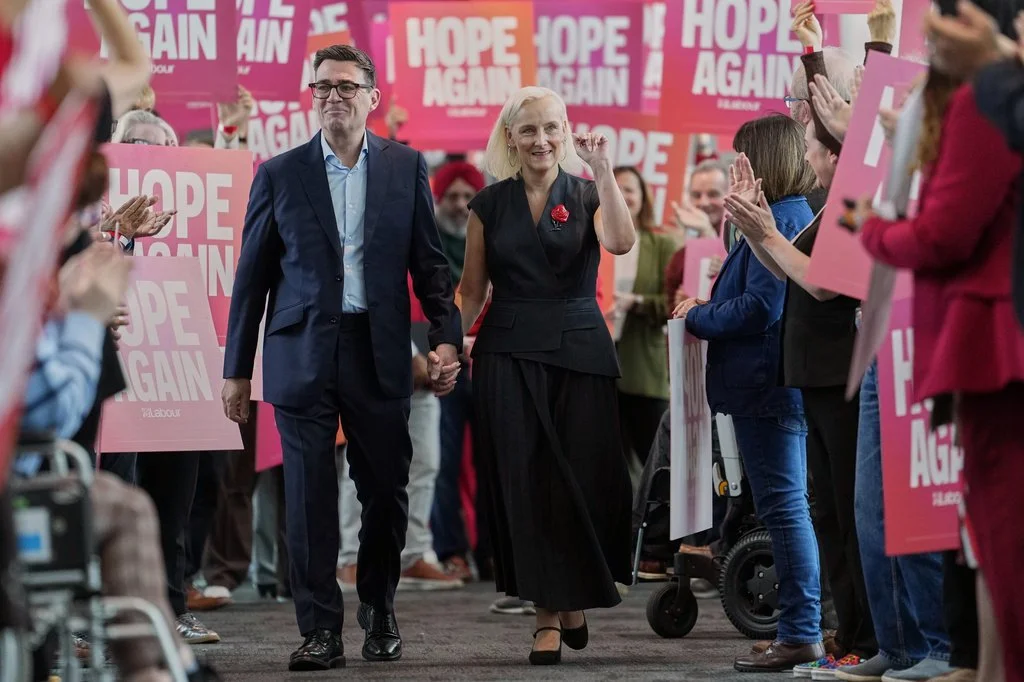
Britain's Prime Minister Andy Burnham and his wife Marie-France van Heel are greeted by supporters ahead of the Leaders Speech at the Labour Party Conference in Liverpool, England, Tuesday, Sept. 29, 2026. (AP Photo/Jon Super)
UK Prime Minister Andy Burnham announced in an address to the House of Commons on Monday that the UK and EU will discuss new post-Brexit deals at a summit in Brussels on November 20. Burnham says the agreements are aimed at boosting UK economic growth. The push toward a closer relationship with the EU has drawn opposition from right-wing Reform UK and the Conservatives, even as polls show most Britons now believe the UK was wrong to Vote to Leave.
Under prior Prime Minister Keir Starmer, the UK hosted the first EU-UK summit since Brexit in London in May 2025. Leaders agreed to strengthen bilateral relations and signed off on a renewed cooperation agenda covering areas from security to energy. However, negotiations from the meeting are still ongoing. The biggest unresolved issue is a youth mobility scheme, which would allow young EU citizens to live and work in the UK for a limited period, and young Britons to do the same in the EU. Westminster has sought to cap visas for young Europeans at below 50,000 annually, while Brussels has pushed for significantly more, up to 150,000.
In the midst of this continued disagreement, PM Andy Burnham stated that “the status quo is not good enough for Britain” and that it would be a “major dereliction of duty to turn away” from its relationship with the EU. He also cited Russia’s escalating “campaign of hybrid attacks” across Europe as a reason for the necessity of closer ties, defending his past remarks that “Russian actors sought to interfere in the [2019] general election.” Burnham concluded that a serious dialogue on the options for the UK’s long-term relationship with the EU is needed.
During the summit the PM wants to secure a deal on the agreements begun under Starmer, including agri-food trade and emissions trading. Boosting economic growth is central to the government’s case for the summit. Brexit is estimated to have cut UK exports to the EU by 12% to 16%, which has weighed on productivity and job growth. Estimates put the overall cost to the economy between 6% and 8% of GDP per capita.
The deals carry particular weight for Burnham, who pledged to reduce the cost of living crisis when he entered office. The Prime Minister told MPs the agreements under discussion would add the equivalent of around £10bn a year to the economy by 2040. He highlighted losses in agriculture and fisheries, where not being able to sell some products in the EU is having a “real impact”on businesses. UK National Farmers’ Union analysis of HMRC data shows sales of a great variety of British agricultural products fell 37.4% in the five years since 2019, the last full year before Brexit. The food deal Burnham is pushing for would help lift bureaucratic burdens and lower energy costs. The PM argued the proposed energy deal could also cut wholesale energy costs in Northern Ireland by 20%.
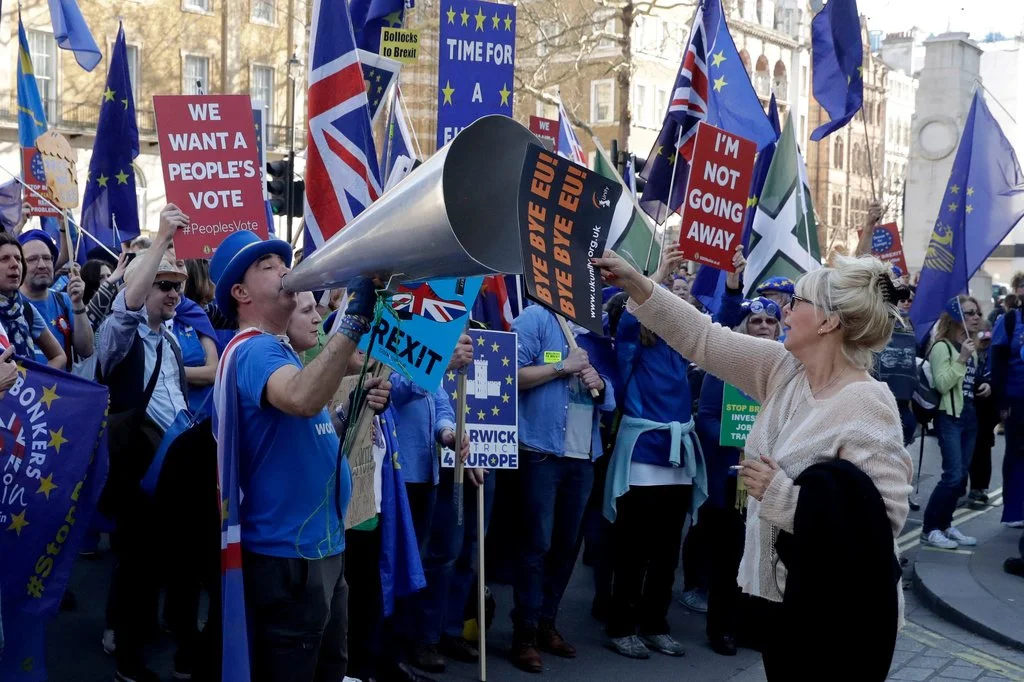
A supporter of Britain's departure from the European Union, at right, holds a placard up in front of supporters of remaining in the EU, including Stop Brexit Man, Steve Bray, with his foghorn, outside Parliament in London, Wednesday, Feb. 27, 2019. (AP Photo/Matt Dunham)
Downing Street has also raised concerns about the EU’s “Made in Europe” legislation, one of the main points of contention going into the summit. The Industrial Accelerator Act is part of wider EU efforts to help the European automobile industry compete with producers abroad who do not face the bloc’s strict regulations and higher energy prices. The Commission has yet to publish a list of qualifying countries who will be exempt from the proposed export tariff. Burnham has lobbied for the UK to be included but has met resistance from European leaders. The British carmakers’ association SMMT has said that excluding Britain would put shared investment and a €80 billion trading relationship at risk.
PM Andy Burnham’s proposals have drawn a split response from Westminster’s parties. The leaders of both right-wing parties have voiced opposition. Responding to him in the Commons, Conservative leader Kemi Badenoch accused the prime minister of “unpicking” Brexit ten years after the referendum, arguing his focus should instead be on the budget the chancellor delivers in two weeks. At a press conference in Dover on Monday, Reform UK leader Nigel Farage mocked Burnham’s vow to forge closer ties with the EU and rejected his claim that Brexit has done “more harm than good.” Farage said UK growth may not be remarkable but continues to be better than “France, Germany and Italy.” On the other hand, the Liberal Democrats support closer ties with the EU but say Burnham’s plans stop short. Lib Dem MP Paul Kohler told a Westminster Hall debate that Burnham “remains wedded to his predecessor’s red lines,” which he said would limit progress at the summit.
Meanwhile, polling shows majority support for a closer relationship with the EU. A YouGov poll found 57% of Britons think the UK was wrong to vote to leave, including 23% of Leave voters. This figure contrasts with the 2016 referendum, in which the UK voted to leave the EU by 52% to 48%. A separate Public First poll found seven in ten voters want the government to build closer ties with Brussels, including 51% of Reform UK voters, compared with 25% who want more distance. Green Party voters were the most supportive, with 64% backing much closer ties even if that meant applying more EU rules. Overall, it is clear that creating closer ties with the EU is embraced by most Britons across the political spectrum.
Burnham has said he will work over the next five weeks to secure the deals, emphasizing that “at every stage, the British public will be the boss.”