
South Africa’s Ramaphosa Implements Measures to Combat Gender-Based Violence
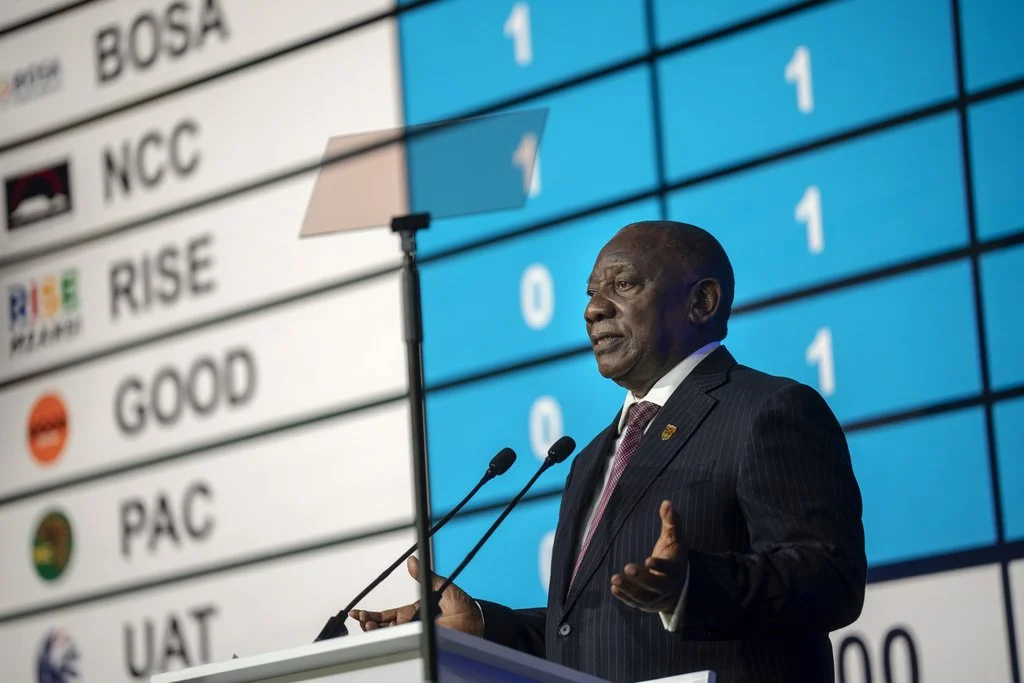
South African President Cyril Ramaphosa speaks during the announcement of the results in South Africa's general elections in Johannesburg, South Africa on Sunday, June 2, 2024. Humbled by a stinging election result, South Africa's African National Congress was talking to everyone in an effort to form a stable coalition government for Africa's most advanced economy after it lost its 30-year majority. (AP Photo/Emilio Morenatti)
South African President Cyril Ramaphosa addressed the nation on the recent killings of 12 women in Ekurhuleni, a province east of Johannesburg. Over the past two months, South African Police have confirmed the discovery of the bodies of 12 women. So far, police have made three arrests and do not believe the cases are related. Of the 12 documented killings, 9 of the 12 were located in Kempton Park, a major city within Ekurhuleni. The three remaining cases were in Dawn Park, Kwa-Thema, and Springs.
In Ramaphosa’s opening remarks, he lamented South Africa’s gender-based violence as a “national shame”, using his address to express his grief and righteous anger that the country should be sharing, calling South Africa’s norm of gender-based violence and femicide “inhuman.” He expressed that each of these women whose lives were lost had a story worth remembering and whose absence will leave a family and community grieving. Ramaphosa’s address conveyed his shame at the lack of change and government accountability across South Africa, citing his 2019 address to the nation on the same crisis. In his current address, he mentioned, “What we have done has not been enough. We need to do much more. It has not been enough to prevent women from being killed.”
Ramaphosa detailed the steps the government is taking in reaction to the wave of femicides across the country. The South African government’s Inter-Ministerial Committee on Gender-Based Violence and Femicide has approved a comprehensive emergency response aligning with the National Strategic Plan in the fight to combat gender-based violence. In this plan, a specialized multidisciplinary investigation has been elevated to the national level under the Deputy National Commissioner for Detective Services, bringing together the country’s best detectives, forensic officers, and other specialists to find the perpetrators.
Ramaphosa then detailed the four advanced measures the country will take. First, the Minister of Police and the Minister of Justice and Constitutional Development, alongside the South African Police Service and the National Prosecuting Authority, will undertake a national case recovery operation meant to focus on “unresolved murders, attempted murders, rapes and serious sexual offenses involving women and children.” Second, the Minister of Police, the National Commissioner of Police, and forensic authorities have been tasked with presenting a funded plan to lower forensic backlogs and establish standards for priority femicide cases. Third, every municipality across the country will now begin a women’s safety audit with guidelines of 60 days and 90 days, respectively, to identify hazards and then resolve them or fund plans to do so. Fourth, the Minister of Trade, Industry and Competition, alongside the Ministers of Health, Social Development, Police and Cooperative Governance, have been tasked with drafting legislation and developing an enforcement package to reduce alcohol-related violence.
The President's remarks served as a vocal plea to his nation to “do better”, emphasizing the people’s obligation while also recognizing the government's role in ensuring women do not live in fear because of a lack of government protection. Ramaphosa’s plans focused not only on ensuring that all regions across the country work to tackle broken lights, unsafe transit routes, and enforce all required laws, but also on ensuring that all areas of government understand that protecting women is one of their most important responsibilities.
One of the victims, Elizabeth "Tsontso" Moselakgomo, murdered while going on her daily run, was a nationwide wake-up call about the uptick in gender-based killings in recent months. After her death, run clubs across the country gathered in an act of solidarity to protest that the government does more to combat the increase in femicide across the country. She was honored with a candlelight vigil in Kempton Park. Across Durban this past week, large groups of protestors have taken to the streets to demand stronger government action against gender-based violence and femicide, but also to demand action to prevent these killings from occurring in their provinces. One community member, Zandile Nxumalo, speaking to DW Africa, criticized Ramaphosa and his plan to combat gender-based violence, stating, “Our government has failed us.”
South Africa has seen 5,427 homicides from April to July, and it reports one of the highest femicide rates in the world, 5.5 per 100,000 women, almost 5x the world average. Femicide in South Africa remains a looming issue, with 44% of femicide cases in South Africa failing to identify a perpetrator. Research provided by Human Rights Research finds that “deeply ingrained gender norms and dynamics against women” are the leading cause of gender-based violence.
The controversy and eruption of anger across the country in the wake of the killings is rooted in South Africa’s history of demanding reform for gender-based violence. In 2018, #TheTotalShutdown was a massive protest drawing over 40,000 participants across South Africa in the country’s largest coordinated protest led by women to protest femicide and gender-based violence. Led by activist Mandisa Khanyile, who listed 24 demands for President Ramaphosa, the wave of protests swept across the country, and after he received the memorandum, he convened a national presidential summit on gender-based violence, among other sweeping reforms.
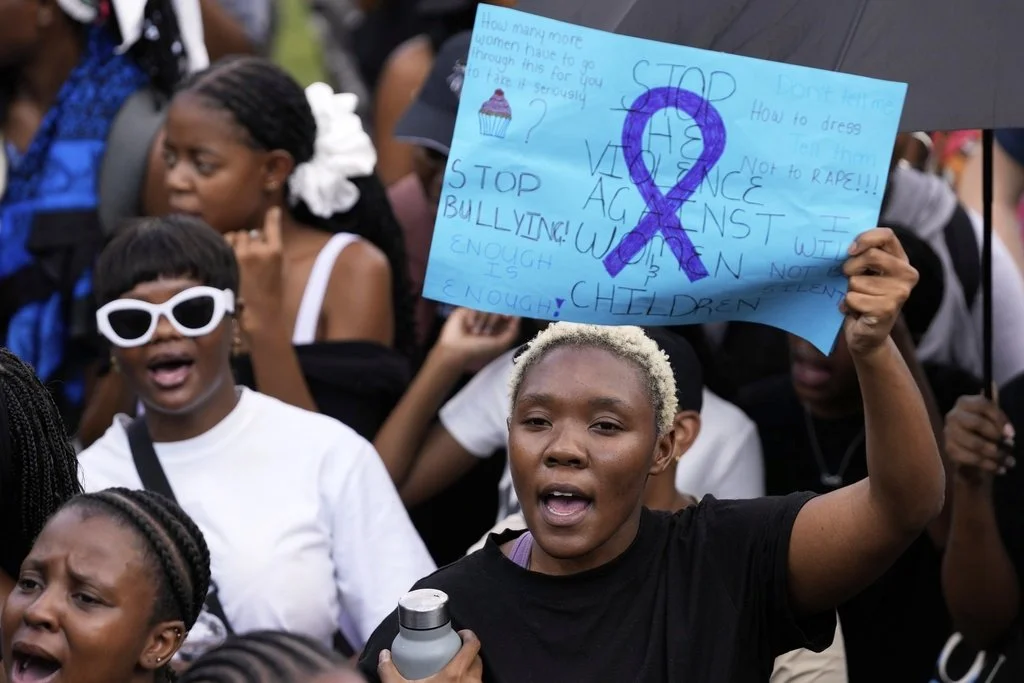
Activists chant slogans as they hold placards during the women's protest and hand over of a petition demanding that gender-based violence and femicide be declared a national disaster, at the Union Buildings in Pretoria, South Africa, Friday, April 11, 2025. (AP Photo/Themba Hadebe)
In 2019, protests spread across the country in reaction to the rape and slaying of Uyinene Mrwetyana, a 19-year-old University of Cape Town student. At the time, President Ramaphosa expressed, “Enough is enough.’ I agree with you that, indeed, Enough is enough.” Seven years later, the country looks back on him with marches echoing the same sentiment he gave to the crowds, hoping that the 12 women’s names will not be forgotten and will mark a turning point in eradicating the culture of gender-based violence in South Africa.