
Eastern DRC: Peace Negotiations Continue as Conflict Persists
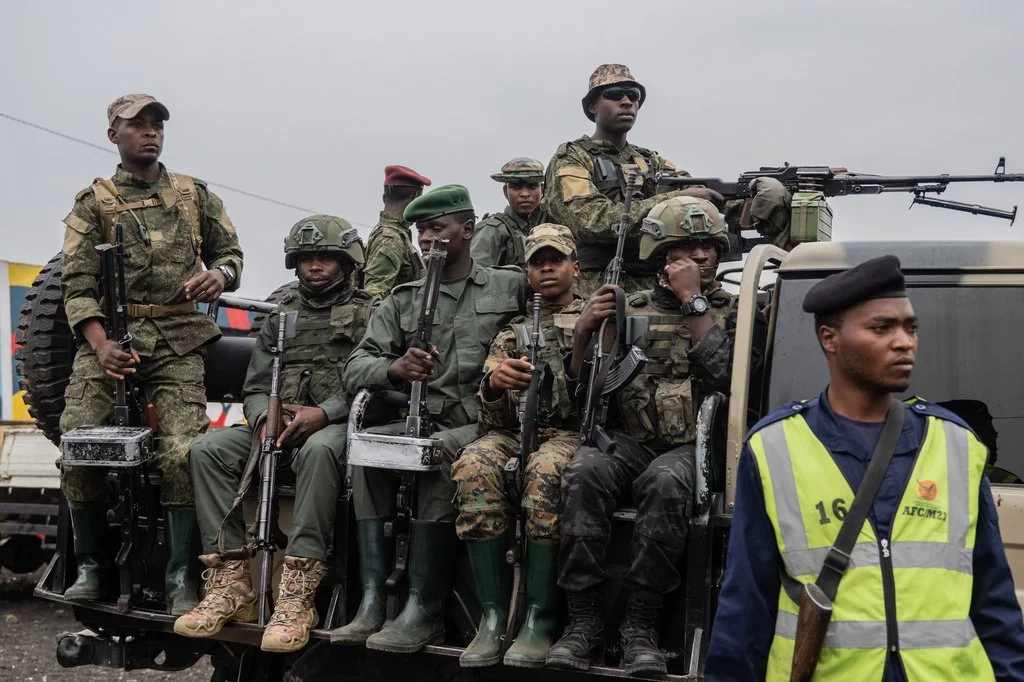
AFC/M23 soldiers stand by during the funeral service for civilians killed in a drone strike in Goma, Democratic Republic of Congo, Thursday, Jan. 8, 2026. (AP Photo/ Moses Sawasawa)
In the eastern Democratic Republic of the Congo (DRC), fighting continues. In September 2026, Congolese government forces and the AFC/M23 fought each other in North Kivu and South Kivu despite several ceasefire monitoring efforts. The conflict persists even as negotiations and international monitoring efforts continue.
The AFC/M23 is a political and military organization opposing the Congolese government in eastern Congo. The group emerged in 2012 after former fighters from the National Congress for the Defense of the People (CNDP), a Congolese rebel group, alleged that the Congolese government in Kinshasa had failed to fully implement a peace agreement signed on March 23, 2009. After a military defeat in 2013, the group resumed armed activities in 2021 and expanded territorial control in 2022.
According to the United Nations, in 2025, the AFC/M23, with support from the Rwandan Defense Forces, seized Goma and Bukavu, gaining control of the main cities of North Kivu and South Kivu. The rebel group established its own administrations in several areas. The United Nations has reported that the Rwandan government, based in Kigali, “provided backing support to the rebels intending to control the territory of the DRC and its natural resources.” However, Rwanda cites concerns over the FDLR, an armed group in eastern DRC linked to individuals responsible for the Tutsi genocide in Rwanda. Rwanda’s involvement has extended the conflict beyond a confrontation between the Congolese army and a rebel group, turning it into a regional issue.
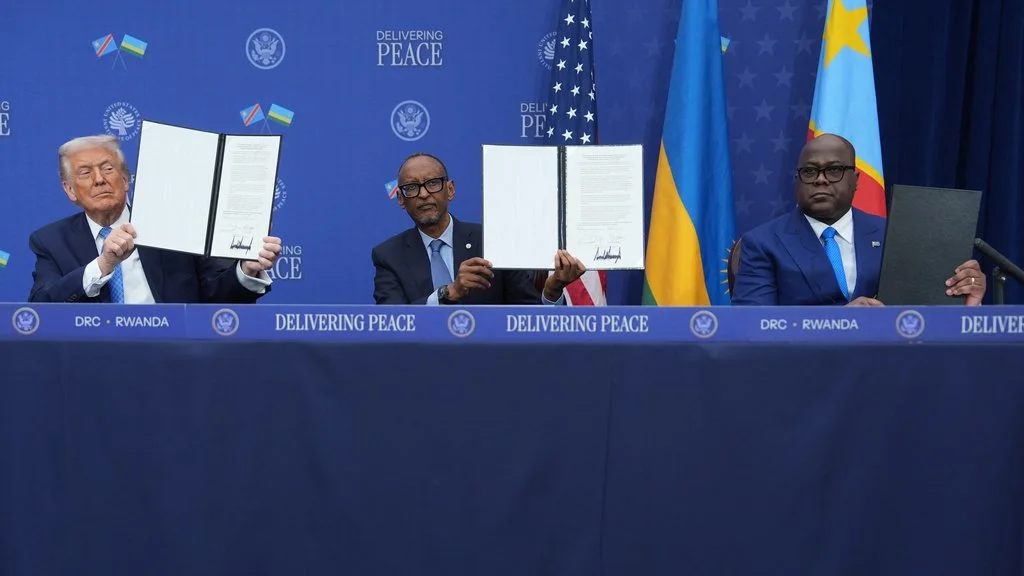
President Donald Trump, Rwanda's President Paul Kagame and Democratic Republic of Congo President Felix-Antoine Tshisekedi, during a signing ceremony at the U.S. Institute of Peace, Thursday, Dec. 4, 2025, in Washington. (AP Photo/Evan Vucci)
There are two main diplomatic tracks aiming for peace in the area. On one hand, the Washington Accords for Peace and Prosperity are a U.S.-brokered peace framework between the DRC and Rwanda. On December 4, 2025, the two governments signed a peace agreement under the Trump administration’s mediation, aiming at a “cessation of hostilities” and the “establishment of a permanent ceasefire, a disarmament program, a process for the return of displaced people and measures to hold perpetrators of abuses accountable.” The agreement then addresses the interstate dimension of the conflict.
On the other hand, the Doha process between the Congolese government and the AFC/M23 directly addresses the conflict between Kinshasa and the armed movement. On November 15, 2025, the two parties signed the Doha Framework for a Comprehensive Peace Agreement, establishing a framework for a final peace agreement composed of eight protocols. These protocols address issues including the release of prisoners, the establishment of a humanitarian mechanism for aid, the restoration of state authority, and the return of displaced persons. By 2026, only two of the eight protocols had been signed, and the remaining six were still subject to negotiation. Even with these diplomatic efforts, many of the political, security, humanitarian, and governance issues driving the conflict remain unresolved.
The principal challenge is no longer the lack of negotiations, but the difficulty of committing to the diplomatic agreement to create real improvements on the ground. On August 20, 2026, the Congolese government suspended - until further notice - the academic and para-academic activities for the 2026–2027 academic year for eleven public higher-education institutions in Goma and Bukavu.
The humanitarian toll has also been significant. The UN Joint Human Rights Office (UNJHRO) reported 2,996 human rights violations and abuses affecting 6 189 victims across the DRC, including 811children between Jan. 1, 2026, and June 30, 2026. Moreover, the UNJHRO recorded 5.8 million internally displaced in the DRC by June 2026. This includes 3.59 million in Ituri, North Kivu, and South Kivu. In an April 2026 report, MONUSCO recorded “532 protection incidents across North Kivu and Ituri Provinces, resulting in the deaths of 468 civilians,” including 75 women and 62 children, and “352 civilians injured, including 40 women and 94 children.”
There is a significant gap between diplomatic agreements and everyday reality. The main issue is no longer to produce new agreements, but to turn the existing commitment into measurable changes on the ground.