
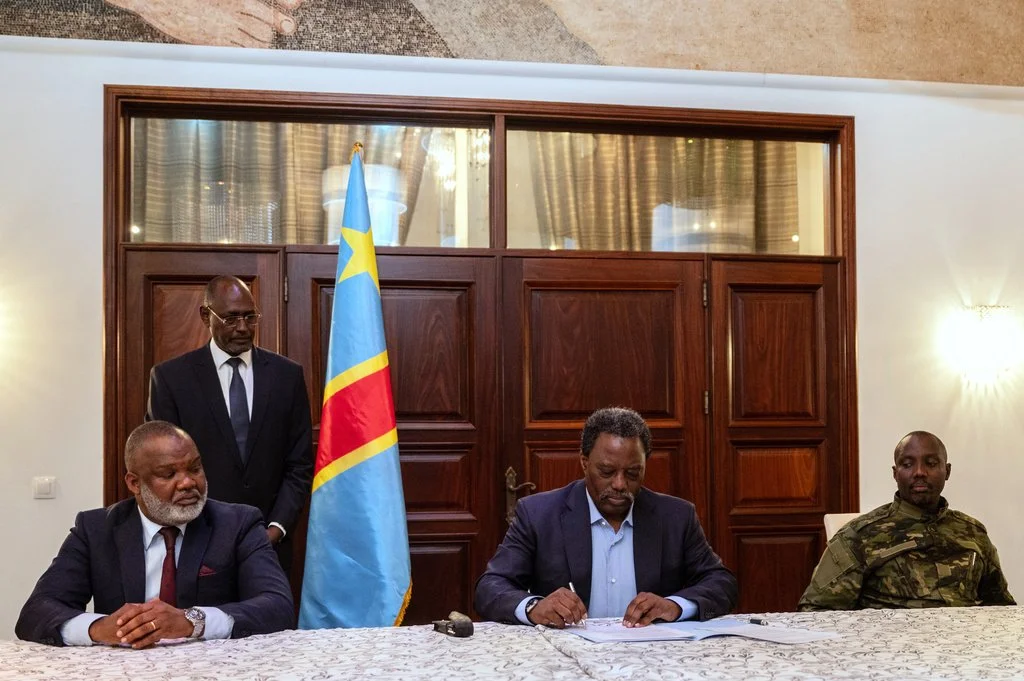
Joseph Kabila, center, former president of the Democratic Republic of the Congo, during the announcement of the creation of the Front pour la refondation de la nation (FRN), or Front for the Refoundation of the Nation, in Goma, eastern Congo, Monday, Oct. 12, 2026. (AP Photo/Moses Sawasawa)
On Oct 12, two rebel groups in the eastern Democratic Republic of the Congo (DRC) announced their union under the same banner, the Front for the Refoundation of the Nation (FRN). These two groups, the Congo River Alliance (AFC) and the March 23 Movement (M23), have chosen Joseph Kabila, the previous president of the DRC, as their leader, with the goal of ‘fighting tyranny’ from the central government in Kinshasa.
Kabila became President of the DRC in 2001, following the assassination of his father, President Laurent-Désiré Kabila, who fought against President Mobutu Sese Seko in the First Congolese Civil War. During the Second Congolese Civil War, political ties with Rwanda collapsed and led them to begin arming militias in the DRC, with M23 becoming one of the more notorious groups, formed in 2012, accusations Rwanda has denied.
The fallout from the Second Congolese Civil War led to severe instability throughout the country. Not only M23, but many other rebel groups have been backed by Rwanda and Uganda, as well as pro-government militias being armed by the DRC. Despite peacekeeping missions, little has been done to improve the situation, making these efforts deeply unpopular among Congolese citizens.
In addition to a history of regional conflict, natural resources also play an important role. The DRC contains some of the largest reserves of metals such as cobalt, with roughly 70% of the total supply coming from the country. Cobalt is used in products such as electric vehicles and other electronic devices such as smartphones. Thus, control of natural resources gave a huge economic boost to companies and countries, which was the aim of warring parties during the civil wars, and remains to this day as Chinese, Swiss, and Emirati companies (among others) sign lucrative deals with mining companies, mostly concentrated in eastern DRC.
While Kabila’s term officially ended in 2016, he managed to illegally remain in power until 2018, citing issues with voter registration. By that point, international pressure to call elections reached a maximum, and the election saw Felix Tshisekedi accede to the presidency, despite criticisms of rigging. This was the first time the DRC saw a peaceful transfer of power between presidents.
During the elections, Tshisekedi and Kabila struck a deal that essentially shared political power between the two of them. Tshisekedi would maintain Kabila’s allies in key institutions in exchange for the presidency. However, the deal began to unravel by 2020, as appointments to courts and the electoral commission removed Kabila-era figures. Corruption cases into Kabila’s presidency soon began, eventually leading him into self-imposed exile in South Africa in 2023.
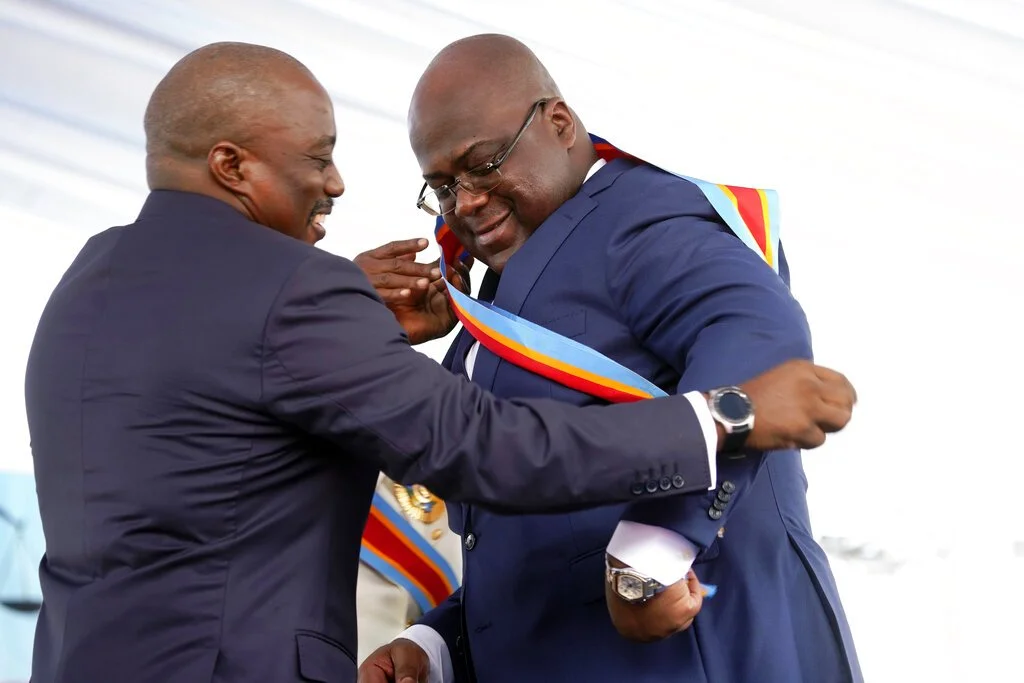
Congolese President Felix Tshisekedi, right, receives the presidential sash from outgoing president Joseph Kabila after being sworn in in Kinshasa, Democratic Republic of the Congo. (AP Photo/Jerome Delay, File)
After spending two years away from the DRC, Kabila returned to the M23-controlled city of Goma, the capital of the North Kivu province in the DRC and close to Rwanda, in 2025. This comes after his immunity was stripped, the banning of his political party, and being sentenced to death in absentia, due to substantial evidence of his collaboration with M23, for acts considered war crimes, treason, and crimes against humanity.
Kabila has since hit back against the court ruling, accusing Tshisekedi’s presidency of being a dictatorship, citing corruption, economic challenges, and the use of mercenaries in the military. Tshisekedi’s government has been marked by democratic backsliding, a crackdown on opposition, and attempts to extend presidential term limits.
From this moment, the DRC, Rwanda, and M23 have agreed to two framework deals to stop the fighting in the east, which flared up again in 2022. Tshisekedi was forced into dialogue after Goma was captured by M23. One deal struck between the DRC and Rwanda was mediated by the US, while another was struck by Qatar between the DRC and M23. Both framework deals included a ceasefire, disbanding of armed groups, and establishing humanitarian corridors; meanwhile, the US-brokered deal also included mineral-sharing agreements. Roadmap issues and accusations of opposing parties committing violations have led to the deal being ineffective.
Kabila’s unveiling as the head of the new rebel coalition provides a new layer to the conflict. Many residents in the east believe the war will drag on for much longer than previously anticipated. Political dialogue becomes a less viable option as bargaining through the exercise of hard power has seen success, as seen through the Qatari and US frameworks that came after M23’s capture of Goma.
Having merged several groups that took part in the Qatari dialogue, the FRN has stated that it bears responsibility for all the commitments and obligations agreed to in the framework deal. It remains to be seen how the group will assume this responsibility, or if it will act in accordance with the deal.