
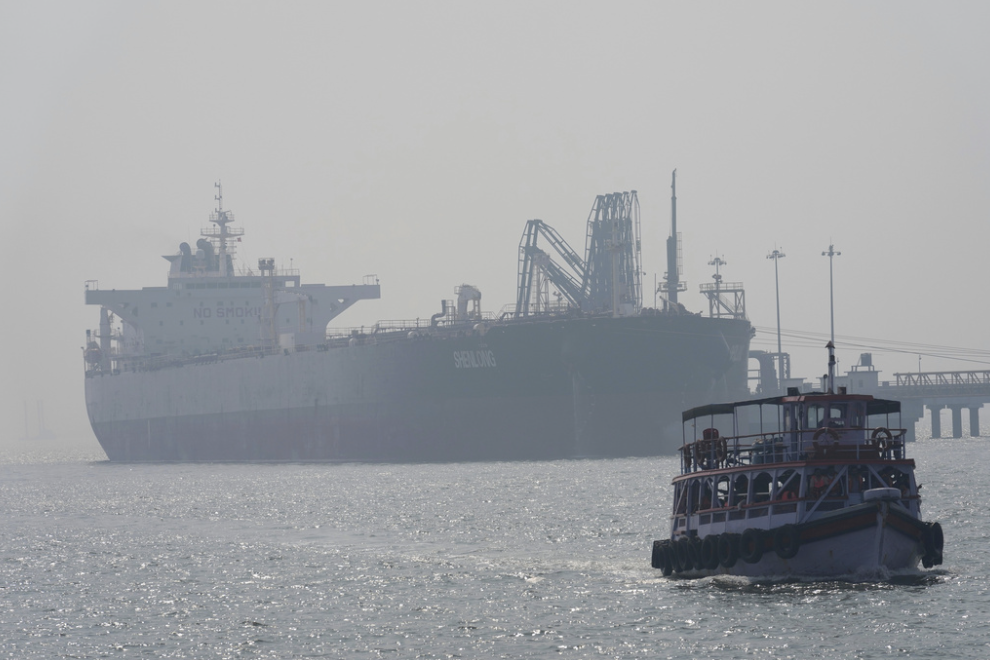
Liberia-flagged tanker Shenlong Suezmax, carrying crude oil from Saudi Arabia, that arrived clearing the Strait of Hormuz, is seen at the Mumbai Port in Mumbai, India, Thursday, March 12, 2026. (AP Photo/Rafiq Maqbool)
About 45 miles off the east coast of Malaysia's Johor state, oil tankers have spent the Iran war doing what a US naval blockade has prevented Iran from doing domestically: selling oil. However, that oil is almost gone. In early October, the analytics firm Kpler estimated that about 15 million barrels of Iranian crude were still afloat outside the blockade and would run dry by the end of the month. United Against Nuclear Iran, a US advocacy group that tracks the tankers by satellite, put what was left in the anchorage outside of Johor at 10 million barrels after 9 million were moved out in September. The 9 million barrels were all headed for small, independent Chinese refineries known as teapots.
The anchorage, known as the Eastern Outer Port Limits, sits inside Malaysia's exclusive economic zone (EEZ) but outside Malaysia’s territorial sea, where it can effectively enforce policy. Since the war started, Iranian tankers traveled to the Anchorage site, and loaded crude into other ships. These ships would then head for their final destination, a refinery in China, which currently buys about 90 percent of Iran's oil. In late July, UANI counted at least 261 vessels at anchor there, 21 through their transponders.
The stockpile exists during a temporary pause of the blockade. The United States blockaded Iranian ports from April 13 to June 18, then lifted the blockade under a 60 day memorandum of understanding with Iran and issued a license allowing Iranian oil sales. Iran moved fast. Twenty-six tankers left carrying around 45 million barrels of oil sailed for the Malaysian anchorage, and floating stocks there rose above 28 million barrels by July 31.
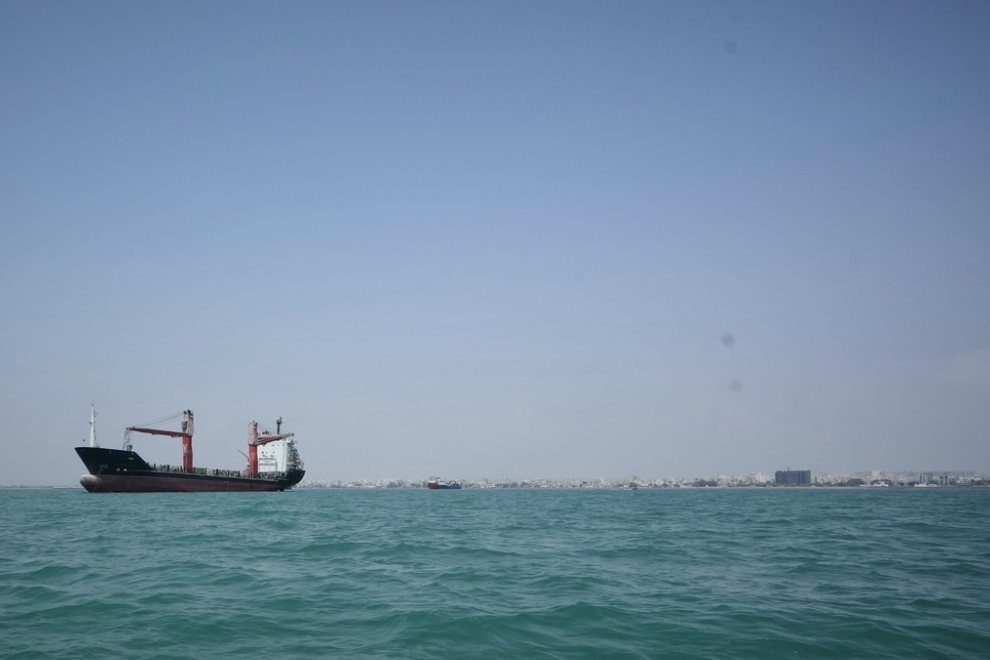
A cargo ship lies anchored in the Strait of Hormuz off Bandar Abbas, Iran, with the city's skyline in the background, Sunday, Sept. 6, 2026. (AP Photo/Vahid Salemi)
The deal between the United States and Iran lasted less than a month. After Iran's Revolutionary Guard renewed attacks on commercial shipping on July 7, Washington revoked the license and reimposed the oil blockade a week later. Iranian crude has not crossed the blockade line since, UANI says, leaving Tehran to sell only what it had already parked off Malaysia’s coast.
The Maritime Executive predicts that those sales are the remaining lifeline for Iran. Oil revenue has covered about 40 percent of Iran's government revenue, and once buyers pay for the last barrels, likely by the end of December, Iran could lose a substantial share of its annual income.
Washington has also pursued the trade outside the Persian Gulf. In April, US forces boarded the sanctioned tanker "Tifani" in the Indian Ocean as it carried 2 million barrels of Iranian crude bound for Southeast Asia. “Tifani” is noted as a vessel of the Iranian ‘shadow fleet’, whose previously made transfers off of Singapore and Malaysia prior to seizure by US forces. "International waters are not a refuge for sanctioned vessels," the Pentagon said in a statement addressing the seizure of the tanker. In August, Treasury Secretary Scott Bessent announced sanctions on the brokers, fuel suppliers, and financial intermediaries that keep the tankers running.
However, doing business with Iranian ships remains legal in Malaysia, as the Malaysian government has rejected the legitimacy of US sanctions on Iran. China, the end buyer, rejects the premise of Washington’s argument. In April, after Washington sanctioned a Chinese private refiner over its ties to Iran, a foreign ministry spokesperson proclaimed Beijing opposes unilateral sanctions that lack a basis in international law.
Malaysia's legal position has shifted throughout the conflict. In May, the head of its maritime enforcement agency told The Associated Press that the transfers often happen in international waters where Malaysia has no jurisdiction. In June, the government introduced regulations requiring Malaysia’s written permission for cargo transfers anywhere in its EEZ. Malaysia invokes the law of the sae, which gives coastal states the right to protect their marine environment there. In September, it declared a marine sensitive area near the Singapore Strait, banning bunkering and most anchoring.
Malaysia’s rules have had limited success. UANI said Malaysian authorities ran targeted operations against the “Shadow Fleet” in September and at least 25 tankers departed, moving their transfers to waters south of Hong Kong and Zhuhai, China. On Oct. 8, the group counted about 22 tankers loitering inside and 24 more just to the north.
The summer demonstrated how quickly the trade resumes. When the blockade was lifted in June, it took about six weeks for Iran to refuel the anchorage, filling back up to peak capacity. As Iran loses its primary source of income, it raises questions about how the United States will use the blockade as leverage in ending the war.