
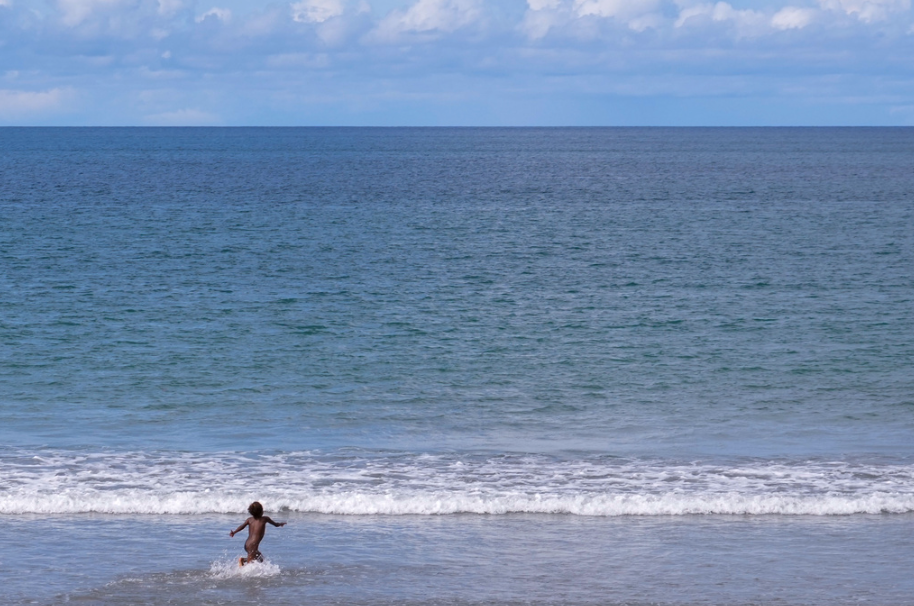
A boy has fun on the shoreline of Vanimo, Papua New Guinea, where Pope Francis met with the faithful, Sunday, Sept. 8, 2024. Pope Francis celebrated the Catholic Church of the peripheries on Sunday as he traveled to the remote jungles of Papua New Guinea, bringing with him a ton of medicine and toys and a message of love overcoming violence for the people who live there.(AP Photo/Gregorio Borgia)
Bougainville, an autonomous island in Papua New Guinea, is on the cusp of independence after a devastating civil war that lasted nearly a decade.The decade-long war was helped triggerd by the Panguna copper and gold mine on the island, which is now being reopened as an economic guarantor for Bouganville’s independence. However, Panguna’s history complicates recommencement as it questions whether the resources would be extracted in a way that benefits Bougainville's people
After Papua New Guinea gained independence from Australia in 1975, Bougainvilleans unilaterally declared independence, but the declaration was not recognized. Panguna’s opening, which was once one of the world’s biggest mines run by an Australian company Rio Tinto, provoked the decade-long civil war. The mine was closed and abandoned in 1989 after facing backlash over how the region received less than two percent of the wealth generated although the environmental costs paid by the region were devastating. Under Francis Ona’s leadership, the Bougaainville Revolutionary Army (BRA) fought in the civil war to restore Bougainville as Me’ekamui, or the “Holy Land”. The conflict killed as many as 15,000 people and displaced an entire generation, cementing Bougainville’s desires for independence from Papua New Guinea. The war ended with the Bougainville Peace Agreement in 2001, which provided for the territory’s autonomous governance and that a referendum would be held to determine its political future.
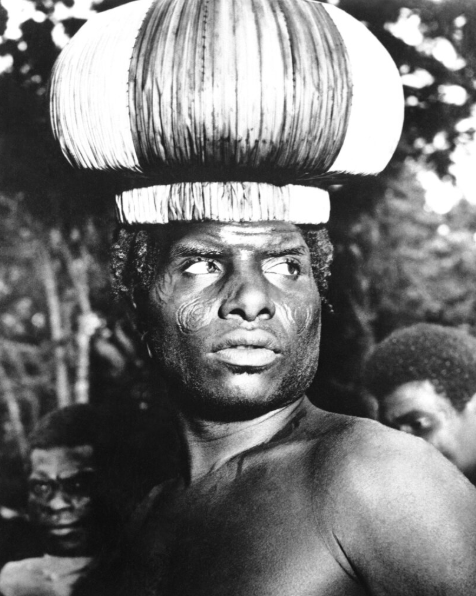
In this image provided by the U.S. Marine Corps, a native boy of the Buka Passage district of Northern Bougainville, came to Ibu on Jan. 7, 1945 with several others of his tribe to act as porters for a Marine patrol moving North. He wears the blue and red headpiece until married and it is taboo for a woman to see him without it. The facial scars are tribal tattoos. When the Marine beachhead was established on Bougainville, part of the Fiji Regiment participating in the engagement set up an outpost at Ibu, barely ten miles from the heart of the Japanese forces at Numa Numa. While on this 60-day foray into enemy territory, these jungle fighters killed more than 400 Japanese, with a loss of one man. (AP Photo/U.S. Marine Corps)
With questions about whether Bougainville can sustain itself economically, President Toroama said the mine can generate economic development that could provide the region with essential revenue, infrastructure and jobs earlier in September. Bougainville’s mining company spent several months conducting a public search for an international partner, speaking to some of the world’s most experienced mining companies. China and the US showed interest, both offering major investments and an American military base.
However, last November, an unexpected announcement followed. Despite warnings from the state-owned Bougainville Copper Ltd (BCL), the president signed a memorandum of understanding (MoU) to redevelop the mine with Lloyds Metals and Energy Ltd. An Indian company with no background in copper or gold extraction. BCL cautioned that Lloyds lacked the resources to reopen the mine and might not be able to provide adequate support to the region following independence. Toroama, however, said that he chose Lloyds partly due to claims that the company delivered economic support to conflict-affected communities in India.
Nevertheless, the lack of transparency and consultation with landowners during the selection process has sparked concern. The company provided medical assistance to Toroama’s wife when she was flown to India for a kidney transplant. Both the company and the president deny this as the reason behind the partnership. The Indian company’s rapid progression has angered some landowners whose memories of the war remain fresh. Last month, 45 heavy vehicles bearing the Lloyds sign were set on fire by the local alluvial miners. Nonetheless, the president called the incident an isolated act of violence and the work on the mine would continue.
Residents also worry about the environmental costs of reopening Panguna. Theonila Roka Matbob, a regional environmental activist, said she had to travel miles to another region to find trees. Others also shared how their homes downstream have turned into deserts and large areas have increasingly been inundated with mine water. Roka Matbob was among the Bougainvilleans who filed a complaint against Rio Tinto, alleging environmental and human rights violations. The toxic waste and decaying infrastructure left behind by the Rio Tinto-operated mine continue to threaten thousands of residents decades after closing. A large-scale study done in 2024 revealed violations of indigenous people’s right to water, education, and daily life. There were also potential impacts to their rights to life, health, nutrition, housing, and standards of living. Few residents live past the age of 60 and the health effects of the mine on the people of the region are very apparent.
The reopening of the Panguna mine raises questions about whether the mine will benefit or harm the island’s future. Beyond mine operations, Lloyds has promised investments to hospitals, women’s sewing initiatives, tourism, higher education, and a special economic zone. A smaller partner may afford Bougainville greater administrative leverage, ensuring that a giant multinational corporation does not overshadow the state government or dictate terms of the nation's future. However, residents continue to fear that this reopening will increase environmental costs and deprive would deprive the region of a chance of becoming a successful sovereign nation.