
How is Southeast Asia Navigating AI?
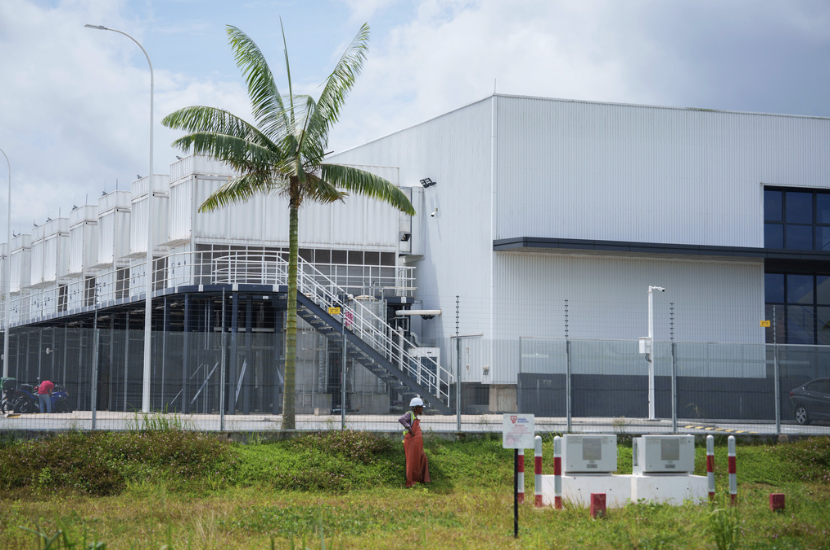
Construction workers stand outside a Data center in construction in Sedenak Tech Park in Johor state of Malaysia, Friday, Sept. 27, 2024. Photo: AP Photo/Vincent Thian
Due to increasing regional investments in artificial intelligence (AI), Southeast Asia has become the epicentre of the AI boom. The ASEAN economies remain attractive investment destinations because they offer cheap land, massive volumes of water, and high-capacity power grids. However, these states have begun to surrender high-margin intellectual property, algorithmic sovereignty, and corporate profits to foreign headquarters.
Singapore, due to its strong base for semiconductor talent, has become a regional base for developers and cloud providers, leading the city-state to increase its annual economic growth forecast from 2-4% to 4.5-5-5%. Major investments from global tech giants include Amazon Web Services’ plan to invest over $33 billion through 2039 and Microsoft’s $2.2 billion pledge in Malaysia, among others. These commitments have brought a massive influx of capital into Southeast Asia.
Southeast Asian governments, technology firms, and research institutions have begun building mixed AI stacks, combining foreign foundational models, and cloud infrastructure with local-language data and regionally developed applications. Built on global foundational models, AI programmes such as Singapore’s SEA-LION (Southeast Asian Languages in One Network) and Indonesia’s Shabat-AI were developed with a focus on Southeast Asian language, code-switching, and multimodal capabilities. So far, this has helped the region avoid having to align with either American or Chinese technology.
The mixed stacks offer three main advantages for the region. Firstly, local adaptation can improve performance in sectors such as healthcare and education. They also improve efficiency, as smaller, more specialized models may be cheaper to operate and easier to customize for developers. Finally, they can strengthen governance capacity, allowing governments and firms to compare performance in local context and identify weaknesses earlier on in the development process.
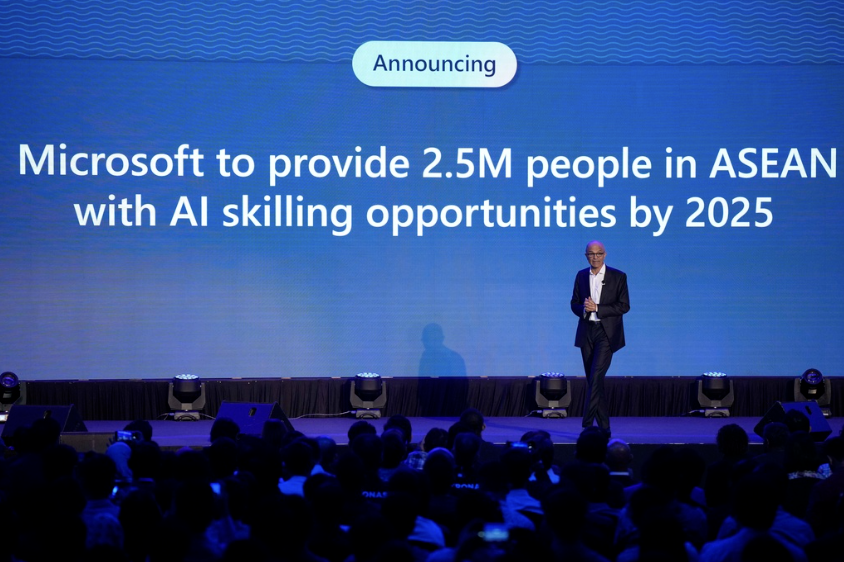
Microsoft CEO Satya Nadella speaks during a conference in Kuala Lumpur, Malaysia, Thursday, May 2, 2024. Microsoft will invest $2.2 billion over the next four years in Malaysia's new cloud and artificial intelligence infrastructure as well as partnering with the government to establish a national AI center, Nadella said Thursday. Photo: AP Photo/Vincent Thian
The region, however, remains especially vulnerable to a possible collapse in the AI boom. Positioned at the center of global AI supply chains and increasingly integrated into AI-driven financial markets, the region is particularly exposed to disruptions that could trigger shocks across financial markets and the real economy. With growing concerns of global warming and environmental crises, data centers pose a high threat to the environment. While the AI surge promises jobs, digital infrastructure, and a strong foothold in the global economy, its rapid growth is straining resources and sparking public backlash. Earlier last week, the governor of Indonesia’s West Java province ordered an immediate halt to construction at a site run by Singapore’s BDx Data Centres. Earlier in September, Thailand paused over 160 data centre projects. Residents and farmers of Iloilo province in central Philippines, protested against a proposed 50MW AI data centre, making its Norwegian investor withdraw the application just days later. Even though public backlash might not be the primary reason for governments to reconsider their policies towards AI, it remains a significant political cost.
With increasing investment and more projects, the resources that initially seemed abundant are starting to fall short. Across ASEAN, data center electricity demand is expected to jump from 9 terawatt-hours in 2024 to 68 terawatt-hours by 2030, straining power grids that are reliant on fossil fuels. The evaporative cooling systems for a standard 100-megawatt data center require roughly 4.2 million liters of water daily, a volume equivalent to the daily domestic consumption of hundreds of thousands of local residents.
Along with environmental concerns, Southeast Asia finds itself caught in a structural trap. Caught between two superpowers, the US and China, the region imports hyper-expensive hardware while consuming its own finite natural resources to power intensive workloads. The region then buys back fine-tuned AI applications at high subscription rates that exhaust local economies.
ASEAN governments have begun to carefully navigate AI-related policies, recognizing that local data centres do not equate to jurisdictional sovereignty when system administration, cloud control planes, and decryption keys remain under the authority of foreign corporations. The ASEAN Digital Economy Framework Agreement (DEFA), set to be signed in November, offers a path forward. Positioned as the world’s first region-wide digital economy pact, DEFA harmonizes rules for digital trade and e-commerce across Southeast Asia. By enabling economic interoperability, the agreement allows ASEAN members to pursue distinct technological alignments without losing sight of regional cost burdens.
In the event of heightened geostrategic conflict, similar to supply chain disruptions such as the Strait of Hormuz, foreign providers retain the capability to execute a 'digital kill-switch.' Abruptly disabling access to essential software systems in this manner could dismantle ASEAN's long-standing doctrine of non-alignment and strategic autonomy. In this context, initiatives like DEFA reflect the region’s strategic effort to establish collective guardrails as Southeast Asia continues to navigate AI.