
Flooding Devastates Bangkok’s Drainage Systems
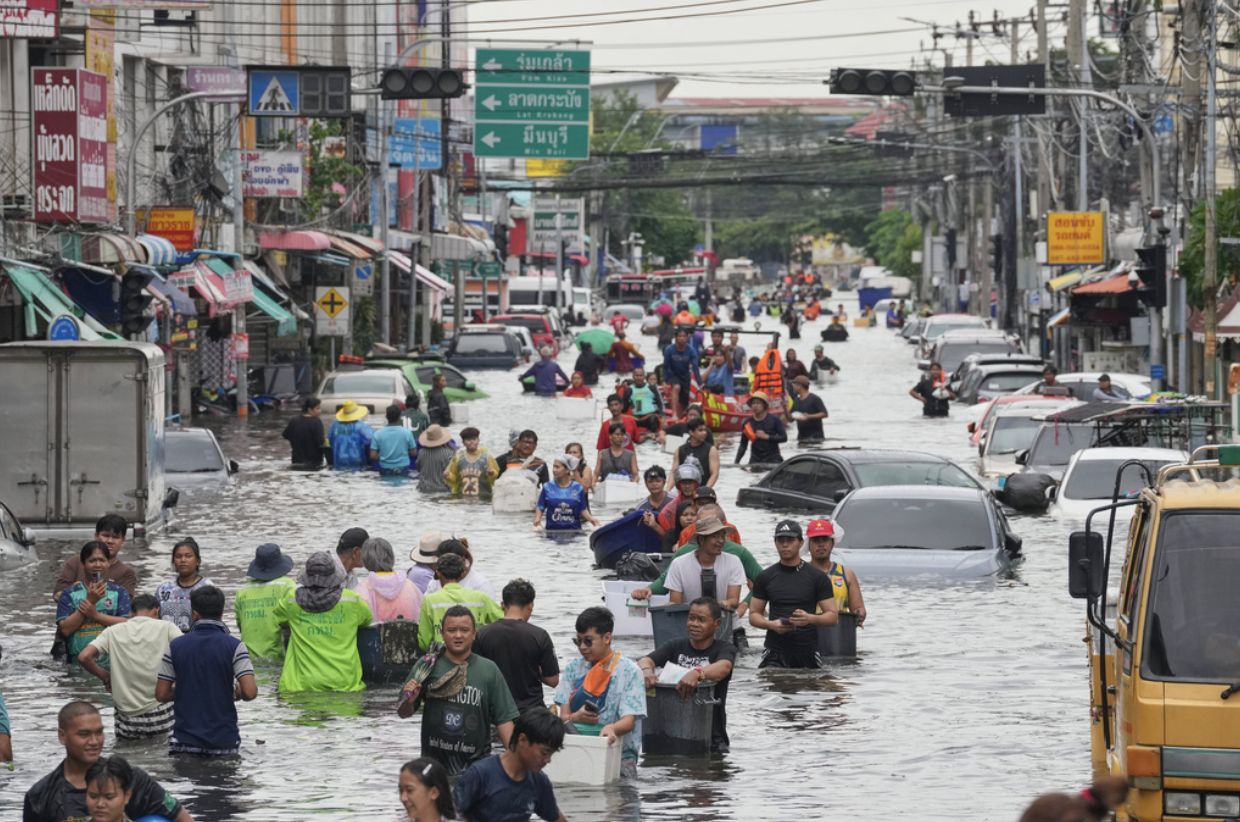
People wade through a flooded street after heavy rain in Bangkok, Thailand, Monday, Sept. 28, 2026. (AP Photo/Sakchai Lalit)
A flood disaster was declared across all 50 districts of Bangkok after more than 300 millimeters of rain fell over a single weekend. While localized thunderstorms are a standard feature of Thailand’s wet season, recent rains have "inundated Bangkok’s drainage system” beyond its operational threshold. The large volume of surface runoff quickly overwhelmed the city’s primary canal network, causing waterways to overflow and leaving major roads submerged in waist-deep water.
The severity and regularity of the flooding across Bangkok was dictated by the city’s natural landscape. Several districts, particularly in northern, northeastern, and eastern Bangkok, sit on low-lying ground, creating a basin-like topography where runoff naturally occurs . The Chao Phraya River serves as the primary outlet for Bangkok’s drainage system. Because these districts are located furthest from the river, gravity-fed runoff moves slowly, leading authorities to warn that it could “take up to two weeks for water to fully recede from the eastern lowlands”. Widespread flooding across Thailand's low-lying Central Plains further increased water pressure towards the capital.
The primary bottleneck occurred within the capital’s gravity-fed drainage channels. As water levels in four major canals rose too high, the central network lost its capacity to absorb runoff from the surrounding municipal streets. This infrastructure breakdown caused severe geographical disparities in flood impact. Eastern Bangkok was hit the hardest, where Governor Chadchart Sittipunt reported that main canals remained completely full, keeping 748 communities flooded across 15 districts. Key commercial and transit areas were deeply inundated. In residential neighborhoods, water levels reached knee-to-waist height, forcing stranded residents to navigate the streets using small boats.
Because passive canal flow stalled under the sheer volume of water, city authorities were forced to rely heavily on active mechanical pumping operations to relieve submerged communities. In Bang Kapi district, municipal crews installed mobile water pumps around housing flats, successfully forcing out stagnant floodwaters and lowering neighborhood water levels by approximately 30 centimeters. Other measures included rerouting floodwater, with emergency teams deploying specialized pumps and boats to accelerate its discharge into secondary canals.
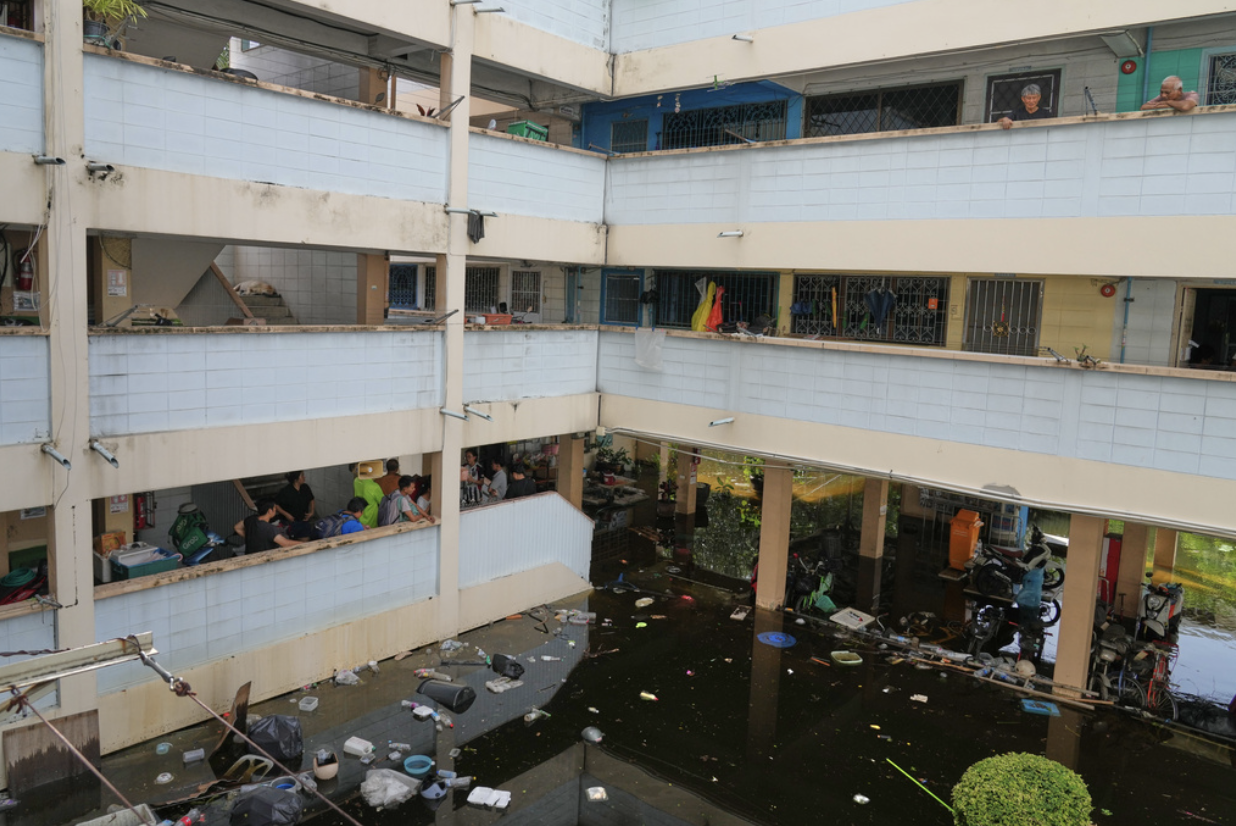
Residents of a building look out at the flooded streets after heavy rain in Bangkok, Thailand, Tuesday, Sept. 29, 2026. (AP Photo/Sakchai Lalit)
Despite these interventions, the systemic drainage failure created widespread issues. More than 329,000 households, comprising over 700,000 residents, were affected across the city. Nearly 7,000 people were displaced to emergency shelters, while 40 flood-related deaths were reported across Thailand. The Bangkok Metropolitan Administration (BMA) temporarily closed all municipal schools on September 28, 2026, for safety checks and campus damage inspections. Meanwhile, special public holidays and extended stay-at-home orders were enacted to reduce traffic. Ground transportation disruptions were so severe that airport staff were unable to reach work, prompting the Thai Air Force to deploy 69 ground personnel to Suvarnabhumi Airport to clear massive passenger luggage backlogs.
As rainfall subsides and sunlight returns, canal levels have begun to drop, allowing drainage pumps to make steady progress. Although floodwaters are receding, the disaster highlights the need for adaptive engineering and stronger community resilience as Bangkok faces increasingly extreme weather.