
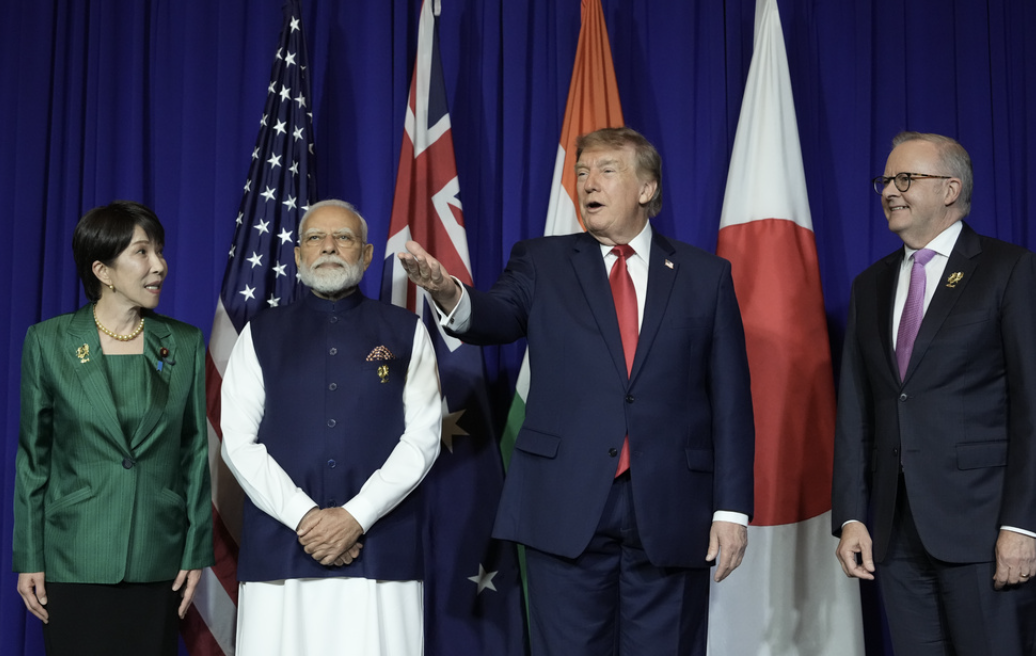
President Donald Trump, second right, reacts as, from left, Japan's Prime Minister Sanae Takaichi, India's Prime Minister Narendra Modi, and Australia's Prime Minister Anthony Albanese look on during the meeting of the leaders of the Quad in Manila, Philippines, Tuesday, Nov. 17, 2026. (AP Photo/Mark Schiefelbein)
When the leaders of the United States, Japan, India, and Australia met in Manila on Nov. 17, their joint press release opposed changing the status quo in the Indo-Pacific region “by force or coercion.” The leaders voiced deep concerns regarding economic coercion, including China’s export restrictions on rare earth metals. However, the Quad refrained from mentioning the South China Sea. In 2024, the Quad’s leaders had condemned “the dangerous use of coast guard and maritime militia vessels.” While meeting this year in the capital of a country whose vessels are being targeted, they left that statement out.
Four months earlier, a China Coast Guard boat with eight people aboard sailed close to the BRP Sierra Madre, a World War II-era landing ship that the Philippines has kept as an outpost on Second Thomas Shoal. A video released by the Philippine military shows the Chinese boat ramming a Philippine inflatable vessel sent to escort it away, followed by a confrontation involving poles and oars. The brawl resulted in a Philippine sailor being struck on the head. Manila blames a Chinese baton. China’s coast guard says the Filipinos swung first.
September and October brought further escalation between the two nations. On Sept. 18, a Chinese cutter rammed a Philippine fisheries ship that was delivering fuel subsidies to Filipino fishermen. Beijing then timed its actions to coincide with Chinese President Xi Jinping’s state visit to Washington. On Sept. 24, the day President Donald Trump welcomed Xi to the White House, Chinese coast guard ships backed by naval warships blocked a resupply mission to the Sierra Madre. It was the first publicly reported blockade since 2024, when a deal was made to let those missions through. That weekend, China’s military held a naval and air exercise around Scarborough Shoal. Washington’s answer, Brookings fellow Jonathan Czin noted, was virtually nonexistent. On Oct. 8, a cutter turned on its water cannon and closed within about 400 yards of a Philippine Coast Guard ship sent to evacuate a sick sailor from the outpost.
None of China’s actions has been treated as an armed attack, the threshold that activates the 1951 Mutual Defense Treaty. Beijing has spent years learning how far it can push without crossing that threshold and the treaty says almost nothing about the space below it. Washington and Manila can fix that without touching its text. The next time Trump sees Xi, he should say it plainly: a pattern of coast guard assaults on Philippine crews will bring formal consultations under the treaty’s Article III, announced as a step toward Article IV. That’s the clause that commits each country to act. Then he and President Ferdinand Marcos Jr. will have a proper framework to work with each other on, and an additional tool to use to combat gray-zone attacks.
On paper, the treaty already reaches these waters. Article V says an armed attack includes one on either country’s “armed forces, public vessels or aircraft in the Pacific.” Since 2023, both governments have said that those provisions cover their coast guards “anywhere in the South China Sea.” Sending the coast guard instead of the navy doesn’t buy China much of a loophole. Its coast guard has answered to the Central Military Commission, which commands the country’s military since 2018. Gregory Poling, director for the Southeast Asia Program at the Center for Strategic and International Studies, told me on Oct. 28 that many of its cutters are old navy ships that were “simply repainted.” “It doesn’t matter what color the hulls are painted,” he said.
What the treaty doesn’t specify is how much force counts, and international law sets the bar high. In its 1986 Nicaragua ruling, the International Court of Justice separated “the most grave forms of the use of force” from lesser ones. It also said a country can’t come to another’s defense on its own reading of events. The victim must declare that it has been attacked and request assistance, placing the initial decision in Manila’s hands.
Manila has reasons to hold back. “When the Philippines contemplates invoking the treaty, it sort of peers into the abyss and it’s not really sure what’s there,” Ray Powell told me on Oct. 26. Powell, a retired Air Force colonel, founded SeaLight, a maritime transparency project started with help from Stanford University’s Gordian Knot Center. His fear is a split in Washington. Officials at Indo-Pacific Command or the Pentagon promise support, Manila invokes the treaty, and then the president can announce that they won’t follow through. “That’s a huge loss for the Philippines, and you can’t get that back,” Powell said.
Beijing reads that hesitation well. Powell thinks China is trying to avoid three things: killing Philippine sailors, sinking a ship, and putting its navy in the middle of the fight. Then he hedged. “I don’t know if they’re red lines…They just might be kind of orange.” Below those lines, pushing pays. In Beijing’s view, he claimed, “escalation is always your responsibility and de-escalation is always your responsibility.” Each time Manila absorbs a new tactic, China further normalizes escalating tensions in the region. Scarborough Shoal, the Asia Maritime Transparency Initiative which Poling also runs, counted 516 Chinese coast guard ship-days in 2024, 1,099 in 2025, and 933 just in the first half of 2026.
Powell also doesn’t like calling the treaty a trigger, because “it sounds like it’s a binary on-off switch.” He’s right that it isn’t one. Article III commits the two countries to consult whenever either believes its security “is threatened by external armed attack in the Pacific.” Threatened, not attacked, is the most important distinction in the body of the treaty. It leaves the Philippines with a “Trump” card to use, and one that they’ve used in past negotiations. In May 2012, Manila’s foreign secretary pointed to that clause, a month into China’s standoff with the Philippines at Scarborough Shoal.
When I pitched Article III consultations to Poling, he was cooler. Poling stated that the Philippines and its allies are “kind of already doing that”, through more military aid, a new maritime security working group, and updated defense guidelines. The silence is the weakness. Consultations that are never publicly announced tell Beijing little about the potential consequences of a developing pattern and the Quad’s statement in Manila showed the same habit in a bigger context. A public version could deter China, Poling said, “but only if there’s a clear pathway to then trigger” Article IV.
Based on this, Trump and Marcos should set up a joint incident cell, run by both militaries and coast guards, to review every Chinese coast guard assault within 72 hours. The cell would judge each one as part of a pattern, not as an isolated incident. When the cell finds a pattern, the US secretary of state and the Philippine foreign secretary, the officials Article III names, should open consultations in public and say plainly that the next step is Article IV. Each finding should come with released evidence and sanctions on the Chinese units and commanders involved. If Manila asks, US Navy ships should escort its resupply runs to the Sierra Madre. In 2024, Adm. Samuel Paparo, commander of US Indo-Pacific Command, called an escort “an entirely reasonable option.”
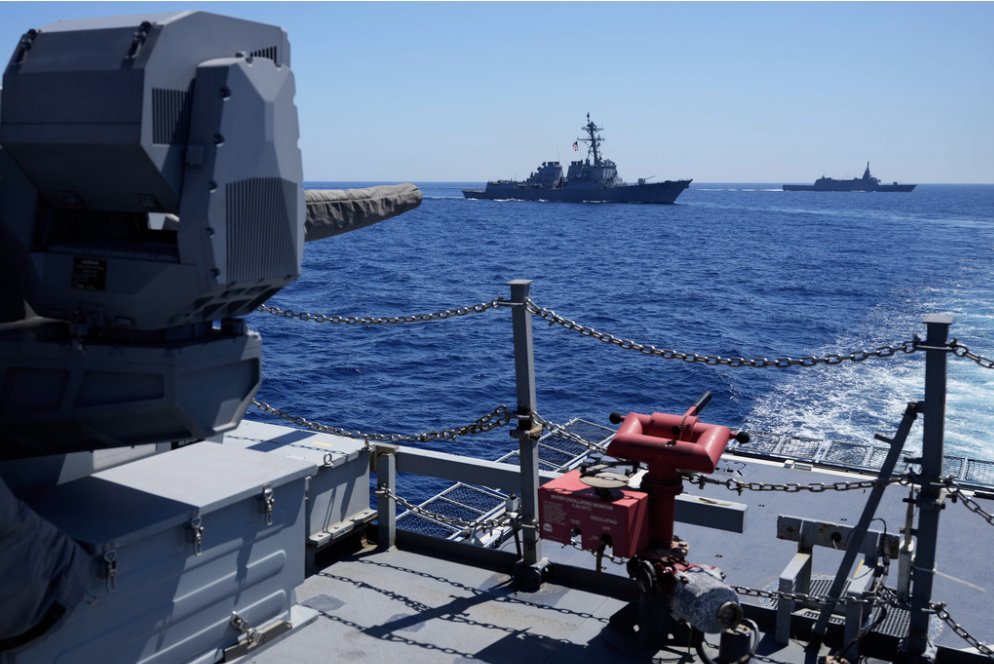
Philippine Navy Ship Jose Rizal leads maneuvers with US Navy USS Shoup (DDG86), center, and Japanese Maritime Self-Defence Force (JMSDF) frigate JS Noshiro. right, during the Philippines United States Japan Multilateral Maritime Cooperative Activity off a disputed South China Sea shoal on Friday, March 28, 2025. (AP Photo/Aaron Favila)
Powell pushed back on the idea of having US Navy ships escorting Filipino resupply missions. Because of the normalization of escalating tensions, Powell claimed that “once you involve the (US) Navy, you invite in the Chinese Navy.” Poling’s reply was blunt: “The only rational response to that logic is surrender.” China’s navy is already there. Poling pointed out that Chinese PLAN (People’s Liberation Army Navy) ships have been part of the blockade at Second Thomas Shoal; they “just stayed farther out.” If Manila judged that Chinese crews had threatened Filipino lives and the US Navy responded, any further escalation, he said, “would be on China, not on the United States.” Regarding escorts, Poling makes the better case. Powell’s warning should still set the order of events. Going public first ensures that if a US warship ever sails beside a Philippine supply boat, Beijing already knows why it’s there.
I asked the question about sending the US Coast Guard instead. Both experts agreed that the Philippines wants more joint naval drills with the US Coast Guard. However, Powell brought up the fact that the Coast Guard has neither the doctrine nor the ships for the job. At any given time, it may have “one or two” large cutters available, he said, and even those are “nowhere close to the size of the China Coast Guard ships.” Poling added a legal problem: the US Coast Guard has “absolutely no legal authority to conduct operations” in the Philippines’ exclusive economic zone. It’s a law enforcement agency under the Department of Homeland Security, not a branch of the military.
The hardest objection is one Poling raised himself: no mechanism can force a president’s hand in making a decision. “There is no way under US law that that decision doesn’t run through the person of the president,” he said. A public pathway won’t bind Trump or anyone after him, but it raises the price of walking away. A promise made in front of Xi, with each step on the record, is much harder to drop quietly than a private assurance. Poling’s answer to the president's problem is political cost, built by “creating more and more constituencies in the United States” that would demand the treaty be honored. Powell doubts that the constituency exists yet. With the United States in an isolationist mood, he said, “there’s not really a huge constituency” for treaties or interventions.
Congress has started building one. The defense bill passed in late 2025 intended to provide $500 million a year in security aid for the Philippines for five years. A bipartisan bill from Sens. Tammy Duckworth, D-Ill., and Marsha Blackburn, R-Tenn., S. 5160, would require the State Department to write a strategy against China’s gray-zone tactics and set up a task force to track them. “The Pentagon does war,” said Powell, who testified on the problem to the Senate in 2025. “There is no Department of Gray Zone War.” The Duckworth-Blackburn bill has sat in committee since July. If it doesn’t pass before this Congress ends in January, it dies and has to start over.
None of this takes the decision away from Manila. “The Filipinos are the ones that get to decide what the parameters are,” Poling noted. If a Philippine sailor were killed, he expects Manila would ask for more US presence and support on the water, which is “a lot easier for Trump to say yes to” than a war with China. Nor does any of it require reopening the treaty, which Powell warned against. He would “almost just rather leave it alone.”
Washington has its own reasons to care because the treaty runs both ways. Even if Manila stayed neutral in a war over Taiwan, Poling pointed out, a Chinese attack on US forces anywhere in the Pacific would seem to trigger the Philippines’ obligations to aid US forces against China. Philippine soil would sit next to that fight. The Philippines knows this, as the US and Philippine Marines have deployed troops and missiles to the Batanes Islands in the Luzon Strait last year. Manila’s own national security policy says a conflict in the Taiwan Strait “would inevitably affect the Philippines.” The treaty can die from either end, Poling warned. If Washington doesn’t show up when Philippine crews are attacked at sea, it dies. If Manila sits out a Taiwan war after China hits US forces, it dies just the same – only “in the opposite direction.”
For now, the abyss Powell described belongs to Manila. After every new assault, the Philippines has to guess what Washington would do if it asked for help. A public pathway from Article III to Article IV would hand that uncertainty back to Beijing. If Washington made clear ahead of time that it would treat a request seriously, Powell said, “China could then be the one that’s looking into the abyss.” Trump’s next chance comes when he and Xi are due to meet at the G20 in Doral, Florida, in December.