
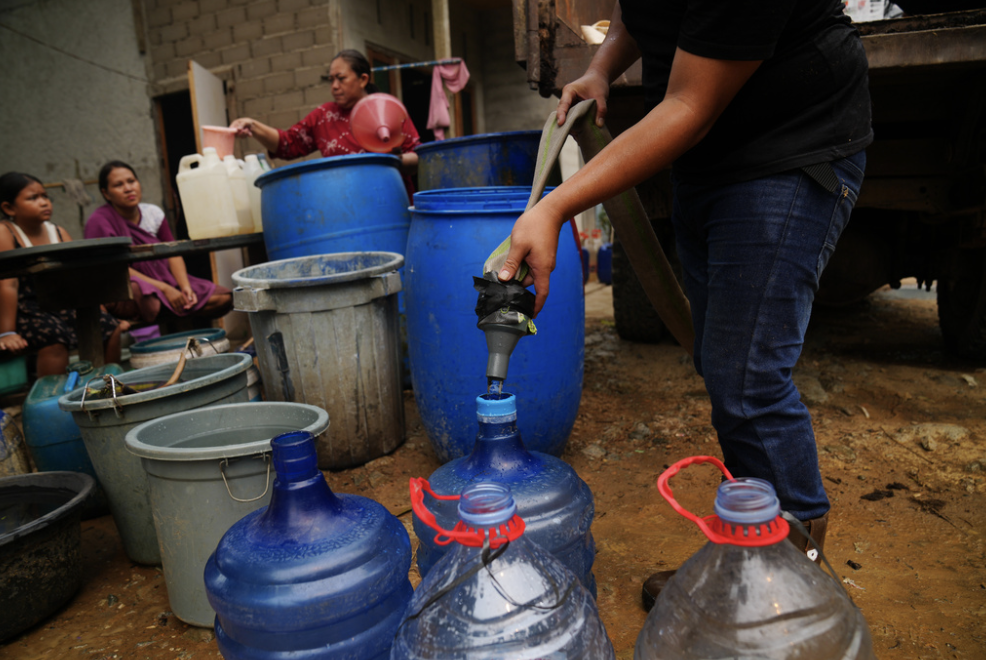
A resident fills their container with clean water as others wait for their turn from a tanker truck amid a drought in Sanggau, West Kalimantan, Indonesia, Sept. 11, 2026. (AP Photo/Tatan Syuflana)
For Juniardi Adinda Sembiring Gurukinayan, a 54-year-old tradesman living on the Indonesian island of Batam, the arrival of global tech investment initially inspired optimism. Local leaders promised economic modernization as state-of-the-art server farms sprang up to power the world’s artificial intelligence boom. But this optimism evaporated when municipal taps abruptly ran dry across his neighborhood. Juniardi told the Agence France-Presse that severe water outages soon forced him to skip daily showers just to conserve what little liquid remained for basic survival.
This disruption extended far beyond personal hygiene and affected more than one person. Juniardi experienced the blunt reality facing thousands of working-class households. Residents of Nongsa district say their neighborhoods went months without piped water. Ordinary citizens struggled to perform basic domestic tasks or buy expensive bottled water from delivery trucks. Meanwhile, less than 2 kilometers away, massive warehouse-like facilities inside technology parks continued drawing millions of liters of fresh water around the clock to cool rows of high-performance servers.
To fully understand how a digital boom can trigger a domestic water crisis, one must first understand the unique and fragile hydrological geography of Batam. Unlike other Indonesian islands, such as Java or Sumatra, Batam possesses no major natural rivers, freshwater lakes, or usable groundwater aquifers. Groundwater extraction through private wells is prohibited by municipal order due to poor subsoil quality and salt intrusion. Consequently, the island’s 1.3 million residents rely entirely on raw surface water collected from seasonal rainfall in six man-made reservoirs.
This delicate system produces roughly 382 million liters of clean water per day and under normal climate conditions, this supply leaves a very small margin for population growth and traditional industrial manufacturing. However, when the climate shifts abruptly with dry spells or droughts, or when new industrial consumers are added to the island’s grid, that margin vanishes. Thus, any spike in commercial consumption directly threatens the stability of residential activity.
When municipal taps ran completely dry for up to three consecutive months in coastal communities like Bakau Serip and Teluk Mata Ikan, public anger boiled over. Frustrated residents staged demonstrations outside the gates of Nongsa Digital Park, blocking entrance roads. These demonstrators pointed out that household supply disruptions directly coincided with the construction, commissioning, and testing of newly built data center facilities. Residents questioned why tech parks operated uninterrupted while village taps stayed empty.
Officials reject the link between outages and data centers. Batam's mayor, who also heads the Batam Free Zone Authority (BP Batam), said in October that the disruption was not caused by data centers or AI investors. BP Batam attributes the outages to prolonged El Niño drought conditions, declining reservoir water levels, and localized electrical failures. Furthermore, they clarified that data centers in the Nongsa Special Economic Zone draw cooling water from Duriankang Reservoir through a dedicated industrial pipeline separate from residential ones. Yet, as local residents and environmental advocates observe, this technical distinction offers very little comfort. Whether water travels through separate pipes or not, both draw from the exact same rain-fed basins. This has raised the rather concerning question of who or what will get priority when droughts shrink total reservoir capacity: local families cooking daily meals or international tech firms cooling AI processors?
The investment behind this boom comes partly from neighboring Singapore pausing new data centers from 2019 to 2022, and developers looking across the border for new investment opportunities. By 2024, BMI estimated that Johor, Malaysia, had over 1,800 megawatts of capacity and Batam 285 MW. Companies at Nongsa Digital Park include the Singapore-headquartered BW Digital and DayOne, with investment on the island reaching roughly $6.7 billion. Singapore limited data centers partly because of their resource demands and Batam is now absorbing some of that demand along with the water.
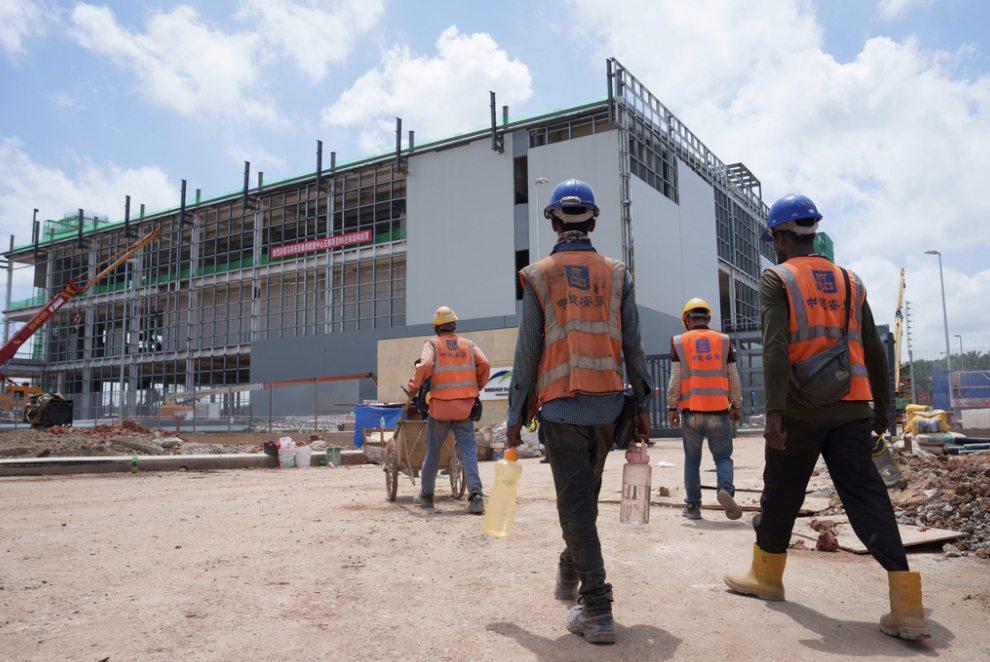
Construction workers walk to a data center building under construction in Sedenak Tech Park in Johor state of Malaysia, Sept. 27, 2024. (AP Photo/Vincent Thian, File)
The sheer volume of water required by modern data infrastructure dwarfs conventional commercial usage. A single 56-megawatt hyperscale data center facility can consume up to 3 million liters of water daily for cooling, an amount equivalent to the daily domestic needs of 30,000 residents according to World Health Organization guidelines. In high-density AI centers, intensive evaporative cooling towers across large facilities can draw as much as 29 million liters per day.
By 2032, planned and operational data centers across Batam are projected to consume 29 million liters of water per day. Compared with Batam’s total clean-water production capacity of 382 million liters per day, tech facilities alone will devour over 8 percent of the island’s entire freshwater supply. The AI sector is also concentrated, with the Jakarta Post reporting that over 60 percent of Indonesia's data centers sit in just two places, Greater Jakarta and Batam.
Nobody outside of the industry can say exactly how much water the centers use. Reliable data regarding data center water use remains very limited, and researchers are calling for public disclosure of water-efficiency metrics. Technology operators regularly classify their water consumption data and Water Usage Effectiveness (WUE) ratios as confidential “proprietary information”.
By refusing to disclose daily water withdrawal rates, companies prevent municipal regulators and environmental scientists from accurately evaluating the impacts on regional river basins. Communities are left guessing how much water is being drawn, while regulators are forced to make zoning and licensing decisions in an information deficit. This corporate opacity prevents public accountability and fuels a community distrust, which leads to further conflicts.
Recognizing the mounting threat to local reservoirs, BP Batam issued a policy directive requiring all data center developers on the island to construct independent Sea Water Reverse Osmosis (SWRO) desalination plants. Under this directive, tech operators must convert sea water into industrial freshwater rather than tapping into municipal reservoirs. Local authorities envision desalination capacity reaching 750 to 1,000 liters per second to support digital infrastructure growth without burdening local dams.
While BP Batam’s desalination mandate is a step in the right direction, voluntary measures and ad hoc industrial directives are insufficient to protect vulnerable populations. In West Java, the governor halted construction of a BDx data center because it lacked permits, not because of environmental violations. Furthermore, companies have a financial incentive to delay as desalinated seawater costs more than reservoir water, roughly Rp 28,000-36,000 versus Rp12,000 per cubic meter.
Indonesia urgently requires national rules establishing three frameworks. Firstly, implement statutory household priority, which ensures that drinking, cooking, and sanitation needs come legally before industrial withdrawals in a drought. Secondly, enforce mandatory transparency, meaning operators should publish audited water withdrawals and water-efficiency figures on open government portals. Environmental group WALHI has already called for zoning limits and water and energy efficiency standards. Finally, set siting limits, where water-intensive cooling should not be allowed in basins that are already stressed or near public reservoirs, which would push developers towards closed-loop or low-water cooling.
Industry representatives and BP Batam officials often counter that current fears are exaggerated. They point out that many planned data centers are not yet operating at full capacity, and several developers are actively preparing SWRO facilities. However, these are commitments, not requirements, and promises made before the centers are running are not enforceable, and it is harder to restore a household’s water supply after the centers have taken it. Furthermore, because Indonesia's hot and humid climate forces mechanical coolers to operate at peak loads year-round, voluntary efficiency targets routinely break down during severe heatwaves.
Technological advancement cannot come at the expense of basic human dignity. Indonesia’s ambition to become a digital hub for Southeast Asia is commendable, but digital progress loses all legitimacy when it denies local citizens their fundamental right to clean, accessible water.
If the same data centers that Singapore would not host are drawing on Batam’s reservoirs, then Batam’s households should not be the last in line. Digital transformation must not be built on dry taps. If a nation cannot guarantee water for its people’s daily meals and showers, no amount of artificial intelligence can claim to represent genuine progress.