
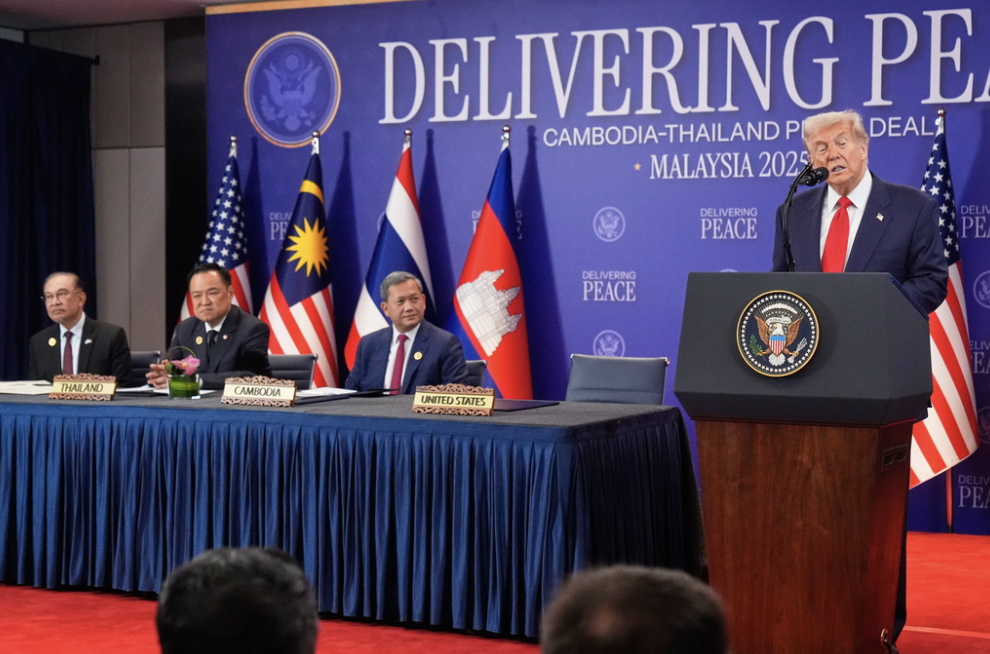
President Donald Trump, speaks as Malaysian Prime Minister Anwar Ibrahim, left, Thailand's Prime Minister Anutin Charnvirakul and Cambodian Prime Minister Hun Manet watch during a signing ceremony on the sidelines of the ASEAN Summit in Kuala Lumpur, Malaysia, Sunday, Oct. 26, 2025. (AP Photo/Mark Schiefelbein)
The Philippine government confirmed that President Donald Trump will be attending the ASEAN summit in Manila this November. The visit is scheduled just before he attends the Asia-Pacific Economic Cooperation summit in Shenzhen that same week.
Trump’s planned visit would mark his second consecutive attendance at an ASEAN summit during his second term. This marks a quiet shift in US presidential engagement with Southeast Asia. During his first term, Trump attended one ASEAN summit in person, whereas former President Joe Biden attended once in person and once virtually. “His attendance at two consecutive ASEAN summits is significant, given his preference for bilateral engagement and transactional diplomacy over multilateral institutions,” commented Joanne Lin, a senior fellow at the ISEAS - Yusof Ishak Institute.
The summit’s agenda is expected to center on tariff negotiations, heightened US-China competition, and persistent regional security challenges. The Trump administration's changes to tariffs and trade negotiations have become a central point of friction between the United States and ASEAN countries. ASEAN is a major source of industry supply while American goods and services are vital imports for the region. In 2025, US imports of ASEAN manufactured supplies and other exports reached $453.7 billion. The rise in tariffs and changes in trade negotiations have created challenges for businesses entering Southeast Asia.
The broader implications extend beyond individual tariff rates. In a 2026 study published in the Journal of Law, Market & Innovation, researcher Judy Yueh Ling Song examines how renewed unilateral tariffs are testing ASEAN’s trade-governance framework. The research argues that the bloc’s reliance on consultation and flexible coordination helps it manage external economic shocks, although differences between member states complicate a unified response.
ASEAN countries are key economic partners to both China and the United States. Washington’s recent efforts to reduce dependence on Chinese supply chains have created uncertainty for regional manufacturers operating across multiple economies.
A 2026 study published in the Asia & the Pacific Policy Studies examines how past US tariffs on Chinese imports shifted trade flows across Southeast Asia. Rather than cutting cross-border links, the tariffs spurred an increase in regional exports of targeted goods to the United States. The study highlights that ASEAN commands a 22.5 percent share of global semiconductor exports, ranking as the world's second-largest semiconductor exporter. Malaysia, Singapore, Vietnam, the Philippines, and Thailand ranked among the top 15 globally in 2019.
As critical minerals, semiconductors, and advanced manufacturing have become increasingly important to US economic and strategic policy, Southeast Asia is attracting investments. However, the region risks exposing local economies to scrutiny over their commercial links with Chinese suppliers. For ASEAN governments, the challenge is to retain access to the American market without damaging trade and investment relationships with China.
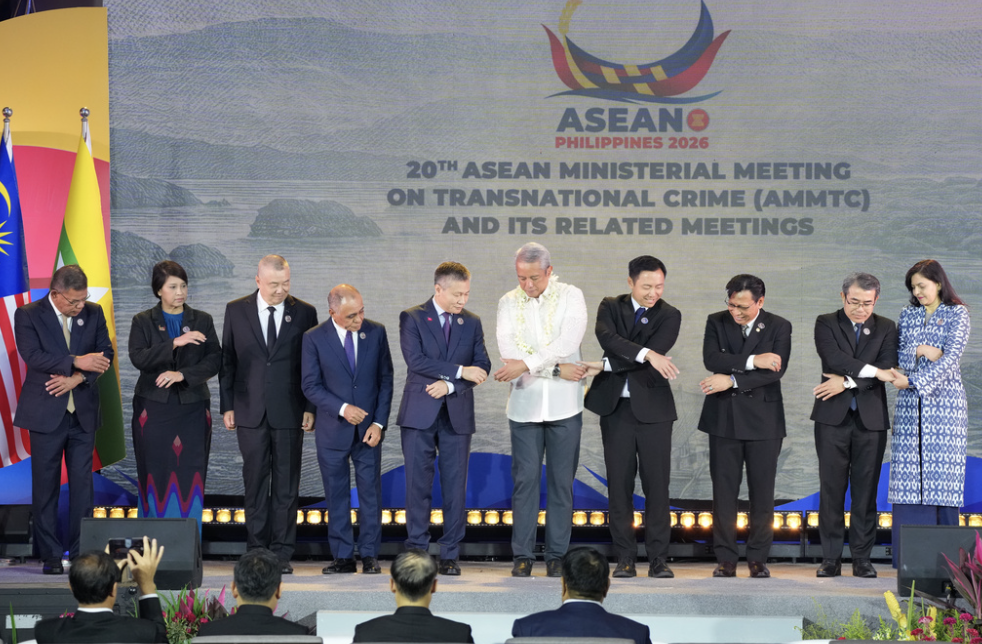
From left, Datuk Seri Saifuddin Nasution bin Ismail, Minister of Home Affairs of Malaysia; Ei Ei Tin, Ambassador of the Embassy of the Republic of the Union of Myanmar; Pol. Lt. Gen. Ittipol Itthisarnronnachai, Assistant Commissioner-General of the Royal Thai Police; Francisco da Costa Guterres, Minister, Ministry of Interior of Timor-Leste; Senior Lieutenant General Nguyen Ngoc Lam, Deputy Minister, Ministry of Public Security of Vietnam; Juanito Victor Remulla, Secretary of the Department of the Interior and Local Government of the Philippines; Goh Pei Ming, Senior Minister, Ministry of State for Home Affairs of Singapore; Dato' Seri Setia Awang Haji Sufian bin Haji Sabtu, Minister, Prime Minister's Office (Security and Law) of Brunei Darussalam; Maj. Gen. Kongsavat Bounlieng, Vice Minister, Ministry of Public Security of Laos; and Dato' Astanah Abdul Aziz, Deputy Secretary-General for Political-Security Community, ASEAN Secretariat pose for a family photo during the 20th ASEAN Ministerial Meeting on Transnational Crime and Its Related Meetings prepare to pose for a family photo during opening ceremony on Tuesday, Oct. 20, 2026, in Makati, Philippines. (AP Photo/Aaron Favila)
Due to ASEAN’s status as a regional intergovernmental organization, the association includes 11 countries across the Southeast Asia region. This multilateral relationship brings several security issues to the forefront. These include tensions in the South China Sea, Thailand-Cambodia relations, and Myanmar’s ongoing political instability.
Security remains a major pillar of US engagement with Southeast Asia, particularly through Washington’s defense partnership with Manila. Military exercises, maritime cooperation, and deterrence are central to that relationship amid continuing tensions in the South China Sea.
Trump also intervened in efforts to halt fighting between Thailand and Cambodia in 2025. However, the durability of any ceasefire hinges on strict implementation, independent monitoring, and bilateral diplomacy between both nations.
Myanmar remains a difficult issue for ASEAN following the February 2021 military coup and the ongoing conflict. The bloc’s Five-Point Consensus has largely struggled to produce sustained progress toward ending violence and facilitating political dialogue.
The Philippine government’s Oct. 14 confirmation of Trump’s attendance sets the stage for a pivotal summit in Manila, offering an opportunity for regional leaders to address trade pacts, investment flows, defense cooperation, and Washington’s strategic role. However, the talks will unfold against a backdrop of trade friction and geopolitical competition. Ultimately, meaningful progress will hinge not only on the specifics of any agreements signed, but on whether leaders can address these tensions and uncertainties to deliver lasting diplomatic outcomes.