
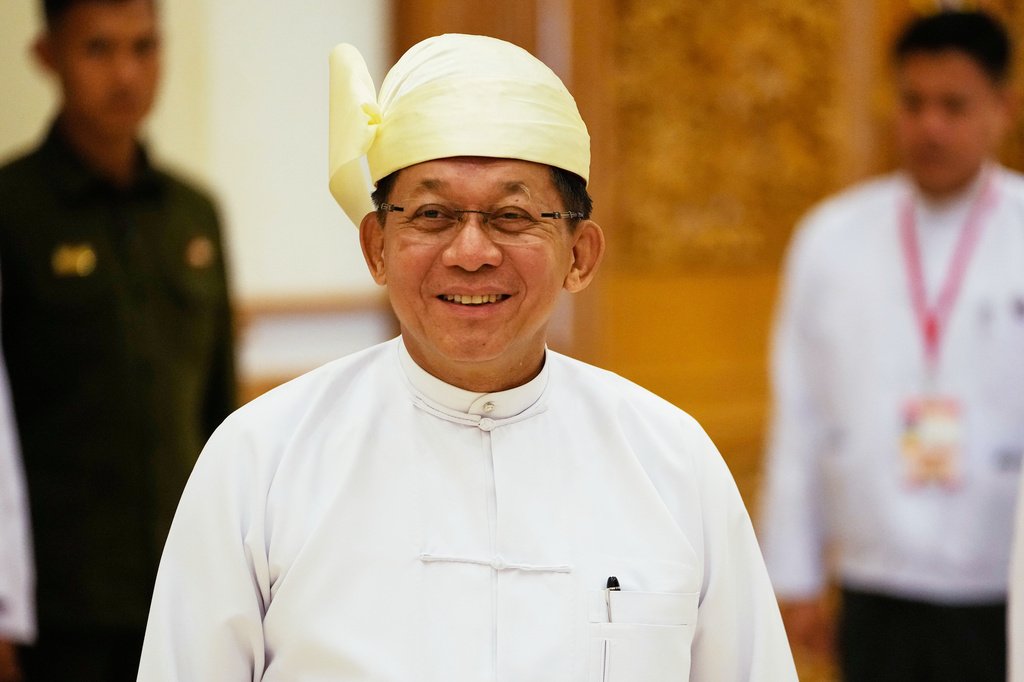
Myanmar's newly elected President Min Aung Hlaing talks to journalists as he leaves after a swearing-in ceremony at Union Parliament in Naypyitaw, Myanmar, Friday, April 10, 2026. (AP Photo/Aung Shine Oo)
Senior Gen. Min Aung Hlaing has swapped out his military fatigues to formally lead a new civilian administration. Behind the scenes, however, the general has led Myanmar’s military junta since deposing its democratically elected government five years ago—sparking civil war and international condemnation in the process.
Min Aung Hlaing’s inauguration came after months of inevitability as opposition parties and ethnic minorities were barred from participating in the parliamentary election. Large parts of the country remain controlled by rebel groups and rival ethnic armed organizations who reject the legitimacy of this election.
Myanmar’s last free and fair vote happened in 2020. The National League for Democracy (NLD) led by Nobel Prize winner Aung San Suu Kyi was reelected with an overwhelming mandate, securing 68.31% of the vote compared to the military’s 22.16%. One day before the new Parliament was to be sworn in, the military seized power, arresting Suu Kyi and prompting the remnants of the NLD to take up arms against the new regime.
The international condemnation of the coup was swift. The U.N. special rapporteur on human rights in Myanmar wrote that the people were “experiencing the illegal overthrow of their government and the brutal repression of a military authoritarian regime.” By then, Myanmar had already been a pariah on the world stage. Under the direction of Min Aung Hlaing and tacitly supported by Suu Kyi, the military had conducted “clearance operations” against the Rohingya—displacing 700,000 people in what the U.N. has described as exhibiting genocidal intent. The coup has only further entrenched Myanmar’s diplomatic isolation.
In response, the Association of Southeast Asian Nations (ASEAN) introduced the Five-Point Consensus (5PC) to restore political stability in Myanmar. These include the immediate cessation of violence, dialogue among all parties, the provision of humanitarian aid, the appointment of a special envoy, and for that envoy to meet with all stakeholders.
Although critics called the 5PC “toothless”, the junta nevertheless reneged on their commitment to the plan just days after the announcement. Human Rights Watch reported that a year on from the Five-Point Consensus, the military has only ramped up its attacks, killing over 1,700 people and arbitrarily arresting 13,000 people by 2022. In response to this noncompliance, ASEAN took the unprecedented step to bar Min Aung Hlaing from its leaders’ summits. Five years on, this remains the status quo.
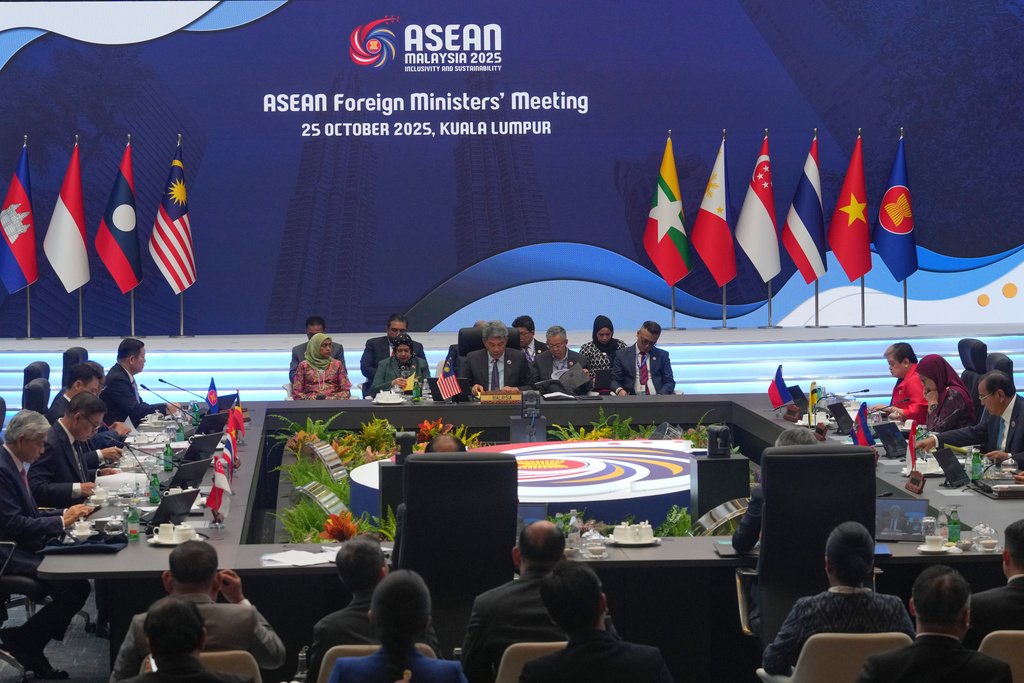
Malaysia's Foreign Minister Mohamad Hasan, center in the background, delivers a speech during the ASEAN foreign ministers' meeting in Kuala Lumpur, Malaysia, Saturday, Oct. 25, 2025. (AP Photo/Rafiq Maqbool)
Armed with his new civilian title, Min Aung Hlaing’s presidential address included a reference to “enhance international relations and strive to restore normal relations” with ASEAN. Some leaders within the bloc are already signaling their openness to do just that. Thailand’s Anutin Charnvirakul was the first to congratulate Min Aung Hlaing, saying that Bangkok “stands ready to support Myanmar’s effort toward peace, stability and national development.”
While some countries are insisting on the strict enforcement of the 5PC, analysts like Professor Derek Grossman have observed the steady backsliding of the ASEAN position from diplomatically isolating the regime to now hoping that the situation improves enough to bring Myanmar back into the fold.
It seems that ASEAN is ready to return to its cornerstone policy of non-interference. Unlike the EU, which is a highly integrated political and economic union, ASEAN confines itself to being a primarily economic institution with limited mechanisms for political enforcement. However, analysts are skeptical of the idea that deeper economic integration can be achieved without a baseline of political stability and mutual trust.
Despite widespread concerns that Myanmar’s election was a "sham", ASEAN appears divided on the next steps. Do they reengage with the nominally civilian government of Min Aung Hlaing or hold firm until political conditions improve?