
Op-Ed: Who is Responsible for the Tatmadaw’s Rise?
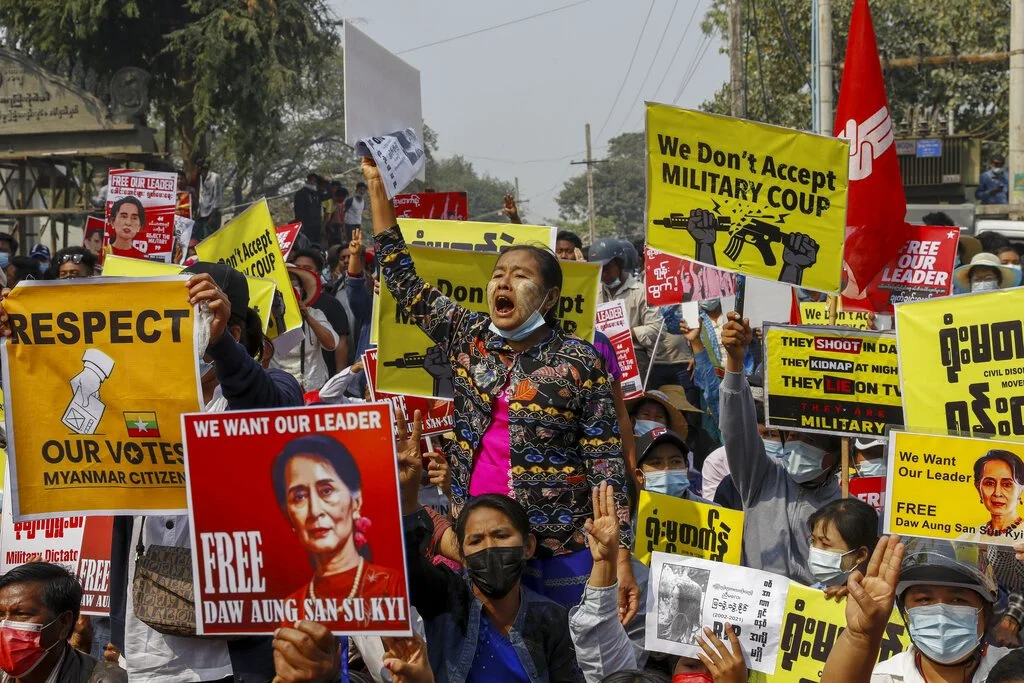
FILE - Demonstrators protest against the military junta's arrest and charging of National League for Democracy party lawmakers, Mandalay region Chief Minister Zaw Myint Maung and Mayor Ye Lwin, outside Aung Myay Thar Zan Township court in Mandalay, Myanmar, Feb. 18, 2021. (AP Photo, File)
Myanmar’s civil war is one of the longest ongoing civil conflicts in history, dating back to the 20th century, yet the abuses of the military often go unnoticed by many. Inside the country’s borders, the Tatmadaw has destroyed and taken lives. Outside its confines, the conflict is being largely mishandled by the international community.
In late 2023, a military draft was enacted in Myanmar by the ruling junta, forcing thousands of Burmese men to enlist in the Tatmadaw. Over 60,000 ethnically Burmese men joined the army, dramatically strengthening the junta’s power. Others chose to hide in the countryside, join armed ethnic groups as part of the resistance, or flee to neighboring countries for refuge. Myanmar’s ethnic armed organizations have attempted to fight back, succeeding in blocking or slowing down the junta on certain attempts. However, the Tatmadaw has received recent foreign support from China, making the fight even more unbalanced.
Historically, the United States (U.S.) has placed economic sanctions on Myanmar, with the Obama administration briefly removing them while Thein Sein held office. Since the 2021 coup, the U.S. Congress has condemned the junta, provided nonlethal aid to resistance organizations, and tried to legitimize Suu Kyi’s government.
Neighboring countries are either unable or unwilling to help those who flee from the civil war in Myanmar. Over 150,000 Rohingya migrants have entered Bangladesh, which is strained for resources and unprepared to house large numbers of people. An estimated 40,000 Rohingya refugees have entered India, which has begun to deport them back to Myanmar out of fear of disruption. With nowhere left to turn, the Rohingya and other ethnic groups have attempted to sail the Andaman Sea and the Malacca Strait in pursuit of reaching Malaysia or Thailand. The migration routes are deadly, with recent boats sinking near the border of Malaysia while carrying around 300 Rohingya asylum seekers. Bodies are being recovered, and though the trip is exceptionally dangerous, refugees have declared that they would prefer to die at sea than be murdered on land by the Tatmadaw.
In 2021, the Association of Southeast Asian Nations released the “Five-Point Consensus,” which called for the violence to come to a halt and promised humanitarian aid but has failed to change Myanmar’s worsening political climate. Additionally, in April 2025, General Min Aung Hlaing of the Tatmadaw was welcomed to Bangkok for a regional summit, his first trip to a Southeast Asian state since the military coup. The summit brought together leaders of Bangladesh, Bhutan, Nepal, Sri Lanka, India, and Thailand to discuss support for Myanmar after a devastating earthquake. The Thai government’s invitation to the general was met with significant backlash, as many viewed the gesture as a legitimization of a brutal military junta.
China holds a special interest in Myanmar, recognizing the nation as a pathway to the Indian Ocean, and has decided to support the Tatmadaw as it strives to hold an election in December. China has sold the junta thousands of efficient drones and has enforced tighter border controls on those attempting to escape. It has also detained armed groups, coercing them into surrendering, and securing victories for the Tatmadaw in doing so. Similarly, Russia has sold the Tatmadaw approximately a billion dollars’ worth of weapons since the revolt.
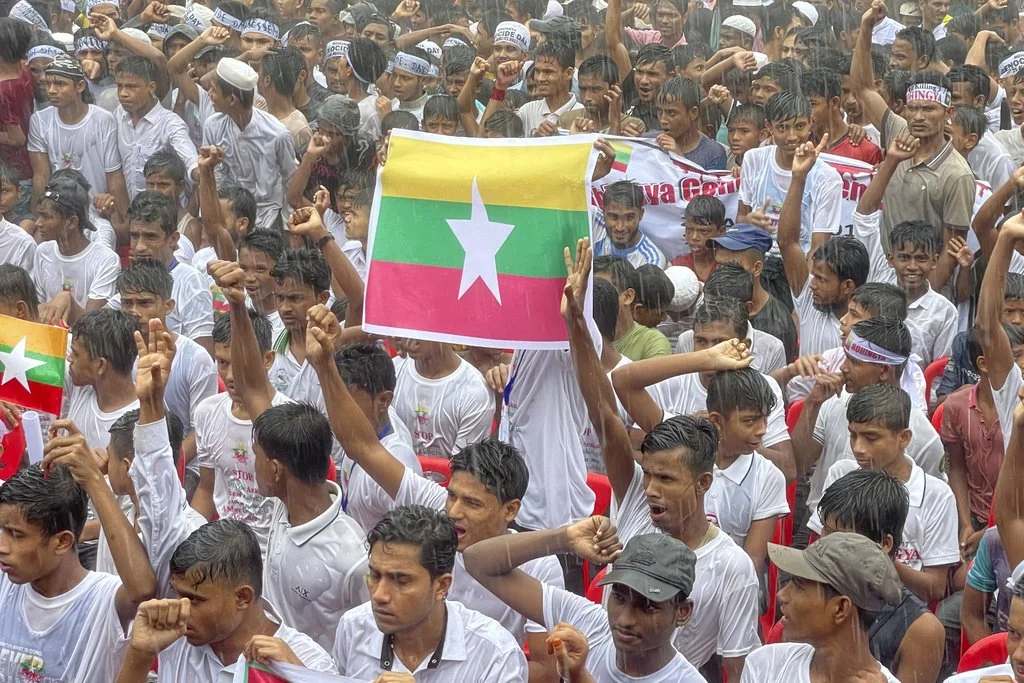
Rohingya refugees gather in the rain, with a flag of Myanmar seen at center, to demand safe return to Myanmar's Rakhine state as they mark the seventh anniversary of their mass exodus at their refugee camp at Kutupalong in Cox's Bazar district, Bangladesh, Sunday, Aug. 25, 2024. (AP Photo/ Shafiqur Rahman)
The actions and inaction of these states have contributed to the devastation in Myanmar, rather than supporting its impoverished and vulnerable communities. Countries such as the U.S. have demonstrated their stance on the military by imposing harsher economic policies on select leaders and further distancing themselves. These efforts, though not insignificant, have done little to dissuade the Tatmadaw in its plans. A 2021 BBC investigation revealed that opponents of the Tatmadaw have suffered torture and mass murder, a practice that the government shows no sign of stopping.
Nearby South Asian nations, including Thailand and India, have proven to provide minimal support for the Rohingya and other Burmese asylum seekers. While seeking to restore peace in their respective confines, they have mishandled the tragedy at the heart of their region. Finally, global superpowers such as Russia and China have sought to support Myanmar’s junta rather than its people. Through the supply of weapons, interference with ethnic armed organizations, and a public embrace of junta leaders, the two countries have demonstrated their stance amid an ongoing genocide.
The international community has shown minimal solidarity for Myanmar. Since late 2019, the International Court of Justice has investigated Myanmar’s genocide on the Rohingya after Gambia filed a case against the state. Later, in Nov. 2023, a joint declaration of intervention was filed by Canada, the United Kingdom, France, the Netherlands, and other members of NATO. However, there is an overall lack of conversation regarding the civil war and the involvement of other nations. The junta’s violence has been devastating for civilians, but equally harmful is how little attention Myanmar receives, leaving one of the globe’s longest-lasting mass atrocities largely unaddressed.
These continuous failures to confront the Tatmadaw are clear indicators of the priorities of global powers. Without direct stakes in Myanmar, Western nations have chosen to prioritize other conflicts while South Asian states have been unable to collectively stand their ground against Min Aung Hlaing. Similarly, the limited visibility for the crisis in the West is a testament to the rapid cycles through which international issues are now consumed and then forgotten. As Instagram feeds become populated with colorful infographics and individuals exchange quick words about the conflicts abroad, people have learned to transition seamlessly between tragedies. While the number of civilian deaths rises in Myanmar, the junta’s incessant brutality and the international community’s disinterest are further exposed, signaling a need for the nation’s victims to be given a proper voice. Myanmar’s crisis persists not as an isolated incident, but rather as evidence of a global system that chooses to endure violence when it falls outside the realm of personal interests.