
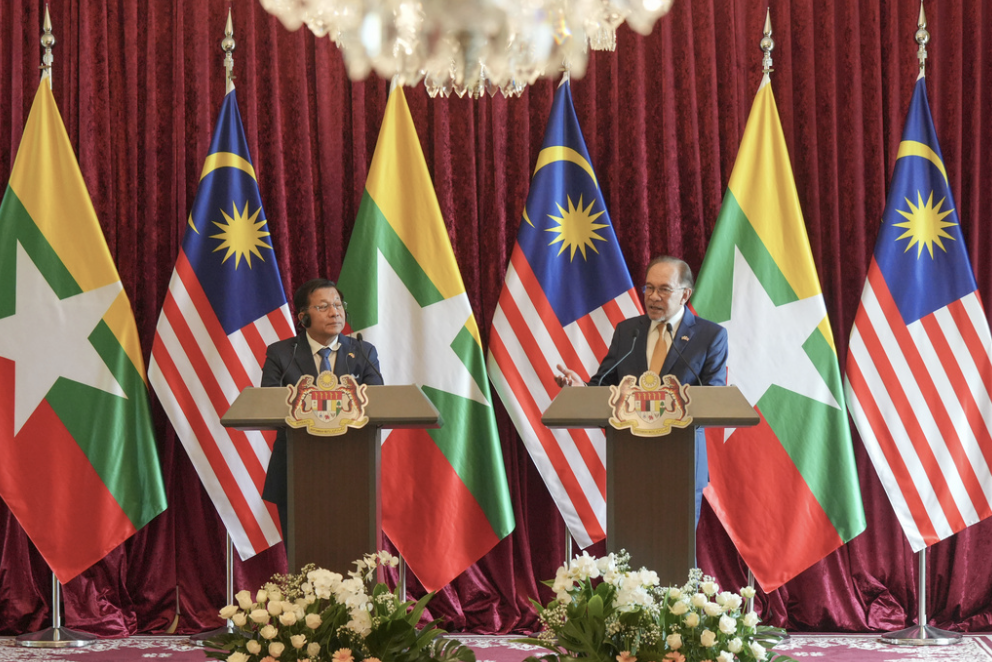
Myanmar's President Min Aung Hlaing, left, and Malaysia's Prime Minister Anwar Ibrahim attend a joint press conference following their meeting in Putrajaya, Malaysia, Thursday, Oct. 8, 2026. (AP Photo/Azneal Ishak, Pool)
Myanmar’s President Min Aung Hlaing landed in Malaysia on October 7, his first visit to the country since the 2021 military coup. He arrived at the invitation of Malaysian Prime Minister Anwar Ibrahim to discuss returning 5,000 Myanmar migrants. The visit came about a week after 1,476 migrants were sent back on September 29 in what Malaysia calls a "voluntary repatriation."
This decision follows the growing tensions surrounding immigration in Malaysia, where, according to ACLED, blame the migrants for burdening public resources and have voiced concerns over their hygiene and involvement in criminal activity. The Malaysian Foreign Ministry has described the talks with Min Aung Hlaing as concerning the safe repatriation of Myanmar nationals of all ethnic groups who are in the country illegally. Malaysia is not a party to the UN Refugee Convention and is therefore not bound by its protections, treating refugees as undocumented migrants, although ASEAN has kept Myanmar out of its high-level summits since the coup. After the talks, Anwar stated that Myanmar was willing to take people back in large numbers, and Min Aung Hlaing offered another naval ship.
This year, escalating raids on refugee communities have left around 57,000 people in detention centers, and a petition calling for their deportation has gathered 400,000 signatures. However, Malaysian sentiment has not always been hostile. When the Rohingya fled the military’s 2017 crackdown in Rakhine state, Malaysians saw them as "fellow Muslims whose lives were threatened for being a persecuted minority". ACLED argues that Anwar’s coalition feared losing the next election and succumbed to the public outcry.
Malaysia is home to 215,600 refugees and asylum seekers registered with the UNHCR, with about two-thirds of whom are Rohingya. Anwar has not directly stated whether any Rohingya are among the returnees. Myanmar disclosed that it has also flown home roughly 8,000 migrants on weekly flights since January, indicating that the ship transfers are part of a larger operation. The Malaysian Home Ministry has said everyone was screened and returned voluntarily.
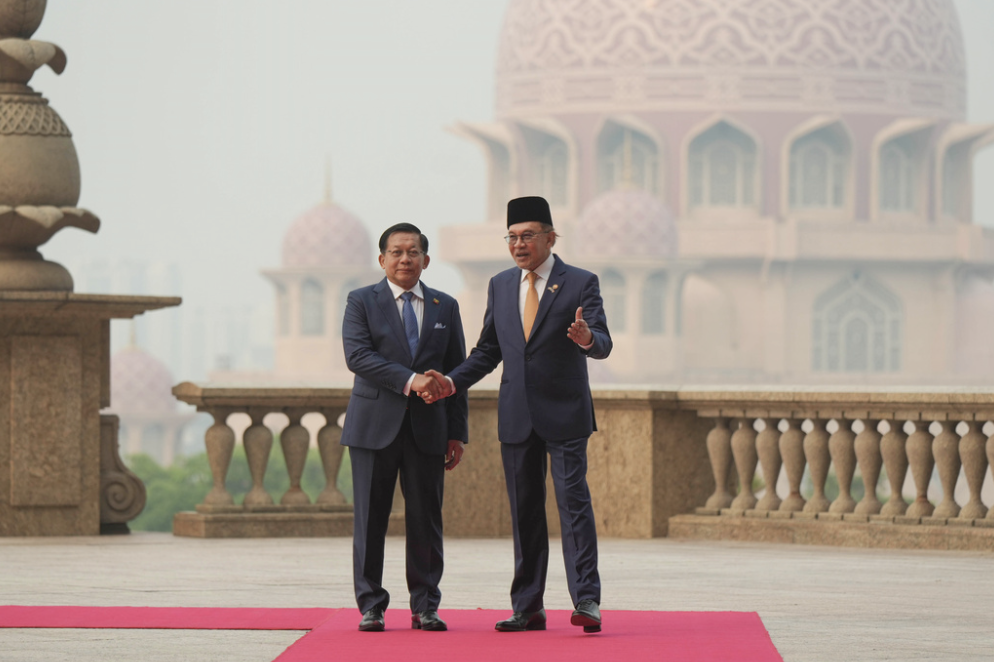
Myanmar's President Min Aung Hlaing, left, shakes hands with Malaysia's Prime Minister Anwar Ibrahim during their meeting at the Prime Minister's Office in Putrajaya, Malaysia, Thursday, Oct. 8, 2026. (AP Photo/Azneal Ishak, Pool)
Rights monitors have described the process as opaque, and there are fears that the Rohingya are being sent back to a country where many consider their persecution a genocide, a charge the International Court of Justice is still weighing. The UN Refugee Agency (UNHCR) has not had access to the Malaysian detention centers since 2019 and, consequently, has not had a role in identifying who was deported. Instead, the "Myanmar junta authorities had identified those slated for return". Without access to the UNHCR or meaningful protection assessment, consent to this repatriation "cannot be truly voluntary". The UN has warned that any returnees could be at risk as "there is no telling how the regime will treat returnees". They also could face persecution and forced military persecution in an active war zone, with Rohingya returnees continuing to be denied citizenship.
Myanmar has been embroiled in a civil war since the military seized control from the elected government in 2021, and the conflict has killed over 100,000 people. Min Aung Hlaing, who led the coup, was installed as a nominally civilian president in April after the junta organized a national election. Malaysia is the fifth ASEAN nation to host him since then, helping fulfil his desire for diplomatic recognition. The International Criminal Court’s prosecutor has requested an arrest warrant for Min Aung Hlaing over alleged crimes against humanity, and HRW says continued bilateral visits like this one undermine ASEAN’s collective ban. Fortify Rights’ Yap Lay Sheng has said that migrant returns are the only reason Malaysia now wants to engage, calling the move a 180-degree turn from years of giving the regime the cold shoulder
While an exact date has not yet been provided, 3,524 people have been approved for the next phase of the return, and the AFP predicts around 3,000 people are currently being held in detention centers. ACLED warns that other host countries, such as Bangladesh, Thailand, and India could now follow Malaysia’s lead "putting the lives of 1.6 million Myanmar refugees at risk". If the second group goes ahead, the total would reach the 5,000 returns Anwar has promised.