
From Noida to Haryana, India’s Industrial Belt is Cracking Under the Weight of a Distant War
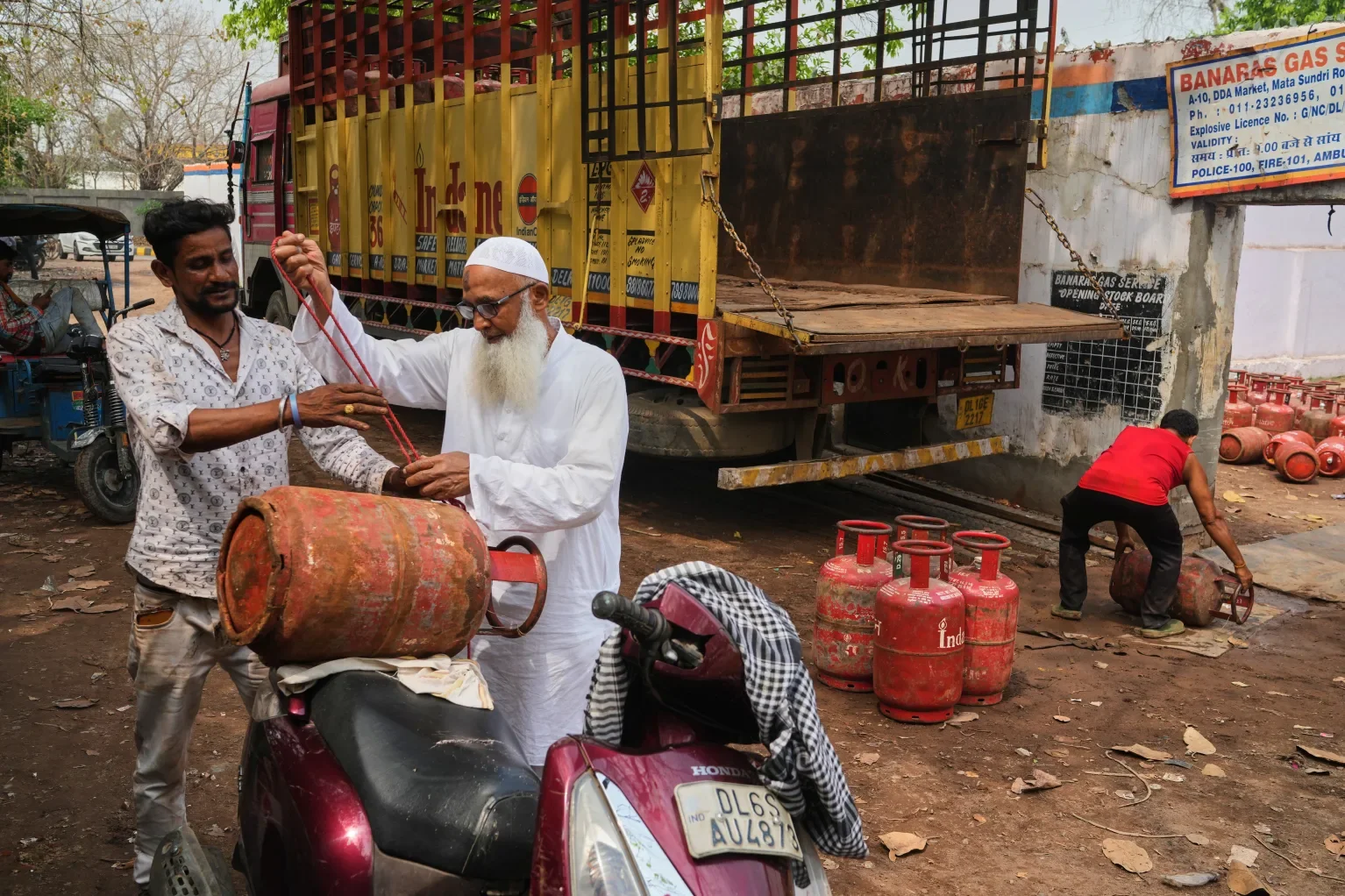
An elderly man ties a gas cylinder to his scooter after collecting it from a depot in New Delhi, Thursday, March 19, 2026. (AP Photo/Manish Swarup)
On the fourth day of protests in Noida, New Delhi, at one of Asia’s largest industrial townships, the images told the story before any official statement could. Overturned vehicles in flames, workers hurling stones through clouds of tear gas, anti-riot police in strict formations outside factories. Behind it all, workers had a simple demand: pay us enough to eat.
Police threw tear gas shells and used what they described as “minimum force” to quell the protest in Noida, a satellite city of New Delhi that houses thousands of industrial units, after vehicles were torched and stones pelted in parts of the city. About 50 protesters were arrested as a result of the violence, and several police personnel were injured and taken to hospitals.
The trigger was not a single factory dispute or a local grievance. It was a war thousands of miles away. The demonstrations are rooted in a collision between global energy disruptions and local economic precarity. Living costs have skyrocketed as the U.S.-Israel war on Iran has curbed fuel supplies. Subsequently workers are demanding wage increases, fixed overtime pay, and adherence to federal labor guidelines.
What is happening in Noida is not an isolated incident. Similarly, protests spread to Faridabad and Manesar in Haryana, Bhiwadi in Rajasthan, and several other industrial areas across the Delhi-NCR region, with workers blocking roads, fighting with police, and vandalizing factory property. Taken together, the unrest is tracing the outline of a much larger problem.
In April 2026, a week before Noida erupted, the government of Haryana did something that manufacturers had not seen coming: it surrendered.
After factory workers boycotted work and staged protests over rising living costs, Haryana’s government ordered a hike in minimum wages for unskilled workers, raising the monthly floor to $165 from roughly $120, effective April 1. The decision came under pressure from workers at Manesar, a town 30 miles south of New Delhi that functions as a spine of India’s auto industry, home to Maruti Suzuki and hundreds of smaller suppliers that feed into it.
While the relief was real for workers, for manufacturers it added to the cost burden facing an industry already under pressure. India’s car industry, already dealing with higher raw material prices stemming from the Iran war, now faces additional labor costs. Tata Motors and Mahindra have already raised car prices, and Maruti has warned of a similar raise.
Beneath the visible protests is a quieter crisis that may be harder to reverse. Workers are not just striking. They are going home, and not coming back.
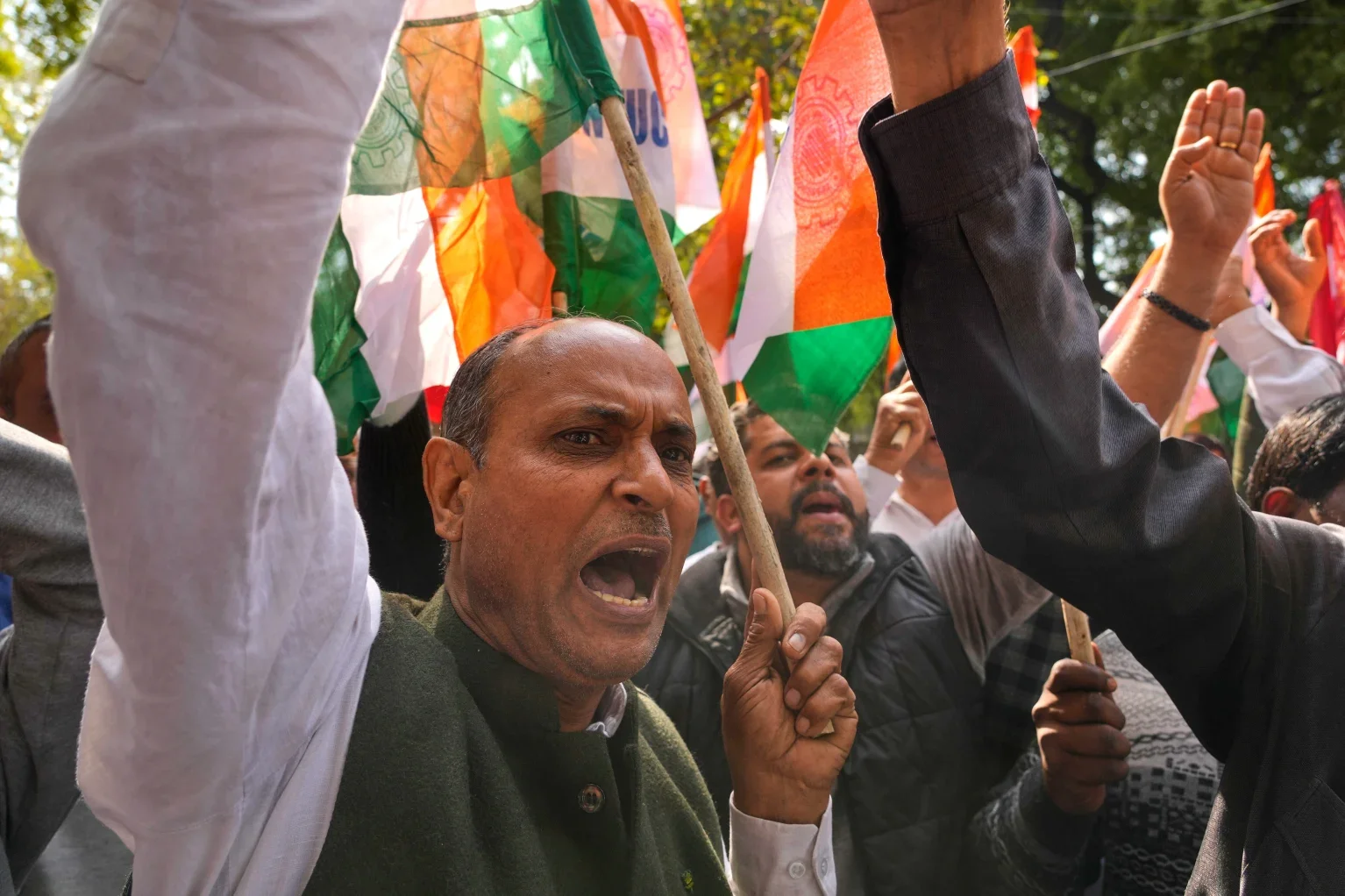
Members of trade unions shout slogans during a nationwide strike to protest an interim trade deal with the United States, saying the agreement undermines the interests of farmers, small businesses and workers in New Delhi, India, Thursday, Feb. 12, 2026. (AP Photo/Manish Swarup)
The Liquefied Petroleum Gas (LPG) shortage has forced migrant workers from states such as Bihar to abandon industrial cities entirely. Workers earning between 500 and 800 rupees a day say that they cannot afford both LPG (cooking gas) and food. The price of small 5-kilogram LPG cylinders, which previously sold for 500 to 550 rupees, has surged to between 1,100 and 2,000 rupees in several cities.
In cities like Delhi, people who once migrated in search of better opportunities are packing their bags and returning home. The rising costs of LPG cylinders, coupled with limited availability, has made it nearly impossible for daily-wage workers to sustain themselves.
Manufacturers are scrambling to stop the bleed. Vinod Kumar, president of the India Small and Medium Sized Enterprises (SME) Forum, said most employers are trying to hold on to their workforce by offering meals or small bonuses, and his organization is seeking government help to establish emergency common kitchens. His warning was clear: “Once labor leaves, it is very difficult to get them back.”
The India SME Forum has warned that if disruptions persist, SME’s risk production slowdowns in key industrial clusters, a defeat in the export competitiveness against rivals including Vietnam, Bangladesh, and China, and supply chain fragmentation that could ripple into larger industries - including automotive, pharmaceuticals, and electronics - that depend on small manufacturers for critical components.
Both Noida and Haryana’s Manesar sit at the center of India’s manufacturing identity, one as a hub for consumer goods and electronics, and the other as a main spot of the country’s auto sector. Disruption in either is likely to have consequences that extend far beyond state borders, reaching the global brands and foreign investors that are relying on Indian manufacturing as a stable alternative to China.
Industry estimates suggest the conflict has already delayed over 300,000 job placements for Indians in the Gulf region. State governments are trying to help, through wage concessions, appeals for calm, and promises of new laws. Authorities in the province of Uttar Pradesh said they are identifying individuals who allegedly instigated the violence in Noida, and anti-terrorism units are also questioning people, though no charges have been filed.
Whether any of that will be enough is far from certain. The workers now setting fires in Noida’s industrial zones are not acting out of ideology. They are acting out of logic–-the brutal logic that a paycheck will no longer cover the cost of a meal.