
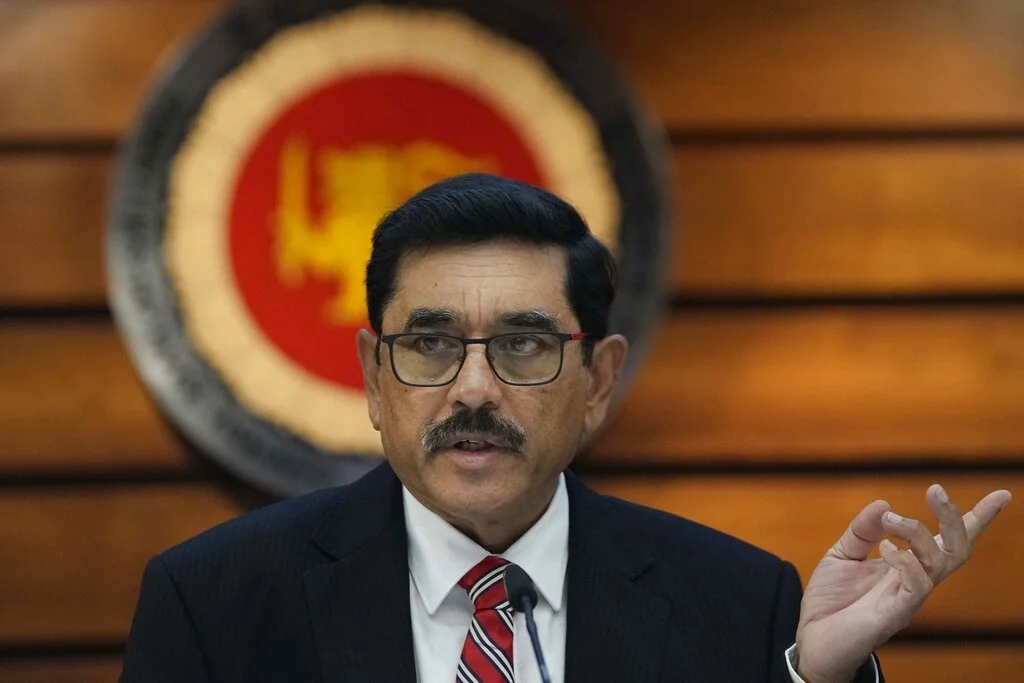
Governor of Sri Lankan Central Bank Nandalal Weerasinghe speaks during a media briefing in Colombo, Sri Lanka, Thursday, May 19, 2022. (AP Photo/Eranga Jayawardena)
As Sri Lanka advances toward another $345 million in International Monetary Fund (IMF) funding following its 2022 economic crisis, its recovery underscores the growing intersection of international debt restructuring, regional power competition, and strategic influence in the Indian Ocean. However, the funding announcement comes amid continuing economic vulnerabilities, and nationwide electricity blackout on October 17, renewing attention to the infrastructure and financial pressures that the island nation continues to face.
Sri Lanka’s recovery also carries significant geopolitical implications. Its debt restructuring has involved negotiations with China, India, Japan, as well as private creditors, such as BlackRock, illustrating how sovereign debt crises can intersect with strategic competition in the Indian Ocean.
Sri Lanka’s economic crisis reached its peak in 2022, when dwindling foreign exchange reserves left the government unable to finance essential imports, including fuel, food, and medicine. Years of fiscal deficits, combined with heavy borrowing, tax cuts that reduced government revenue, and declining foreign currency earnings, contributed to mounting financial pressures. The COVID-19 pandemic further weakened tourism, an important source of foreign exchange. In April 2022, the government suspended external debt payments, effectively defaulting on its foreign obligations. The resulting shortages and public protests culminated in the resignation of President Gotabaya Rajapaksa in July.
In March 2023, the IMF approved a four-year, approximately $3 billion Extended Fund Facility (EFF) to support economic solidity and debt sustainability. The program included fiscal reforms, changes to energy pricing, revenue mobilization, and measures to rebuild foreign reserves. Progressive tax reform was centered as a pillar of the EFF, to increase government revenue, and encourage economic growth. Anti-backsliding buffers were also implemented, especially in the form of the Governance Diagnostic Assessment (GDA), which highlights macro-critical policy vulnerabilities that impede reform objectives, that can then be corrected for. These conditions were underscored with a commitment to negotiations with external creditors to establish a sustainable path for repayment.
China’s role as a major creditor has positioned it as central to these negotiations. Chinese institutions have financed infrastructure projects in Sri Lanka, including developments associated with Hambantota Port and Colombo Port City. China’s Export-Import Bank was among the country’s principal bilateral lenders, requiring separate negotiations alongside the restructuring process coordinated by the Official Creditor Committee. In June 2024, Sri Lanka finalized a debt restructuring agreement with the committee, co-chaired by India, Japan, and France, while also reaching a separate agreement with China’s Export-Import Bank.
These negotiations demonstrated how international financial recovery depends on coordination among countries with different creditor arrangements. Although China was not a formal member of the Official Creditor Committee, it participated and contributed separately in debt restructuring negotiations as Sri Lanka worked to meet the IMF program’s requirements. The process also reflected wider debates about how bilateral and commercial creditors should share the costs of sovereign debt crises.
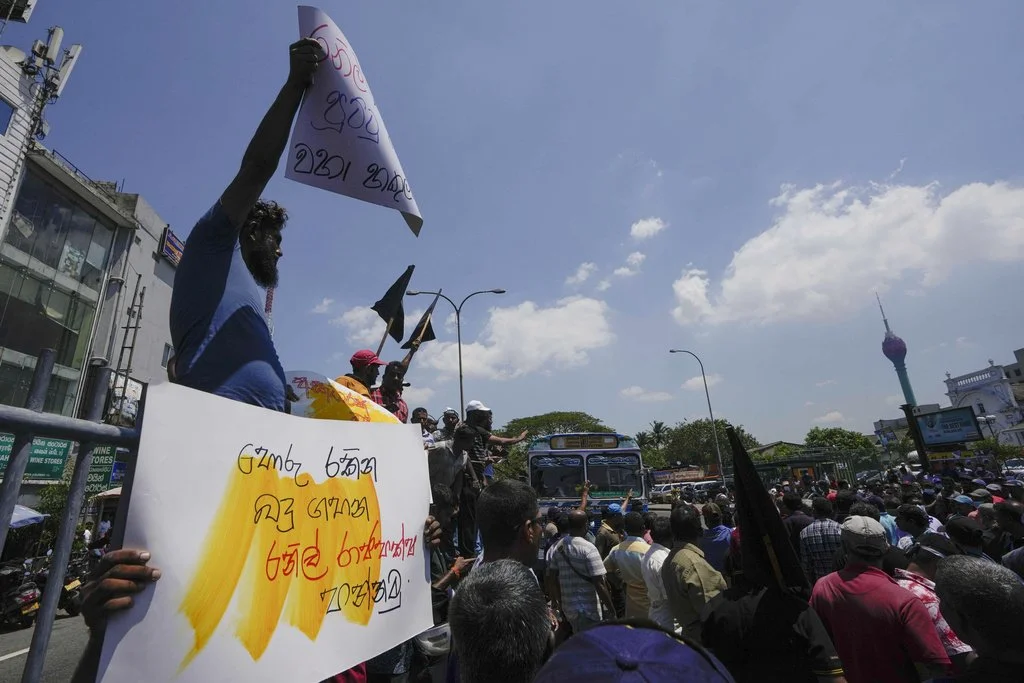
Sri Lankans shout slogans during a protest against the government increasing income tax to manage day to day expenses amid an unprecedented economic crisis in Colombo, Sri Lanka, on Feb. 22, 2023. The International Monetary Fund said Monday, March 21, that its executive board has approved a nearly $3 billion bailout program for Sri Lanka over four years to help salvage the country's bankrupt economy. (AP Photo/Eranga Jayawardena, File)
India’s involvement as another major creditor further shaped the response to Sri Lanka’s economic crisis. In 2022, New Delhi extended approximately $4 billion in financial assistance through credit lines and other support as Sri Lanka struggled to pay for essential imports. India subsequently co-chaired the Official Creditor Committee and supported the debt restructuring process. According to India’s Ministry of External Affairs, the country was the first creditor nation to provide financing assurances to the IMF, helping facilitate approval of the initial program.
India’s assistance occurred against the backdrop of its longstanding strategic interests in the Indian Ocean. Sri Lanka lies near important maritime shipping routes connecting Asia, the Middle East, and Europe, making its ports and infrastructure relevant to regional trade and security. India has maintained close geographic, economic, and security ties with the island, while China’s investments have expanded its commercial presence there. These relationships have placed Sri Lanka within a wider regional environment shaped by competition over infrastructure, investment, and maritime influence.
However, the countries’ involvement in Sri Lanka’s recovery reflects a range of economic and diplomatic interests beyond direct strategic competition. India, China, Japan, and other creditors have participated in different aspects of the country’s recovery, while the IMF provides a multilateral framework for financial assistance and economic reform. The United States also holds influence through its role in the IMF and its broader engagement in the Indo-Pacific, although the current financing agreement is not a bilateral U.S. aid package. Sri Lanka’s challenge has been to negotiate with these partners while maintaining working relationships across competing strategic interests.
The latest IMF agreement illustrates how these international relationships remain relevant. Approval of the additional $345 million is contingent on the presentation of Sri Lanka’s 2027 budget in line with program requirements and completion of a financing assurances review, including confirmation of multilateral partners’ contributions and adequate progress on debt restructuring. The IMF reported that Sri Lanka’s economy grew by 4.2 percent year-on-year in the second quarter of 2026 and that official reserves reached $6.9 billion at the end of August. However, the Fund continues to identify external shocks and global economic uncertainty as risks to the recovery.
As Sri Lanka advances through the remaining stages of its IMF program, its recovery will depend on both domestic reforms and continued engagement with international creditors and partners. The country’s experience illustrates how sovereign debt restructuring can extend beyond financial negotiations, intersecting with regional strategic interests and multilateral cooperation. With the current IMF program scheduled to conclude in 2027, Sri Lanka’s next steps will provide further insight into how smaller states navigate economic vulnerability while maintaining relationships with multiple major powers.