
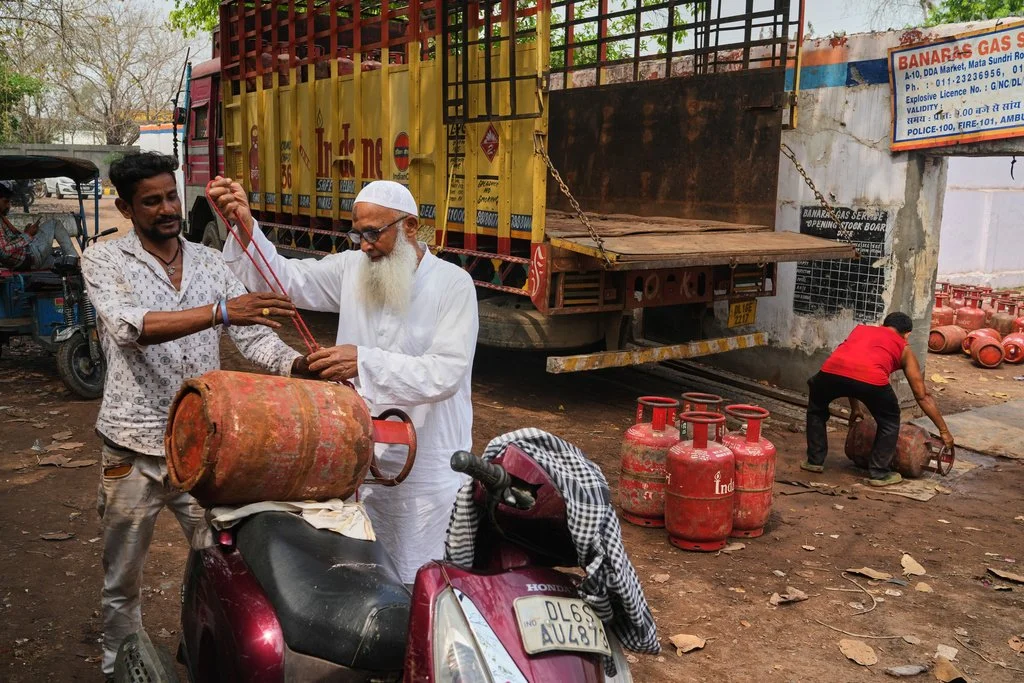
An elderly man ties a gas cylinder to his scooter after collecting it from a depot in New Delhi, Thursday, March 19, 2026. (AP Photo/Manish Swarup)
As Iran moves to close the strait that carries 40% of India’s crude imports, New Delhi has turned to Russian oil and sanctions waivers, measures that analysts say cannot substitute for a long history of energy dependency.
The Strait of Hormuz carries approximately one-fifth of the world's oil supply, according to The New York Times, and India has long relied on it for roughly 40% of its crude imports. That dependence, long treated as manageable, has become acute since Iran moved to close the passage following U.S. and Israeli strikes. India imports around 90% of its crude oil, leaving it with few alternatives as the situation escalates.
The fiscal cost of shielding consumers has been immediate. The government's decision to cut petrol and diesel duties will cost nearly 1.55 trillion rupees on an annualized basis, Emkay Global economist Madhavi Arora told Reuters. Petroleum Minister Hardeep Singh Puri told Al Jazeera the country remains “resilient” and dismissed circulating reports of an impending lockdown as “completely false.”
The rupee, however, has already weakened to a record low of 92.34 against the dollar, driven by surging crude import bills, according to the Institute for Energy Economics and Financial Analysis (IEEFA). The severe drop in value has simultaneously fed inflation and raised the country's borrowing costs.
The effects of the oil shortage have moved quickly into daily life. IEEFA reported a 60-rupee increase in the price of LPG cooking cylinders, a 7 percent jump in household fuel costs. The New York Times reported citizens in Lucknow hoarding liquefied petroleum gas amid fears of a supply cutoff. The government has also invoked the Essential Commodities Act to prioritize residential gas use, a step IEEFA warns could hurt industries and refineries by reducing their demand.
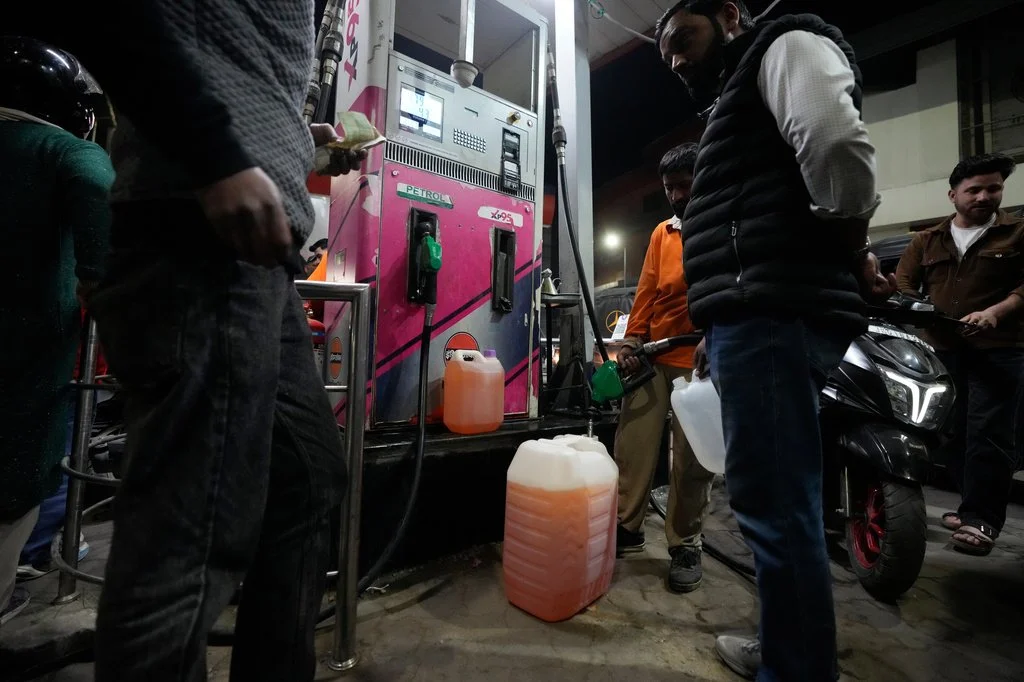
People store fuel in a plastic can at a petrol pump amid fears of a possible shortage due to the US Iran war, in Srinagar, Indian controlled Kashmir, Wednesday, March 25, 2026. (AP Photo/Mukhtar Khan, file)
Furthermore, the aviation industry has absorbed the sharpest shock. Jet fuel has doubled to a record $200 a barrel. James Noel-Beswick, head of commodities at Sparta Commodities, told The New York Times that aviation fuel acts as a “canary in the coal mine” for the broader economy. He explained it has the highest likelihood of running short first because of strict quality standards and limited storage capacity.
The crisis extends beyond fuel prices. Some 10 million Indians live and work across Gulf economies, and retired diplomat Talmiz Ahmad told The New York Times that the two regions are so economically intertwined that “every project in the Gulf has an Indian fingerprint.” Moreover, more than a third of India's $130 billion in annual remittances originates in the Gulf.
India has moved to plug the immediate supply gap through what Chatham House describes as “timely opportunism” by securing U.S. authorization to purchase Russian crude previously frozen by sanctions. U.S. Treasury Secretary Scott Bessent has separately suggested easing restrictions on approximately 140 million barrels of Iranian oil currently at sea, a move the BBC reported could open a relief window of 10 to 14 days for Asian buyers.
Analysts are cautioning against treating either measure as a solution. IEEFA noted that China has proven comparatively insulated from the shock, largely due to its accelerated electrification of the transport sector, for which India does not have the infrastructure. Australian banking group ANZ warned in a research note that India's economic actors “do not have robust financial buffers to withstand a prolonged oil price shock.” Goldman Sachs warned that India's growth trajectory faces a serious risk unless it addresses its structural dependence on Middle East energy.
The conflict has laid bare how thoroughly India's growth model remains tied to a region it cannot control, despite temporary stabilization measures.