
Op-ed: South Asia’s Economic Growth is Real. Its Stability is Not.
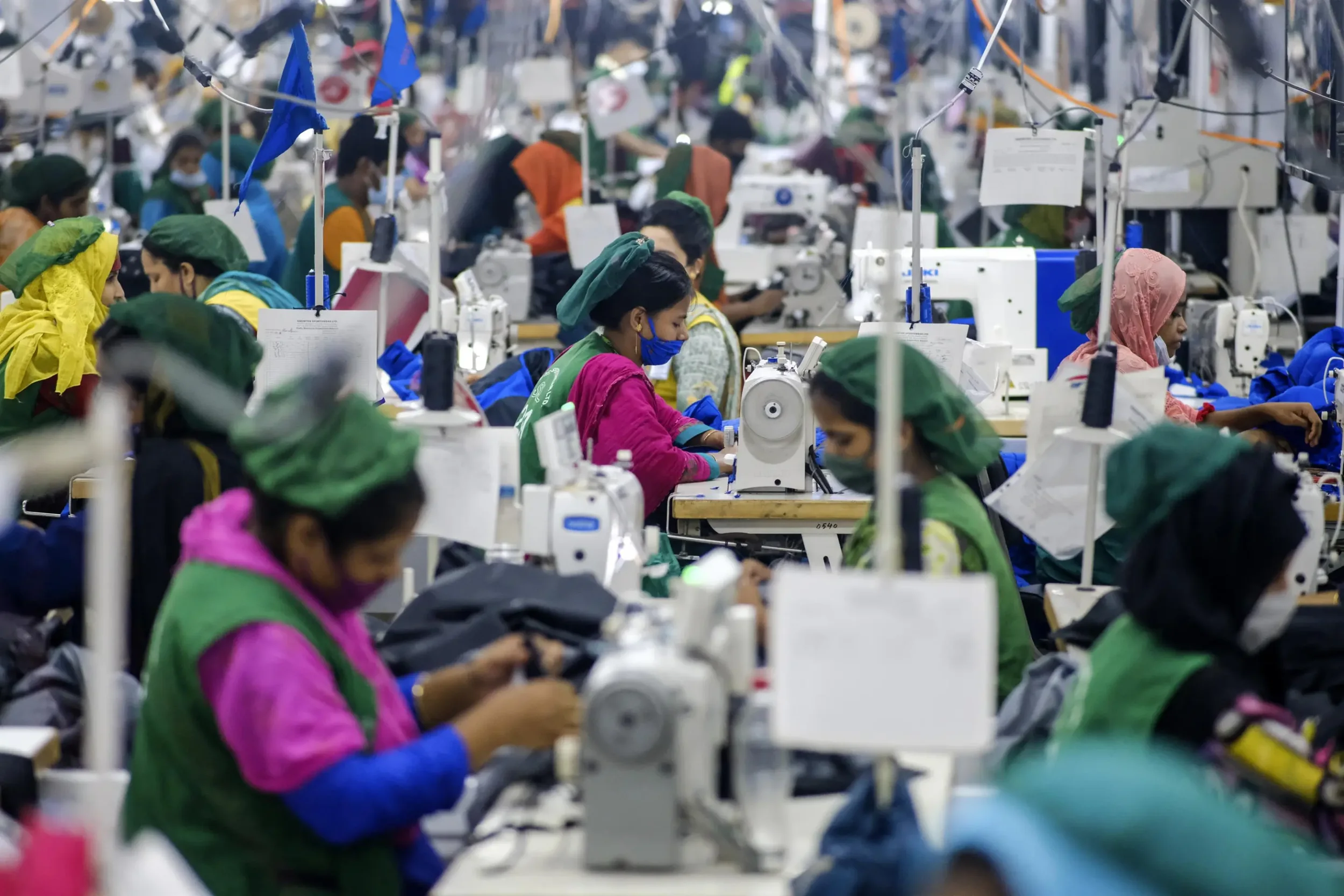
Aug 9, 2021 - Garment employees work in a sewing section of the Snowtex Outwear Ltd. factory in Savar Bangladesh. (AP Photo/Mahmud Hossain Opu)
At the World Economic Forum’s (WEF) gathering in Davos this past January, South Asia wore the crown. Chief economists surveyed identified South Asia as the fastest growing region among emerging economies, with India as the region’s best even as trade pressures increased. The talk in the room centered around India: the fastest-growing, most resilient economy, and the next great engine of global growth. Policymakers and investors at the WEF took a survey and 66 percent anticipated strong or very strong performance for the region, driven by the robust growth in India.
Less than three months later, garments are piling up at airports in Dhaka and Mumbai. The Middle East is on fire. And South Asia’s economic momentum is faltering in ways that should alarm anyone paying serious attention.
The same global architecture that lifted South Asia’s growth numbers is now exposing the region’s deepest structural faults. What people are seeing is not a temporary shock to an otherwise stable system. Rather, it is a system that is revealing what it always was: fragile, and dependent on forces it cannot control.
The numbers are real, and India has posted some of the strongest GDP growth figures of any major economy in recent years. Bangladesh built a garment industry that made it a staple of fast fashion globally. Nepal has leaned on remittances from its diaspora in the Gulf. But headline growth rates hide what the World Bank has noted in its regional assessments. The region is not creating enough jobs for its rapidly growing population, and aggregate job creation has been slower than what is needed to support the working-age population. This is a hidden cost of narrow growth that prioritizes exports - the GDP climbs, but the labor market beneath it strains under the weight of demographics it cannot sustain.
The World Bank's October 2025 South Asia Development Update put it clearly: growth in South Asia is on track to reach 6.6 percent in 2025 but then expected to slow to 5.8 percent in 2026, a significant deceleration with downside risks. Even before the latest Middle East crisis erupted, the trajectory was already declining. The optimism at Davos was, in retrospect, a reading of yesterday’s headlines.
The mechanism of vulnerability became impossible to ignore early this March. Shipments of garments for Zara owner, Inditex, and other major clothing retailers were stranded at airports in Bangladesh and India as the conflict in the Middle East forced airlines such as Emirates and Qatar Airways to cancel flights. The cause was not a natural disaster, a port strike, or a domestic policy failure, but rather, an airspace closure thousands of miles away.
More than half of Bangladesh’s air cargo travels through the Gulf, and 41 percent of India’s does as well, with Emirates and Qatar Airways the most important carriers. When those routes collapsed, freight costs did not just rise; they doubled.
The president of the Bangladesh Knitwear Manufacturers and Exporters Association, Mohammed Hatem warned that if the Strait of Hormuz, a key shipping channel separating Iran from Oman and the UAE, remains closed, it will drive up the cost of sea transport too, foreseeing a major crisis ahead. Bangladesh simultaneously faced problems with its liquefied natural gas supply after Qatar suspended deliveries, prompting people to ration gas, and the government to shut down fertilizer plants. This is what economic dependency looks like when it fails. South Asia is not just integrated into the global economy, but it is subordinated to it, with limited capacity to absorb the shocks that the economy delivers.
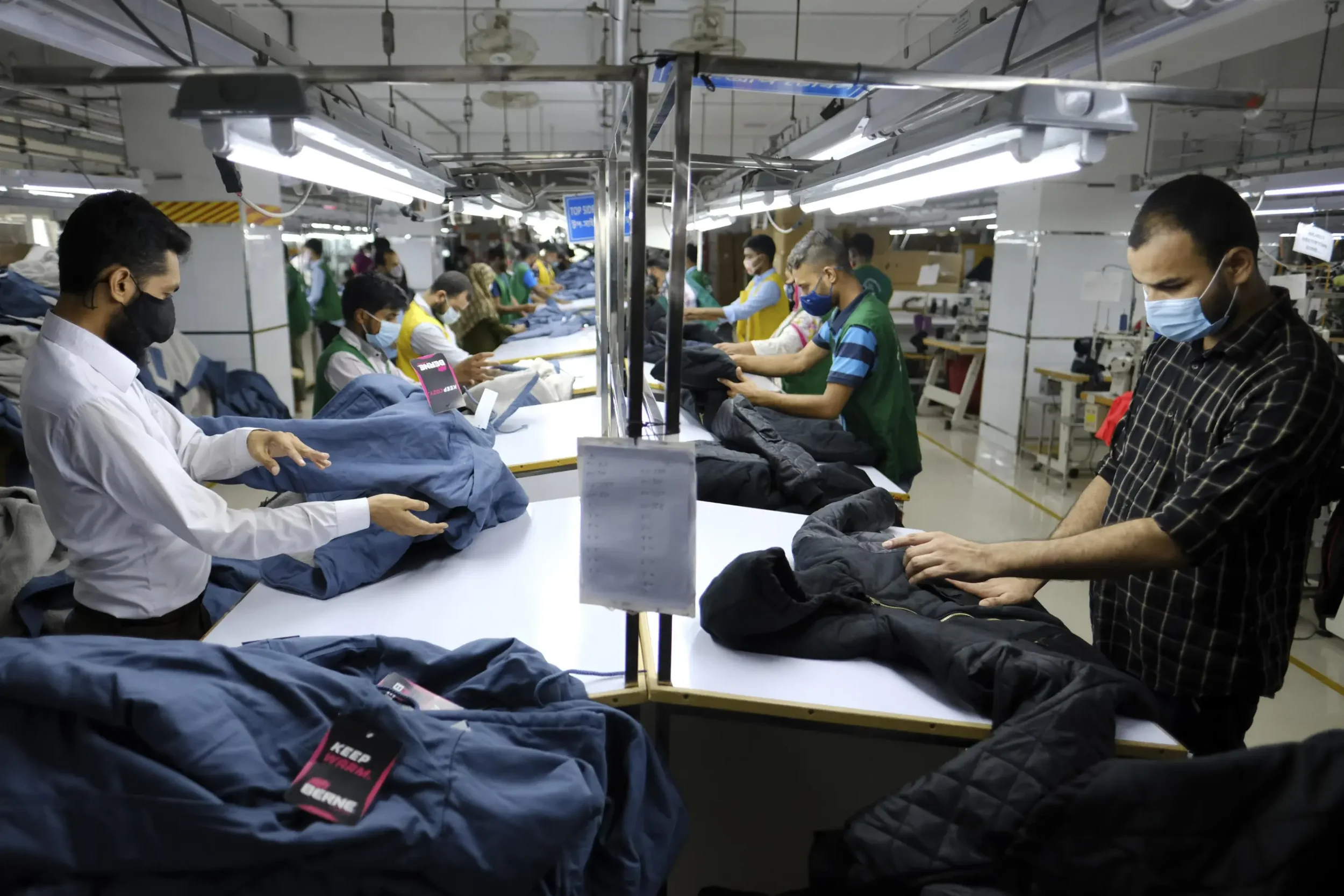
Aug 9, 2021 - Garment employees check final products for shipment at Snowtex Outwear Ltd. factory in Savar Bangladesh. (AP Photo/Mahmud Hossain Opu)
The garment crisis is visible and immediate. The remittance crisis is slower, and in many ways, more dangerous. South Asia’s migrant workers in the Gulf are not just people sending money home. They are, in aggregate, a financial system. India receives $50 billion in remittances from the Gulf alone. Pakistan receives $38.3 billion, Bangladesh $13.5 billion, Sri Lanka $8 billion, and Nepal $5 billion. Together, those five countries collect over $100 billion annually from a region now engulfed in conflict.
Weaker economic activity in Gulf states could reduce labor demands and incomes of migrant workers, leading to lower remittances. A chain reaction would hit household budgets, foreign exchange reserves, and import capacity across the region simultaneously. Experts warn that migration patterns could also be interrupted. Many workers may return home, and those planning to migrate might reconsider, which would further increase unemployment in a region already facing job shortages.
For Nepal, the exposure is existential. Remittances make up more than a quarter of Nepal’s GDP and support nearly six in ten households. Nepal has already temporarily halted labor permits for 12 Middle Eastern nations. Experts estimate that nearly 1,500 people per day who had planned to migrate for work are now stuck at home, specifically those who were heading abroad as a last resort because they lacked employment opportunities in Nepal. For Bangladesh, nearly half of its more than $30 billion in annual remittances comes from the Middle East, with Saudi Arabia, Oman, Qatar, the UAE, and Kuwait together accounting for 86 percent of Bangladeshi migrant workers who secured jobs abroad in fiscal year 2024-25.
For much of the past two years, India has been celebrated as the world’s fastest-growing major economy, a counterweight to slowing growth in China and stagnation in Europe. That story has not disappeared, but it has a bunch of strings attached. India’s private sector expanded at its weakest pace in over three years in March as price shocks from the conflict slowed down domestic demand, even as international orders hit a record high. HSBC’s flash Composite Purchasing Managers’ Index (a monthly survey of “business activity”) fell sharply below the predicted, indicating a significant loss of momentum. Manufacturing took the biggest hit, sliding to a four-and-a-half-year low as the conflict spiked market instability and consumer uncertainty, dragging factory output to its slowest level since August 2021.
The inflationary pressures increased at the same time: input costs including oil, energy, food, and chemicals rose at the fastest pace in nearly four years. As the world’s third-largest oil importer, bringing in 90 percent of its crude and nearly half of its natural gas from abroad, India is directly exposed to oil price shocks. India’s Prime Minister Narendra Modi acknowledged the gravity of the situation in an address to parliament, describing the global conditions created by the conflict as something that will probably continue for a long time. That is a significant concession from a government that has staked considerable political capital on the narrative of India as an unstoppable economic force.
None of this should be read as an argument that South Asia’s growth is fabricated. It is not, but the terms on which that growth has been built leaves the region in a vulnerable position to deal with the kind of sustained global turbulence that is now becoming the norm rather than the exception. Bangladesh’s economy rose on the strength of garments, an industry that, as March demonstrated, depends on airspace it does not control, airlines it does not own, and consumer demand in wealthy countries it cannot influence. India’s services sector, while more sophisticated, is deeply tied to demand from North America and Europe. Nepal’s fiscal stability rests in significant part on remittances from workers who are now trying to stay safe from missile strikes.
The problem is not that South Asia is failing, but that the success has been defined too narrowly, and it is built on a foundation that was always more precarious than the growth numbers showed. Policymakers across the region have had legitimate reasons to display GDP figures with pride, but economic resilience requires more than strong numbers. It requires the kind of structural diversification, domestic demand generation, and institutional capacity that most South Asian economies have not yet developed at scale.
This is revealing in real time where the vulnerabilities lie and how quickly they can translate from abstract risk to concrete harm. The question is whether the region’s governments will treat this moment as a warning. South Asia does not lack growth, but rather the kind of structural depth that would allow that growth to mean something durable when the rest of the world is in trouble.
The best growth in the world is only as good as the global system that enables it. Right now, in South Asia, that system is showing cracks.