
India Expands AI Ambitions at Impact Summit
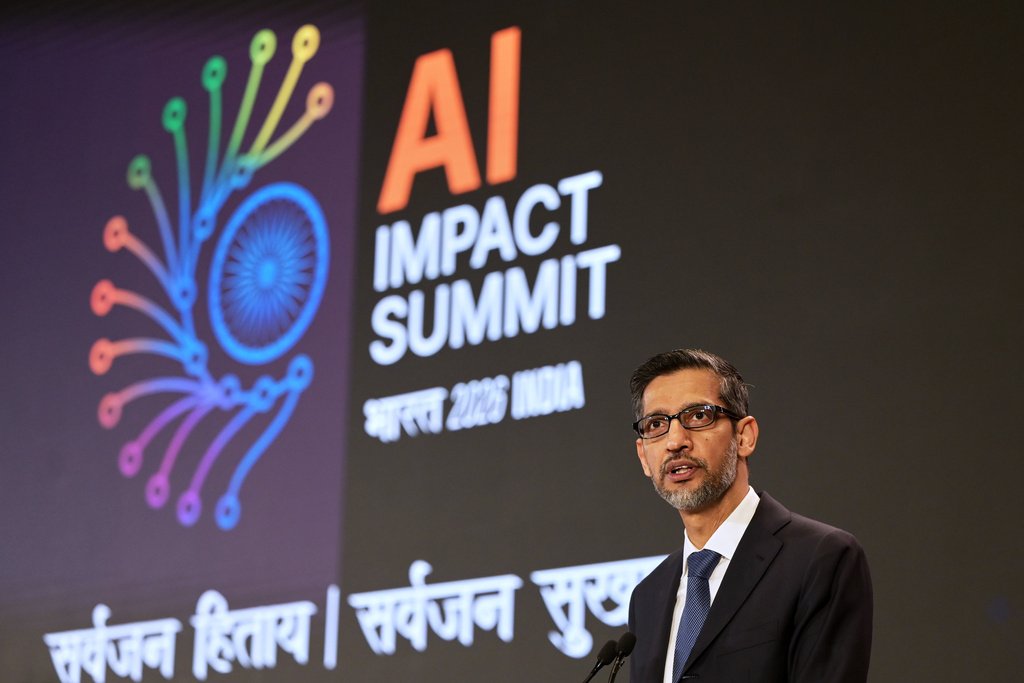
Google CEO Sundar Pichai speaks at the AI Impact Summit in New Delhi, India, Friday, Feb. 20, 2026. (AP Photo)
At India’s AI Impact Summit held in New Delhi from Feb.16-20, Prime Minister Narendra Modi delivered a clear message: India intends to become a major global force in artificial intelligence (AI). Over five highly-publicized days, the summit brought together political leaders, technology executives, and policymakers from around the world, signaling the country’s ambition to compete with established AI powers such as the US and China. Beyond headlines of technological competition, the summit revealed a deeper goal within India’s economic strategy—to use AI as a tool for transforming its labor market, while positioning itself as a leader in technology across the Global South.
Among the summit’s attendees were the most influential figures in the technology industry, including Sundar Pichai, Google’s CEO, and Sam Altman, OpenAI’s CEO. Political figures such as French President Emmanuel Macron and Brazilian President Luiz Inácio Lula da Silva also played a prominent role in the discussions, participating in panels and bilateral meetings. Their presence underscored the growing geopolitical relevance of AI, and the extent to which countries are racing to shape the next generation of digital infrastructure.
The stakes in this emerging industry are particularly high for India. Though it is one of the world’s fastest-growing economies, roughly 88 percent of Indian workers fall into low-skill employment categories, creating a pressing need for economic sectors capable of generating large numbers of higher-productivity jobs. Indian policymakers increasingly view AI as a potential pathway to bridge this gap.
Historically, India has played a major role in the global technology sector as a hub for software services and outsourcing. Several cities became synonymous with IT services that support companies headquartered in wealthier economies. While this model created millions of jobs and smoothed India’s integration into the global digital economy, it also left the country dependent on service-based work.
The government’s AI strategy hopes to move beyond this model. Instead of primarily supplying labor for international firms, India hopes to become a center for cost-effective AI infrastructure and R&D. Officials at the summit emphasized India’s advantages, including a vast engineering talent pool, lower operating costs compared to Western tech hubs, and a massive domestic market capable of generating the data needed to train AI systems.
Major technology companies appear eager to participate in this transformation. Microsoft and other global firms have pledged billions of dollars in investment aimed at expanding cloud infrastructure, data centers, and AI development across India and other emerging economies. These investments are framed not only as commercial opportunities but also as efforts to expand technological access throughout the Global South.
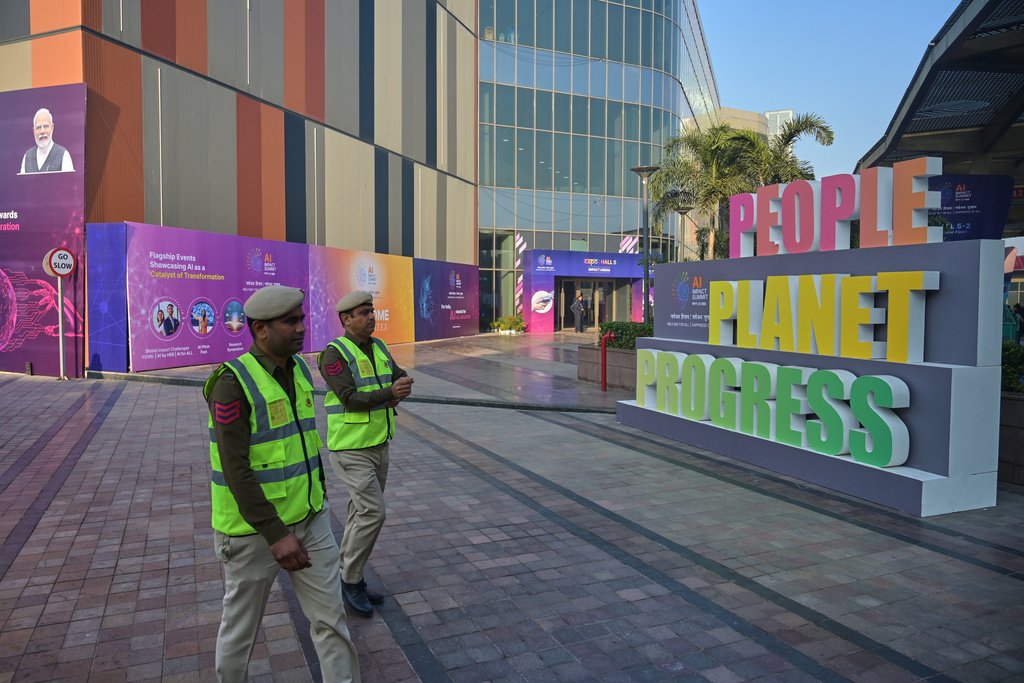
Security people walk at the venue of AI-Summit in New Delhi, India, Monday, Feb. 16, 2026. (AP Photo)
India’s leaders have leaned heavily into this narrative. Rather than positioning the country solely as a competitor to AI giants, such as the US or China, officials increasingly describe India as a potential bridge between advanced technology economies and developing nations seeking affordable digital tools. By offering lower-cost infrastructure and partnerships across Asia, Africa, and Latin America, India hopes to cultivate a new form of technological leadership rooted in accessibility rather than dominance.
Yet the summit also raised questions about the long-term consequences of such rapid technological expansion. AI systems require vast computational power, which in turn depends on energy-intensive data centers and cooling systems. As India scales up its AI ambitions, these infrastructure demands could significantly increase electricity consumption and strain vulnerable environmental systems.
This challenge is especially significant because India is widely considered one of the countries most vulnerable to climate change. Large populations living along the country’s coastline face rising sea levels and intensifying storms, while communities across its plains increasingly experience extreme heat waves and shifting monsoon patterns. Climate assessments have repeatedly warned that warming temperatures could place significant stress on agriculture, water systems, and urban infrastructure throughout the country.
Thus, the tension between technological development and environmental sustainability looms over India’s AI ambitions. On one hand, expanding AI infrastructure could generate millions of new jobs, boost productivity, and strengthen India’s geopolitical influence in a rapidly evolving digital economy. On the other hand, the energy demands associated with large-scale AI deployment may worsen the very climate risks that already threaten the country’s long-term stability.
For policymakers, the challenge moving forward will be finding ways to balance technological advancement and environmental responsibility. Some analysts suggest that India could position itself as a leader in “green AI,” emphasizing renewable-powered data centers and energy-efficient computing architectures. Others argue that India’s experience managing large-scale digital public infrastructure- such as its national digital identity systems- could allow it to develop more resource-efficient models of AI deployment.
India’s summit ultimately demonstrated that the global race for AI leadership goes beyond algorithms or computing power. It illustrated how emerging economies envision their place in the future technological order. For India, AI represents more than just a developing industry; it offers a potential pathway toward economic transformation, global influence, and expanded opportunity for millions of workers.
Yet this strategy’s success will depend on more than rapid technological investment. India’s potential as a global AI powerhouse may hinge on its ability to balance its ambitions for innovation and employment expansion, with caution based on climate sustainability- ensuring the infrastructure powering the digital future does not deepen the environmental challenges already shaping the nation’s present.