
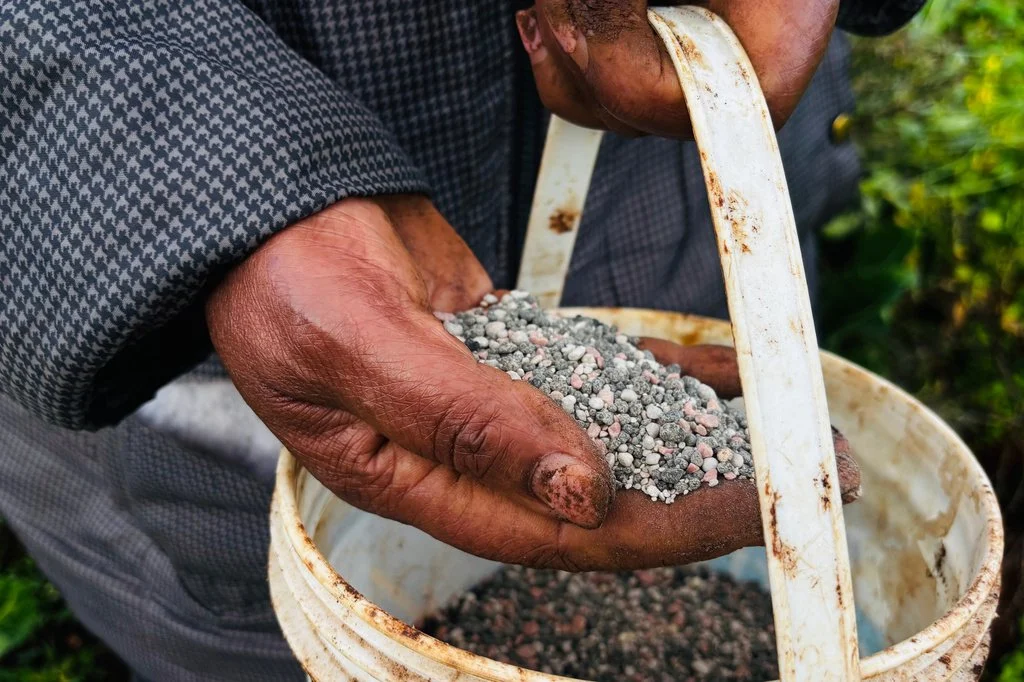
A farmer applies fertilizer to her land in Limuru, Kenya, March 25, 2026. (AP Photo/Jackson Njehia, File)
As tensions have escalated in the Middle East, with the start of back and forth strikes with Iran in late February, global attention has largely focused on energy markets and the vulnerability of oil shipments through the Strait of Hormuz. Yet for India, a quieter but perhaps more immediate crisis is unfolding- one rooted not in fuel, but fertilizer.
Although the use of the Strait is legally governed by international law (UNCLOS), Iran dominates its Northern shoreline, and also maintains control of several key islands within the waterway, its geographical advantage easily leveraged to block the maritime chokepoint off to most foreign vessels.
Since the conflict began, the 20% of the world’s oil supply that typically is shipped through the Strait for energy use, has had to be rerouted to pipelines- which can only carry so much, and nations have thus had to release the biggest strategic oil reserve release on record, to ease the strain of a shrinking market supply. The one-third of seaborne fertilizer that normally passes through the Strait for use in agricultural outcomes has no such reserve to fall back on, driving supply down, and prices of some inputs already up by 50%, according to experts.
Fertilizer production is geographically concentrated where there is an abundance of cheap, abundant natural gas, and accordingly, a significant portion of it is clustered in the Gulf region- as of 2022, exports from Qatar alone were estimated to be keeping 43 million people fed in the US, Brazil, and India. Complex storage and inflexible supply chains mean that sudden disruptions become dangerous when they coincide with key agricultural cycles, where the need for fertilizer is urgent for food production.
In India’s case, the timing of this particular shortage is critical. The Kharif planting season, which begins with the onset of monsoon rains in June, accounts for a substantial share of annual crop output- approximately 2.77 million acres. Rice, one of the primary crops grown during this season, is not only a staple for hundreds of millions within India, but also a component of food security across South Asia. India happens to be especially dependent on fertilizer imports to maintain optimal crop yields, sourcing about 40% of its urea and phosphate specifically from the Gulf region.
Fertilizer shortages, or even the anticipation of them, can significantly affect market behavior, spiking prices, which naturally influences the behavior of those who face higher input costs to create a final agricultural product for consumers- farmers. A jump in the cost of production, due to inflated input prices, may lead farmers to reduce fertilizer usage, switch to less input-intensive crops, or scale back cultivation altogether. Each of these responses carries consequences for overall agricultural output. Lower yields, particularly in staple crops like rice, can tighten domestic supply and place upward pressure on food prices. For low-income households, which spend a larger share of their income on food, even modest price increases can have outsized effects on consumption and nutrition.

A cargo ship sails in the Persian Gulf toward the Strait of Hormuz, Wednesday, April 22, 2026. (AP Photo)
Beyond food security, the fertilizer supply disruption also carries broader economic implications, though these are best understood as secondary effects. Agriculture contributes a significant share to India’s GDP and remains the primary source of livelihood for about 58% of the population. When agricultural output is threatened by input scarcity, the consequences extend to incomes, consumption patterns, and employment stability. Export-oriented segments of crops grown during the Kharif season, like rice, cotton, and soybeans, may be particularly vulnerable. If farmers are unable to produce at expected levels, or if logistical challenges persist in shipping goods abroad, earnings from agricultural exports could decline.
However, these downstream effects ultimately trace back to the same core issue: the fragility of fertilizer supply. By centering the analysis on this bottleneck, the broader economic picture becomes clearer. Reduced access to fertilizer constrains production; constrained production affects prices and incomes; and these shifts ripple outward through the economy.
India has not been passive in the face of these challenges. Policymakers have long recognized the strategic importance of fertilizers and have implemented a range of measures to manage supply risks. The country maintains a substantial subsidy system designed to shield farmers from global price volatility. By absorbing a portion of the cost increases, the government aims to ensure that farmers can continue purchasing necessary inputs even when international prices rise.
In addition, India has sought to diversify its sources of fertilizer imports, reducing reliance on any single region. This includes strengthening trade relationships with countries outside the Gulf and investing in long-term supply agreements. There have also been efforts to boost domestic production capacity, though these initiatives face constraints related to feedstock availability, infrastructure, and environmental considerations.
Yet these measures do not fully resolve the underlying vulnerability. As long as India remains significantly dependent on imported fertilizers, it will remain exposed to geopolitical disruptions in key transit corridors like the Strait of Hormuz. The current crisis underscores the need for a broader structural approach- one that could include greater investment in alternative fertilizer sources, improved efficiency in fertilizer use, and expanded domestic production where feasible.
The early months of the Russia-Ukraine war offer a useful precedent for this current crisis. When global fertilizer markets were disrupted in 2022, due in part to reduced exports from Russia and Belarus, both major suppliers of potash, nitrogen products, and other factors, India felt shocks and the anticipation of shocks shook up its agricultural sector. In the wake of sharp spikes in input costs and localized shortages, farmers faced uncertainty around sowing decisions, with some choosing to delay purchases of planting resources, reduce fertilizer application, or switch to less costly crops. Though crop outputs ultimately weathered the shock, the disruption highlighted the inherent vulnerabilities that arise across the agricultural sector from a dependency on concentrated import sources.
Ultimately, the unfolding situation highlights a broader lesson about global interdependence. Supply chains that appear stable under normal conditions can quickly become pressure points when geopolitical tensions rise. In India’s case, the link between foreign conflict and local food prices runs through a single, easily overlooked input. Fertilizer may not command the same attention as oil, but its role in sustaining agricultural production, and by extension, food security and economic stability, is no less critical.
As the Kharif season approaches, the stakes of this more ‘hidden’ crisis are becoming increasingly visible. Whether India can navigate the coming months without significant disruption will depend not only on the evolution of events in the Strait of Hormuz, but also on the resilience of its agricultural policies and supply networks.