
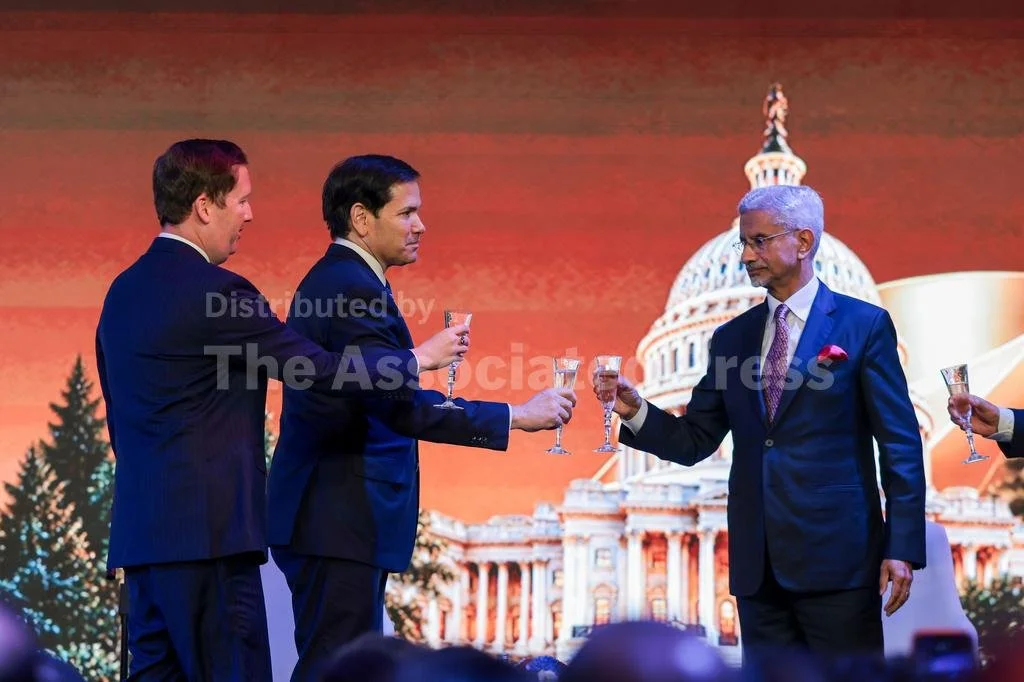
U.S. Secretary of State Marco Rubio, India's Foreign Minister Subrahmanyam Jaishankar, and U.S. ambassador to India Sergio Gor raise a toast during a Freedom 250 reception at the Jio World Convention Centre in Mumbai, India, Tuesday, Oct. 20, 2026. (Kylie Cooper/Pool Photo via AP).
U.S Secretary of State Marco Rubio described Washington and New Delhi as “very, very close” to reaching a trade agreement after meeting Indian Foreign Minister Subrahmanyam Jaishankar in Mumbai on October 20, 2026, adding that only a few issues remained before the agreement could be completed. Although Rubio expressed confidence that the deal was close, the agreement had not yet been signed at the time of the meeting. The talks came amid months of stalled negotiations over American tariffs and India’s purchases of Russian oil.
The meeting covered a range of bilateral priorities, including trade, energy, technology, defense and regional security. Jaishankar and Rubio also held a trilateral meeting with United Arab Emirates Foreign Minister Sheikh Abdullah bin Zayed Al Nahyan. Rubio said the three officials met to discuss “regional energy security and advance our shared economic priorities.” According to Reliance Industries, the discussion covered the global energy landscape and opportunities for commercial partnerships in conventional and renewable energy, including reliable energy supplies, resilient supply chains and investment,
The negotiations have been shaped by disagreements over tariffs imposed by the United States in 2025. The United States raised tariffs on most Indian goods to as much as 50 percent in August 2025 after trade talks broke down. Under the U.S - India Interim Trade Agreement Framework agreed upon in February 2026, the rate was reduced to 18%, while negotiations toward a broader bilateral trade agreement continued. Indian Finance Minister Nirmala Sitharaman said earlier in October that the talks had "plateaued."
The tariff dispute has created uncertainty for both American and Indian businesses seeking access to each other’s markets. India has sought terms that would allow its exporters to remain competitive with manufacturing economies such as Vietnam. For the United States, negotiations also involve broader economic and strategic interests, including expanding American exports and strengthening commercial ties with India.
Energy has been another source of disagreement between the two countries. India has continued purchasing Russian crude oil since Russia launched its full-scale invasion of Ukraine in February 2022. Washington has sought to reduce Russia’s energy revenues, while India has emphasized the importance of maintaining affordable and reliable supplies for its economy.
Before arriving in India, Rubio acknowledged the difficulty of shifting India’s energy suppliers, saying countries like India “are still getting a substantial amount of energy from Russia,” he said, and further noted the time required to shift suppliers. He also described India as an important American partner. His remarks addressed both India’s continued pủchases of Russian and its broader partnership with the United States.
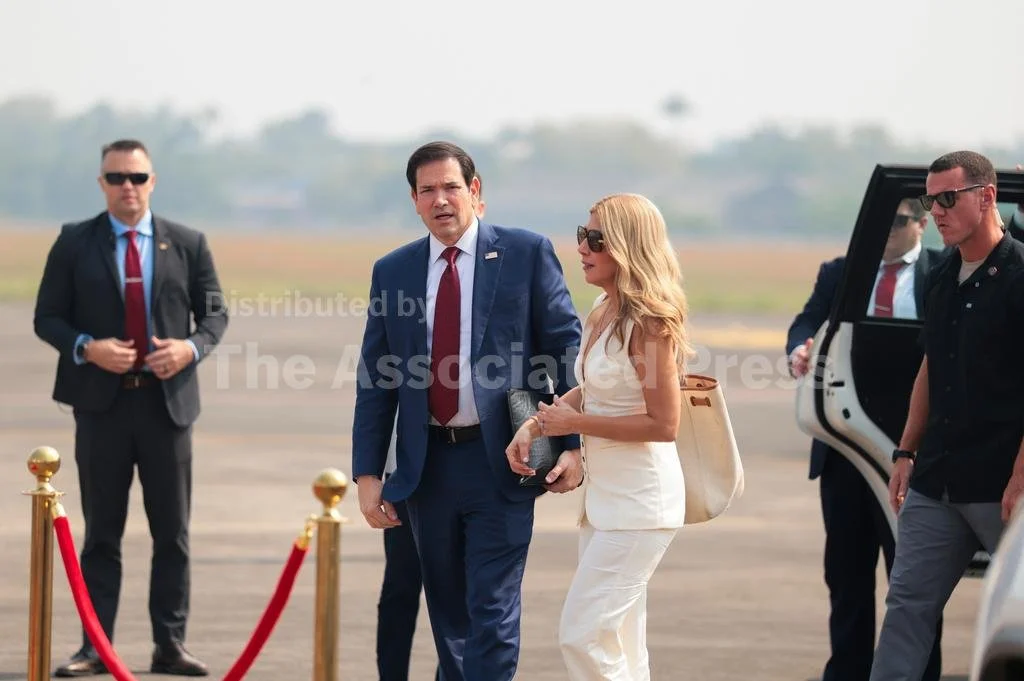
U.S. Secretary of State Marco Rubio and his wife Jeanette Dousdebes Rubio walk ahead of boarding a plane en route to Jamnagar, India, at Chhatrapati Shivaji Maharaj International Airport Mumbai in Mumbai, India, Wednesday, Oct. 21, 2026. (Kylie Cooper/Pool Photo via AP).
On October 21, Rubio visited Jamnagar in the western Indian state of Gujarat, where Reliance Industries operates the world’s largest oil-refining complex. The visit focused on opportunities for India to process more Venezuelan crude as the United States seeks markets for increased Venezuelan oil production.
“They have the capability to refine heavy crude,” Rubio told reporters, referring to Reliance’s facilities. He said the company had processed such oil before and could do so again as Venezuelan production increased. The refinery has a crude-processing capacity of approximately 1.4 million barrels per day. The refinery’s câpcity and ability to process heavy crude ưere relevant to dícussions of potential Venezuelan oil imports.
Rubio also connected energy production to national security, stating that “Energy is related to national security.” His visit came amid concerns about conflict-related disruptions to international shipping routes, including the Strait of Hormuz and the Red Sea. In March 2026, President Donald Trump announced a proposed $300 billion refinery project in Brownsville, Texas, backed by Reliance, highlighting the potential for expanded U.S - India energy investment, although the project had not yet become operational.
Rubio’s visit highlighted efforts to strengthen U.S - India ties through trade and energy cooperation. However, disagreements over tariffs and Russian oil persisted. Despite ongoing disagreements over trade and Russian oil, analysts such as C. Raja Mohan has noted that the foundations of the U.S - India strategic partnership remain strong, particularly in defense, technology and regional security. These differences continue to shape negotiations over trade and energy cooperation between the two countries.