
Stranded at Zero Line: West Bengal's Deportations Spark Citizenship Disputes
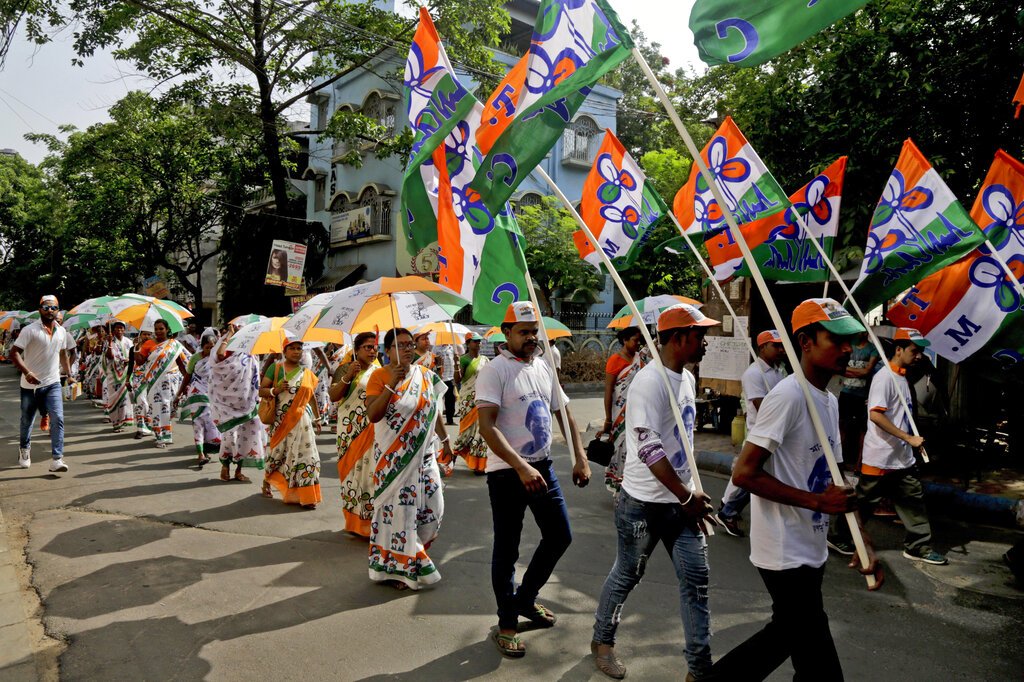
In this Sunday, April 28, 2019 file photo, supporters of Trinamool Congress party hold party flags and walk in an election campaign rally in Kolkata, India. The battle pitting the BJP’s divisive Hindu nationalism against Chief Minister Mamata Banerjee’s Trinamool Congress Party big-tent politics has come to a head on India’s eastern bottleneck of West Bengal, which stretches from the Himalayas in the north to the Bay of Bengal in the south and shares a language and border with Muslim-majority Bangladesh. (Source: AP Photo/Bikas Das)
Across the 2,500-mile border separating India and Bangladesh, hundreds of migrants have found themselves at a zero line border as the two states debate their nationalities. After his election in May 2026, Chief Minister Suvendu Adhikari launched a "detect, delete and deport" campaign to deport illegal Bangladeshi immigrants in the West Bengal region. Adhikari said his government had deported nearly 5,000 Bangladeshi citizens by June and has "established holding (detention) centers in all districts of the state."
Bangladesh resisted these efforts, alleging that around 850 migrants delivered to the border in two months lacked the proper repatriation channels to be deported as citizens of Bangladesh. Officials claim that Bangladesh has taken in around 300 deportees since January, but the Border Guard has refused to take in the substantial escalation of deportations under Adhikari's rule.
Human Rights Watch echoed Bangladesh’s call for proper repatriation channels. Elaine Pearson, Asia Director of the Organization, accused BJP of “fueling discrimination” by “arbitrarily expelling Bengali Muslims from the country, including Indian citizens”. Specifically, officials raised concerns that Indian authorities denied individuals due process and proper verification to confirm Bangladeshi citizenship before deporting them.
Migration between Bangladesh and India dates back to British colonial rule and intensified India’s partition in 1947 and Bangladesh’s Independence in 1971. In recent years, impoverished Bangladeshis cross the border in search of jobs and ferrying goods such as cattle, gold, and raising.
Border tensions often left numerous migrants stranded in between, raising concerns over shelter and safety. Milton Patwary, a local journalist who witnessed events and shared videos to the New York Times, explained the proliferation of fear in the region, saying, "If they went in either direction [of the borders] they could get shot." On another occasion, a group of 10 people, including three children, were stranded in between the two states for three days following refusal by both countries to take them in. According to Bangladesh Ansar member Belal Hossain, these migrants lacked sufficient paperwork to prove either Indian or Bangladeshi citizenship.
These deportation efforts are notorious for targeting Muslims. This is largely due to the citizenship law amendments passed in 2019, which provide Indian citizenship to Hindus and other religious minorities, but not Muslims. Home Minister Amit Shah reaffirmed the amendments that year, announcing, "I want to assure all Hindu, Sikh, Jain, Buddhist, and Christian refugees, that you will not be forced to leave India."
During the 2025 summer months, Indian security agencies in the neighboring state of Assam deported dozens of Indian Muslims across the border into Bangladesh, claiming they were undocumented Bangladeshi citizens. With Bangladesh refusing to take these individuals in, they were stranded in between the borders until India eventually took them back.
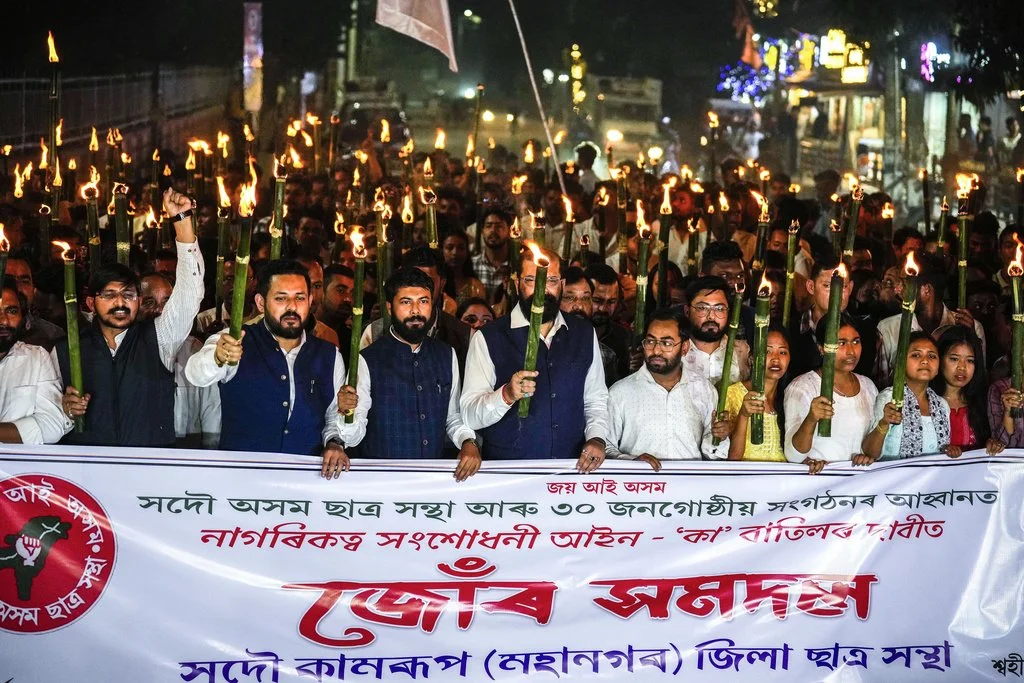
All Assam Students Union (AASU) members take out a torch procession to protest against the Citizenship Amendment Act (CAA) in Guwahati, India, Tuesday, March 12, 2024. India has implemented a controversial citizenship law that has been widely criticized for excluding Muslims, a minority community whose concerns have heightened under Prime Minister Narendra Modi's Hindu nationalist government. The act provides a fast track to naturalization for Hindus, Parsis, Sikhs, Buddhists, Jains and Christians who fled to Hindu-majority India from Afghanistan, Bangladesh and Pakistan before Dec. 31, 2014. (AP Photo/Anupam Nath)
The government faced further backlash in 2026 when Bengali-speaking Muslims reported that despite having all the necessary documents, their names were deleted from electoral rolls. Others explained that their citizenship requests were still pending when they were expelled across the border. In an interview with Al Jazeera, three Muslims in Maharashtra Police custody said their families submitted documents proving Indian citizenship. West Bengal Chief Minister Mamata Banerjee claimed, "Just because they speak Bengali, they were labelled Bangladeshis and sent to Bangladesh," referring to the Maharashtra Police's conduct. According to Human Rights Watch, a family in West Bengal was detained and transferred to the border despite having Aadhaar cards, India's biometric identity document, because they were deleted from the voter lists.
Indian authorities maintain the narrative that these efforts target the numerous illegal Bangladeshi immigrants and that they have offered to help them voluntarily return to Bangladesh. Reporter Sujoy Dhar contended that some illegal Bangladeshis lived in India for over a decade, "participated in the voting process, and enlisted their names in multiple government welfare schemes." Expressing the complicated nature of cross-border migration, he states, "The question of who is a genuine Indian Muslim Bengali and who is an undocumented illegal Bangladeshi remains the most fraught distinction in Indian politics."
Meanwhile, Human Rights Watch has expressed concern that Indian authorities were not adhering to legal means with the deportation campaigns, including the right to due process. Meenakshi Ganguly, deputy Asia director at Human Rights Watch, commented, "The government should stop unlawfully expelling people, ensure procedural safeguards, engage with Bangladeshi authorities to verify citizenship, and end this dismaying animosity toward Muslims." Specific recommendations entitled the migrants to full information about the basis for deportation, the right to legal representation, and a right to appeal a deportation decision.
"The question is not whether a country has the right to deport undocumented migrants," human rights activist Harsh Mander affirmed. "The question is whether those being deported have been identified fairly, given due process, and protected from wrongful expulsion." Essentially, human rights groups urge BJP authorities to take careful measures in preventing arbitrary deportations. By international standards, this includes taking steps to ensure that each individual is given due process, including adequate verification of citizenship and procedural resolving of disputes which prevents any alleged form of discrimination. Human Rights Watch suggests bilateral mechanisms between India and Bangladesh that can verify and transfer nationals safely across the border.
While the question of disputed citizenship among West Bengal’s Bengali population remains a driving force in the states’ politics, it is unclear who will take responsibility for ensuring that people’s human rights and basic security are prioritized at the border.